Topics in the
Management of Technology and Innovation:
A Synopsis of Major Findings
Bedrijfseconomische Verhandeling
March 1997
Koenraad Debackere
Department of Applied Economics, K.U.Leuven
Naamsestraat
69
B-3000
Leuven
Topics in the Management of
Technology and Innovation:
A Synopsis of Major Findings
Koenraad Debackere, Department
of Applied Economics, K.U.Leuven
0. Abstract
In this review paper, major findings
on ‘best practices’ in technology and innovation management are summarised and
discussed. These ‘best practices’ are situated at the strategic level as well
as at the operational level in the organisation. They highlight the strategic
(portfolio-level) and operational (project-level) determinants of innovation
performance. The economic origins of innovation management theory are also
briefly introduced and discussed.
1.
Introduction
Technology is a major stimulus for change in society. We have come
to look to technological innovation to rescue us from the consequences of
exhausting natural resources; to abate inflation through productivity
increases; to eliminate famine; to cure cancer; and to maintain the competitive
position of our nations’ industrial bases. Indeed, technological change has
become a major driver of competition: it propels new firms to the forefront of
the competitive arena while it destroys the competitive advantage of even
well-entrenched firms. Achievements such as electronic computers, test tube
babies, supersonic aircraft, and manned space flights have bolstered our faith
in technical advance. We no longer ask if something is possible, but how soon
it can be done and at what price.
There is little doubt that the rapid
technological progress we have witnessed during the last decades will come to
an end soon. Today, researchers around the globe are working intently on
developing ideas that may create new branches of technological practice and
could ultimately transform industry in ways which are hard for most of us to
imagine. As a consequence, the ability of managers and policy makers to
comprehend the pace and the direction of technological advancement will largely
determine a firm’s or nation’s competitive performance in world markets into
the next century. This is no small task, however. Historical accounts of industrial
evolution and innovation, such as with the development of semiconductors (Braun
and Macdonald, 1978), videocassette recorders (Rosenbloom and Cusumano, 1987),
and personal computers (Smith and Alexander, 1988), show the immense
difficulties some firms encounter when confronted by new technologies. The
inertia, introduced by a firm’s existing technological base, often is a
powerful barrier to internalise new technological trajectories (Utterback,
1994). Hence, there is an obvious need to harness the process of technological
innovation effectively. To do this, technological innovations cannot be
isolated from the complex economic, social and political systems within which
they operate.
As a consequence, an extensive research agenda
into the nature of the technological innovation process started in the 1950s.
This brought a recognition that innovation is an activity which needs careful
‘managerial’ attention and actions. But, before there can be effective
management, there must be a detailed understanding of the process of
innovation, its characteristics and its specific problems.
Therefore, the first part of this paper
will focus on the major characteristics of the innovation process as they have
emerged over the last three decades. The models to be discussed are chosen for
the complementary insights they offer into the complex nature of the innovation
process. We start with the theories on technical change developed by
Schumpeter. Although the study of technical advance as an economic phenomenon
is a relatively recent event, it was Schumpeter who in three books, The Theory of Economic Development (1934),
Business Cycles (1939), and Capitalism, Socialism and Democracy
(1942), portrayed most fully the active role played by economic agents in
technical advance. From these studies, technological innovation emerges as a
non-linear, dynamic, interactive and complex process.
In addition, models of the innovation process
were developed to support managerial actions. Whereas the theories by
Schumpeter attempt to gain a fundamental insight into the nature and the causes
of technological evolution, the three models discussed subsequently focus on
the innovation process within the firm. The first model, by Roberts and Frohman
(1978), depicts technological innovation as a process of uncertainty reduction.
This process necessitates three important activities within the firm. Ideas
have to be generated. Once generated, these ideas have to be turned into good
currency. And, finally, appropriate organisational structures have to be
implemented to manage the transition from what first seems to be an abstract
‘idea’ into a ‘product’ desired by customers. As a consequence, an important
focus of this model is on managing people and their innovative ideas.
The second model explicitly makes the link
between technological innovation on the one hand and organisational strategy
and structure on the other hand. The Abernathy-Utterback model (1975 &
1978) describes how product and process innovations evolve during the
technological life cycle of a ‘productive unit’ or ‘business unit’ and, still
more important, how competitive strategy, production facilities, and
organisation structure ‘co-adapt’ during this evolution.
Finally, the technological S-curve model
(Roussel, 1984; Foster, 1986) enables managers to better estimate the strategic
importance of the different technologies in a firm’s technology portfolio. To
this end, the S-curve model is used to develop a technological typology. A
distinction is made between emerging, pacing, key, and base technologies. The
competitive implications of this typology are highlighted. A link is made with
Wheelwright and Clark’s definitions of breakthrough, platform and derivative
projects (1992).
Once we have obtained a basic understanding on
the nature of the innovation process, we will turn our attention to the
management of technological innovation. This will be the theme of the second
part of this paper. From the previous discussions, we know that ‘managing’
the innovative capabilities of the organisation involves different levels of
attention: (1) attention to the relationship between technology and strategy;
(2) attention to an appropriate organisation structure in which innovative
activity can flourish; and (3) attention to the management of innovative
professionals. It is hence necessary to discuss the management implications
associated with each level of attention. The integration of these three levels
of attention leads to the development of a partnership model on organising
technology and innovation, as discussed by Roussel and his colleagues in their
influential book Third Generation R&D
(1991).
Finally, the third part of the paper
brings together the major issues raised in the previous sections and ends with
a ‘checklist’ of focal activities that are to be considered when managing a
firm’s innovation efforts.
Before embarking upon a detailed discussion of
these topics, though, there is an obvious need to clarify two major concepts
used throughout this paper, i.e. what is meant by ‘technology’ and how do we
define ‘technological innovation’?
1.1.
Technology: what’s in a name?
Throughout the decades of research on the management of technology
and innovation, a host of definitions has surfaced, attempting to describe what
is meant by a ‘technology.’ According to the Oxford Dictionary, technology is “the science of industrial arts.” This
definition, despite its brevity, combines two concepts that are essential to
fully grasp the meaning of ‘technology’: science
and arts. Of course, we do not imply
that technology is the same as
science, not even that it always has to be based on scientific principles or
developments. Indeed, examples exist where the technology was in place before
the underlying scientific principles were known or clarified. One of the most
notable examples undoubtedly is the steam-engine. It was developed before the
science of thermodynamics had originated. However, the Oxford definition does
imply that technology has an important ‘knowledge’ component. Thus, a major
input into technological activities is knowledge about why things work the way
they do. This is the know-how versus
the know-why question. This knowledge
can be derived from scientific developments, but also, from previous
technological experience.
The Oxford definition also points to the fact
that technology has to do with arts.
The products of human art are artefacts.
Artefacts are tangible products and processes created by human skill. Thus,
contrary to scientific activity, the major output of technological activity is
embodied in hardware, i.e. products and processes. Technological output is
tangible. It is not mere knowledge. Figure 1 (adapted from Allen, 1977)
highlights this important contrast between technological activity and
scientific activity. The major inputs into any scientific activity are
information and knowledge. The major outputs of scientific activity are, once
again, information and knowledge. Oversimplified, scientists read papers
(knowledge input), they think and experiment, and they write papers (knowledge
output). The major inputs into technological activity are also information- and
knowledge-related. However, the major outputs of technological activities are
embodied in hardware, i.e. products (which are more and more frequently
integrated with services, or vice versa) and processes.
— Insert Figure 1 about here —
Thus, technological activity can be defined as
the processes by which knowledge
(scientific and experiential) is transformed into artefacts, i.e. products and
processes. As a consequence, technological activity is characterised by
both a less-tangible knowledge component (i.e. the input-side of the equation)
and a tangible product or process component (i.e. the output-side of the
equation). Having defined ‘technology’, we still have to clarify the concept of
‘technological innovation.’
1.2.
Technological innovation
Technological innovation is the successful commercial exploitation
of inventions as they become embodied into new products and processes. The
emphasis thus is on exploiting the
results of technological activity. There are, of course, different opinions of
what constitutes a new product or process. In the most general and pure sense,
the product or process developed is new to the world. This need not be the
case, however. Certain experts go as far as considering any product or process
an ‘innovation’ as long as it is perceived as new to the organisations
involved, even though it may appear to others to be an ‘imitation’ of something
that exists elsewhere (Van de Ven, 1986).
Whereas the invention process may be hard to manage, the
management of the innovation process (as a systematic approach to exploit
inventions and reduce them to practice in a successful manner) has been
well-embedded both in theory and practice over the last decades.
Before turning to these managerial issues,
though, it is necessary to address the following question: What are the
characteristics and the complexities involved along the innovation trajectory?
2. The
process of technological innovation
In this section three different approaches to unravel the
characteristics of the innovation process are discussed (the models by Roberts
(1978)and by Abernathy & Utterback (1975), and the S-curve by Roussel and
Foster (1984 & 1986)). The ‘economic’ origins of innovation theory are
highlighted first. This economic debate has focused on the relationship between
market structure and innovative activity.
2.1. The
economic debate: market structure, technology-push and market-pull
Schumpeter was the first to fully portray the active role played
by economic agents in technical advance. Schumpeter’s different books, though,
reveal the many subtleties involved in explaining the origins of technological
innovations. It is important to grasp those subtleties since they are essential
to understand the more managerial oriented models of the innovation process to
be discussed in the next sections. In his first two books (The Theory of Economic Development, 1934 & Business Cycles, 1939), the entrepreneur plays a central role. The
entrepreneur is defined as the person who creates new combinations. He sees how
to fulfil currently unsatisfied needs or he perceives more efficient ways of
doing what is already done. These acts may, though need not, involve the
presence of inventions. In some cases, it may only involve a new application of
an existing technology. As a consequence, the act of invention and the act of
entrepreneurship are separate: the inventor need not necessarily be the
entrepreneur and vice versa. However, the entrepreneur plays a central role
since he is the one who turns the invention into exploitation.
Given the importance attributed to the
‘entrepreneur,’ this theory has often been called Schumpeter’s theory of
‘heroic entrepreneurship’ or ‘creative destruction.’ Indeed, the logic of the
theory is as follows (see Figure 2). There exists a pool of inventions related
in an unspecified way to the state-of-the-art developments in scientific and
technological knowledge. The important observation now is that this pool of
inventions is largely exogenous to existing firms and market structures. Thus,
they are unrelated to any specific and quantifiable type of market demand. Of
course, this does not mean that they may not be influenced by an anticipated
demand or shortage. We all know that, in an abstract manner, human needs are
infinite. However, in the realm of Schumpeter’s theory of heroic
entrepreneurship, there is no direct coupling between a measured market need
(as we would detect from extensive market research, for example) on the one
hand, and the efforts invested and the directions chosen in the pool of
inventions, on the other hand.
The essential link between the ‘pool’ of
inventions and the ‘market’ is made through the person of the entrepreneur. He
is aware of the potential of certain inventions, and as a consequence, becomes
prepared to take the risk and the commitment necessary to turn these inventions
into innovations. Thus, innovating is
more than inventing. As defined previously, it is the (successful) commercial exploitation of inventions. Schumpeter
then remarks that such a hazardous activity would not be undertaken by an
ordinary capitalist economic agent (such as an existing firm). Only the
entrepreneur has the vision, the drive and the commitment to survive the turbulence
and the uncertainty involved. If he succeeds, though, the rewards are enormous.
The entrepreneur will realise exceptional (be it temporary) monopoly profits
and he may be able to fundamentally alter existing market structures.
— Insert Figure 2 about here —
Examples of the successes of ‘heroic
entrepreneurs’ abound. For instance, the advent of Texas Instruments as a major
electronics firm can be seen as the result of heroic acts of technological
entrepreneurship. The company did not actually invent the transistor, though it
made judicious use of the new technology to create products that would meet
hitherto unfulfilled customer needs. Other examples of heroic technical
entrepreneurship are Edwin Land and the development of the Polaroid camera and Joe
Wilson who turned the Haloid Company, a small photographic paper and supply
firm, into today’s giant Rank Xerox through his vision and ideas about a
revolutionary copying process. More recent examples of ‘heroic
entrepreneurship’ can be found in the formation of new biotechnology firms such
as Plant Genetic Systems, Genentech, Amgen, etc. They all symbolise the
entrepreneurial vision that attempts to turn ‘knowledge’ into ‘commercial
exploitation.’ In doing so, those firms are at the origin of what Schumpeter
called “the eternal gale of creative
destruction.”
In his third book, Capitalism, Socialism and Democracy (1942), Schumpeter’s focus on
technical progress took on new directions (see Figure 3). Instead of focusing
solely on the ‘heroic entrepreneur,’ Schumpeter now incorporates the importance
of scientific and technological activities conducted by (mostly large) firms.
In this additional model of the innovation process, the coupling between
science, technology, innovative investment and the market, which was tenuous at
best in the first model (see Figure 2), is much more intimate and continuous.
Successful innovations generate profits leading to increased in-house
innovative activity and R&D investments.
— Insert Figure 3 about here —
As a consequence, the heroic entrepreneur is not
the only central agent linking invention to its subsequent exploitation.
Whereas science and technology are largely exogenous in the first model
depicted in Figure 2, they are at least partly endogenised in the model described
in Figure 3. Thus, the link between invention and exploitation is internalised
within existing economic agents, i.e. the firm (and preferably the large firm,
as Schumpeter hypothesised). As a consequence, the role of the heroic
entrepreneur who couples invention and exploitation, is complemented by
intrapreneurial modes of invention exploitation. Still more important,
Schumpeter’s paradigm on the economics of technical advance inspired the
hypotheses that innovative activity would be proficient in (1) large firms and
(2) in monopolistic industries.
Large firms were deemed more innovative than
small firms because they can finance a larger research and development staff,
leading to economies of scale in R&D; because large firms are better able
to exploit unforeseen innovations given their more diversified product lines;
and, because indivisibility in cost-reducing innovations makes them more
profitable for large firms.
In the same vein, it was hypothesised that
innovation would be greater in monopolistic industries than in competitive ones
because a firm with monopoly power can prevent imitation and thereby can
capture more profit from an innovation; and, because a firm with monopoly
profits is better able to finance research and development (Kamien and Schwartz,
1982).
Although the hypotheses on the relationship (1)
between firm size and innovative activity as well as (2) between monopoly power
and innovative activity have only received limited support, the models
described in Figures 2 and 3 further lead to the origins of a debate that has
engaged students of the innovation process for quite some time, namely: what is
the causal direction of the relationship between technological research and the
market? In other words, is technological research the initiator of innovations
that lead to the creation of new markets (i.e. the ‘technology-push’
hypothesis)? Or, on the contrary, is it the market that initiates innovations
(i.e. the ‘market-pull’ hypothesis)?
Although the question on causality may seem
superfluous, it has nevertheless important consequences, not in the least at
the macro-level of economic policy-making. Indeed, if one adheres to the
technology-push hypothesis, then one will recur to a supply-side oriented
(neo-classic) macro-economic policy with respect to technological innovation.
Enough money has to be invested in research facilities and R&D programs,
and markets will ultimately follow suit. Oversimplified, a technology-push
oriented policy will allocate considerable sums of money to R&D, hoping that
heroic entrepreneurs will tap the pool of knowledge thus generated and create
new products and processes that ultimately serve markets.
On the other hand, a market-pull policy will
stimulate innovation through creating a demand for new products or processes.
This demand will trigger innovative behaviour. For instance, in order to
stimulate innovations in telecommunication technology, a market-pull oriented
policy might operate through the creation of a national demand for a new
telecommunication network. This demand would then spur the innovative behaviour
of the organisations participating in the national program. A technology-push
oriented policy, on the other hand, might operate through formulating R&D
programs in telecommunications technology.
A scrutiny of government policy frameworks aimed
at stimulating technical innovation shows that, in fact, both technology-push
and market-pull orientations are relevant. Innovations have their origins both
in the market and in the creation of new technological capabilities. For sure,
research has shown that market-induced innovations tend to have a higher
probability of commercial success than innovations that originate from a
technological capability and that are isolated from a market-selection
environment. However, this relationship between market-relatedness and
commercial success is moderated by the fact that market-induced innovations
tend to be more incremental and thus less radical than innovations having their
origins in the research laboratory (Rothwell et al., 1977).
Moreover, it appears that technological
innovation certainly is not a linear, sequential process as might be
(incorrectly) deduced from Figures 2 and 3. Instead, it is a complex,
multi-stage, cross-functional, and multi-disciplinary process in which both
supply-side and demand-side arguments are relevant and should be carefully
considered. This is all the more true when studying technological innovation at
the firm-level. Here the managerial models of technological innovation become
relevant.
2.2.
Managerial models of technological innovation
2.2.1. The process of technological
innovation: a general model
The first managerially relevant model to be discussed is the one
proposed by Roberts and Frohman (1978). This model (see Figure 4) emphasises
three key generalisations. First of all, ideas and opportunities for innovation
originate both from the supply-side (‘technology’) and the market-side
(‘market’). Thus, both the ‘technology-push’ and the ‘market-pull’ dimensions
are highly relevant. Second, the process of technological innovation is a
multi-stage or -phase process. Significant variations in the primary task as
well as in the managerial issues and effective management practices occur
across these different stages. Third, in the model, six stages are presented.
The exact number of stages or phases is, of course, somewhat arbitrary. What is
key, though, is that each phase of activity is dominated by the search for
answers to different managerial imperatives. Finally, each phase requires clear
go/no go decision points and phase-reviews.
— Insert Figure 4 about here —
At the outset (stages 1 and 2), emphasis is on
finding a motivating idea, a notion of possible direction for technical
endeavour. Thus, ideas have to be generated and, still more important, once
generated, attention has to be paid to those same ideas. Good managerial
practice at these early stages frequently involves loose control, the pursuit
of parallel and diverse approaches, fostering conflict or at least
contentiousness, and stimulating a variety of inputs. Small amounts of money
should be rather freely available to enable the assessment and evaluation of
the ideas generated. A major mistake is to set up rigid formal processes for
approval of the small sums needed to try out an idea. But, most of all, an
organisational environment and culture has to be developed that tolerates new
ideas and allows proper attention to be paid to them. 3M’s statement “Thou shall not kill an idea” clearly
reflects what is meant by this attitude. In addition, a tolerance for new ideas
also implies a tolerance for failure. As has been often documented in the
innovation management literature, false
foundations can prove to be challenging new starts. This, though, is only
possible when ‘failures’ are tolerated.
As we move further along the different stages,
the managerial issues and the actions required change dramatically. During
stages 4 and 5, for example, the task involves in-depth specification and
manufacturing engineering of ideas that are being reduced to an acceptable
working prototype. The managerial issues evolve towards co-ordinating a number
of scientists and engineers of different disciplinary backgrounds to achieve,
within previously estimated development budgets and schedules, a predefined
technical output ready for manufacture in large volumes; reliable and at
competitive production costs. Effective managerial practice will thus involve
tight control, elimination of duplication, strong financial criteria and formal
evaluations of resource use, even somewhat rigid adherence to planning. Thus,
during the later stages of the innovation process, the managerial actions
required are rather opposite to the ones advocated during the first stages of
the process. Whereas the first stages focus on ‘managing ideas,’ the later
stages focus on the management of the ‘part-whole relationships’ required to
turn these ideas into a tangible product or process. Part-whole management
indeed requires the co-ordination of the efforts of people with different disciplinary
backgrounds, working together toward achieving the new product or process
goals.
As is obvious from Figure 4, innovation occurs
through efforts carried out primarily within an organisational context, but
involving heavy interaction with the external technological as well as market
environments. Proactive search for technical and market inputs, as well as
receptivity to information sensed from external sources, are critical aspects
of technology-based innovation. Many studies of effective innovations have
indeed shown the presence of significant contributions of external technology
(e.g. via contacts with universities) and have found success heavily dependent
upon awareness of customer needs and competitor activity.
Another remark is warranted with respect to the
model in Figure 4. For ease of presentation, all stages are shown at
equidistant intervals inappropriately suggesting perhaps the similarity of
these phases from a time duration and/or resource consumption perspective.
Stage 5, commercial development, for instance, usually takes as long as the
several earlier stages combined and requires more resources than most of the
other stages together. This is why tight financial control becomes necessary at
this stage. A typical cash flow diagram for new product or process development
is shown in Figure 5 (source: Twiss, 1992). In addition, current practices in
the area of concurrent engineering have emphasised the possibility to engage in
overlapping problem-solving activities, pointing to the different phases just
discussed running (partly) in parallel and simultaneous.
— Insert Figure 5 about here —
From Figure 5 it is obvious that the upstream
‘research-oriented’ activities (idea formulation and problem solving) only
consume minor expenditures compared to prototyping, manufacturing start-up, and
market launch. Of course, the relative importance of these items further
depends upon the nature of the industry. In aerospace, for example, the
construction and testing of prototypes usually requires major expenditures,
while investments in manufacturing or marketing are small or non-existent. In
chemical industries, on the contrary, investments in efficient production
facilities may be the major item. Consumer industries, on the other hand, may
incur extremely important marketing costs in launching the new product.
Finally, although only a limited amount of
feedback loops is shown in Figure 4, they inevitably exist causing reiteration
among the different stages in the model. For example, the problem-solving processes
in stage 3 often generate useful insights for alternative idea formulations
(stage 2). Also, during stage 6 (transfer to manufacturing) new problems may
surface requiring a reiteration to the problem-solving stage (stage 3). Thus,
the real process of technical innovation involves flows back and forth over
time among differing primary activities, internal and external to the
innovating organisation, with major variations arising throughout the process
with regard to specific tasks, managerial issues and managerial answers. Still
more important, as mentioned above, the practice of concurrent engineering and
parallel development has convinced managers of the possibilities of having
several innovation tasks running in parallel as well as of the potential of
engaging in overlapping problem-solving activities (Deschamps and Nayak, 1995).
2.2.2. A
dynamic model of the innovation process
The above model gives a general description of the innovation
process and the different stages involved. Another extremely influential model
was developed by Abernathy and Utterback (1975 & 1978). It takes us one
step further. It describes how the nature of a company’s innovation activity
(and its response to innovative ideas) changes as it grows and matures. It
investigates how the types of innovations attempted by productive units change
as these units evolve. Thus, the model takes a dynamic stance towards the
innovation process. It relates patterns of innovation within a productive unit
to that unit’s competitive strategy, production capabilities, and
organisational characteristics. The model implies that a productive unit’s
capacity for and methods of innovation depend critically on its stage of
evolution from a small technology-based enterprise to a major high-volume producer
(see Figure 6; source: Abernathy, 1978).
— Insert Figure 6 about here —
The model thus focuses on innovation patterns
within a productive unit. For a simple firm or a firm devoted to a single
product, the productive unit and the firm would be one and the same. In the
case of a diversified firm, a productive unit would usually report to a single
operating manager and normally be a single operating division. Thus, the
productive unit consists of both a manufacturing unit and the product line
produced targeted toward specific markets or market segments. For example, an
engine plant and the line of engines it produces is one productive unit. An
assembly plant and the particular car it produces is another. As a consequence,
a productive unit can be compared to the business unit form of organisation as
it has been well-documented in the literature on organisational design and
development.
In the model, two major stages along the unit’s
innovation trajectory are discerned. During the first phase, the product design
is subject to major changes, product characteristics are underdetermined,
product innovations are numerous. However, their emphasis is on improving the
functional performance of the product rather than reducing product costs. This
phase is therefore called the fluid
stage. As the product is still in flux, production systems have to be highly
flexible but at the same time, they necessarily are inefficient. In sum, during
the fluid phase, the competitive emphasis of the productive unit is on
functional product design performance. Recent insights from the management
control and accounting literature, focusing on the notion of ‘target costing,’ further show that
during these early product definition phases, about 85 percent of the product’s
final and total cost structure is being determined.
Many of the product innovations introduced
during this first phase are to a large extent stimulated by information on
users’ needs and users’ technical inputs about how they want the product to
perform. von Hippel (1977) has identified these users as ‘lead users.’ They are the users who are ‘at the front of the
trend.’ Not only do they face the need for the new product or process well in
advance of the bulk of the marketplace. But, they also are willing to
experiment with the new product or process to obtain maximal satisfaction and
solutions to their needs. As a consequence, they represent an important input
to the productive unit which is still experimenting with the product in order
to establish a ‘stable’ product design. This stable design or standard, once
achieved, is called a dominant design in the Abernathy-Utterback model (cf.
infra).
Thus, during the fluid stage, the predominant
mode of innovation are frequent and major changes to product designs. The
product line then necessarily is highly diverse, often including custom
designs. The production process is flexible and inefficient since major product
changes have to be accommodated easily. Production equipment is general-purpose
and requires highly skilled labour. Materials requirements are limited to
generally available materials, as long as the product characteristics have not
stabilised (i.e. as long as a dominant design is absent). The production
facilities will be small-scale. Organisational control is informal and
entrepreneurial.
The second major phase to be discerned in the
dynamic model is characterised by a stabilised product concept (a dominant
design has emerged). The product is standardised, changes are highly
incremental and production systems are rigid but efficient. Therefore, this
phase has been called the specific
stage. During the specific stage, competitive emphasis is on cost reduction.
Innovations level off (both from a product and from a production process
perspective) and are stimulated by the pressures to reduce costs and to improve
quality. As well product as process innovations thus become highly incremental,
with cumulative improvements in productivity and quality. The product line has
stabilised significantly. Product variety and flexibility occur within
determined boundaries. Whereas during the fluid stage, products often contain
custom-designed features, the specific stage is characterised by mostly
undifferentiated standard products.
To achieve these cost and quality imperatives,
the production process is streamlined. It is increasingly efficient,
capital-intensive, and rigid. The cost of change to the process is large. Major
changes in product characteristics would almost certainly involve major
investments to turn around the existing production facilities. Specific-stage
production processes are characterised by special-purpose machines, mostly
automatic with labour tasks mainly monitoring and control. Specialised
materials will be demanded. If these materials are not readily available from
reliable suppliers, vertical integration will be extensive. Production plants
are large-scale, often dedicated to specific products (or product families).
Economies of scale are important. Organisational control is tight. Emphasis is
on structure, goals, and rules.
As a consequence, the fluid and specific stages
are quite opposite with respect to the managerial issues and responses they
raise. The stage linking the fluid to the specific patterns in the model is
called the transition stage. During
the transition stage, a dominant design emerges. The dominant design marks a
reduction in product innovations. It marks the advent of a ‘product standard.’ For example, the DC-3 aircraft is an example of
a dominant design. The DC-3 was a cumulating of prior innovations. It was not
the largest, or fastest, or longest-range aircraft. It was, however, the most
economical large, fast plane able to fly long distances. All the design
features introduced in the DC-3 had been proven in prior aircraft. It was the
combination of those prior innovations into one stable, ‘standard’ product that
made the DC-3 a unique design. No major innovations were introduced into
commercial aircraft design from 1936 onward until the development of the
turbojet enabled a new generation of aircraft in the 1950s. Instead, many
incremental refinements were made to the DC-3 concept. During the period of
these incremental changes, airline operating costs per passenger-mile dropped
an additional 50 percent. Similar design milestones have been identified in
numerous product lines, for example: the internal combustion engine, the
standardised diesel locomotive, sealed refrigeration units for home
refrigerators and freezers (see also Abernathy & Utterback, 1975 and
Abernathy, 1978), and more recently the personal computer or the Internet
protocol TCP/IP.
Thus, during the transition stage, competitive
emphasis is on product variation rather than on functional performance (fluid
stage) or cost reduction (specific pattern). Innovation is stimulated by expanding
the company’s internal technical capabilities. The rate of product innovations
slows down and takes on another character. The advent of a stable, dominant
design enables significant production volumes. It has the effect of enforcing
standardisation so that production economies can be sought. This implies that
subsequent product innovations, whenever they occur, will be rather
incremental.
As far as the production process is concerned,
major innovations are realised during the transition period, though (see also
the changes in both curves in Figure 6). The rising volume, enabled by the
stabilised product design, calls for a more rigid production process with this
rigidity being added in major steps. Sub-processes become increasingly
automated, ‘islands of automation’ are created. Specialised materials may be
demanded from some suppliers, the plant is a mixture of general-purpose
machinery combined with specialised (automated) sections. Organisational
control begins to tighten through the creation of liaison functions, the
formation of project groups and task forces.
Thus, the dynamic pattern underlying innovation
processes within a productive unit has important managerial implications. As a
unit moves towards large-scale production, the goals of its innovation process
change from ill-defined and uncertain targets to well-articulated design
objectives. In the early stages, there is a proliferation of product
performance requirements and design criteria which are difficult to quantify.
‘Lead users’ provide important inputs to reduce this performance uncertainty.
During this initial stage, market needs are ill-defined and market uncertainty
is high. The relevant technologies are only marginally understood. As the
enterprise develops, though, both technological and market uncertainties are
reduced. Larger investments in innovative research, process engineering, and
production facilities can be justified.
As the innovation patterns evolve over time, the
organisation as such also has to adapt. The organisation’s methods of
co-ordination and control change with the increasing standardisation of its
products and production processes. The enormous amounts of uncertainty during
the first stage of its development put a premium on the capacity of the
organisation to process the information necessary for uncertainty reduction.
This can be done by establishing vertical and lateral information systems as
well as project management structures. Later, these may be complemented with
more formal mechanisms such as task force groups and management control systems
such as job procedures and job descriptions.
As the organisation moves into the specific
stage, though, products are standardised and change is at best incremental.
This is reflected in the control and co-ordination systems in place in the
organisation: formalisation and routinisation become prevalent. They both tend
to reduce the need for information
processing.
The dynamic model by Abernathy and Utterback has
provided many useful insights into the characteristics and the complexities of
the innovation process. Whereas the model by Roberts and Frohman presents a way
to look at the different stages of a particular innovation effort (mostly using
a project structure as a vehicle for execution), including the relevant managerial
issues and solutions, the model by Abernathy and Utterback explicitly brings a
multitude of organisational characteristics and their dynamics (described at
the level of a productive unit) into play. As a consequence, it yields insights
complementary to the ones derived from the Roberts and Frohman model.
At the same time, though, we have to conclude
this discussion of the Abernathy-Utterback model with some cautionary comments.
First of all, although the model seems rather generalisable across industries,
it need not necessarily be applicable to all possible types of productive units
that exist. The model is easily applicable to industries such as the automotive
industry, the electronics industry, and the mechanical industry. It becomes
different, though, when studying bulk chemicals, for instance. In this latter
industry, product innovations are minimal or non-existent. What matters is
building an extremely efficient and reliable process able to manufacture the
standard ‘commodity’ product. This remark also holds for other ‘process
industries.’ Thus, the Abernathy-Utterback model is less appropriate to
describe the dynamic innovation patterns as they occur in process industries.
The same is true for certain service industries. If we take as example a hamburger
restaurant chain, such as Burger King or MacDonald’s, we will have obvious
difficulties to observe the complementary product and process innovation
patterns and their evolution over time, as they are depicted in Figure 6. Once
again, the product innovation curve is not present.
The second remark on the model is still more
fundamental. Oversimplified, it boils down to the fact that the
Abernathy-Utterback model, as it has just been described, implies a fundamental
dilemma: innovativeness and productivity cannot be achieved simultaneously.
During the fluid stage, the enterprise displays a high degree of innovative
behaviour. However, because of the extreme degrees of flexibility required to
be innovative, the organisation just cannot be efficient and highly productive.
The opposite is true during the specific stage. Here, the organisation puts a
premium on productivity. As a corollary, innovative activity is at best
incremental, if it has not totally disappeared.
The changing environment of the firm, with its
emphasis on lead time reductions, efficient product development, and time-based
competition, necessitates the firm to achieve both objectives (productivity and
innovativeness) more or less simultaneously. This is no small task and the
Abernathy-Utterback model, through its description of the internal dynamics of
innovation patterns within productive units, points to the many hurdles and to
the organisational inertia to be overcome to develop this simultaneity.
Fortunately, technological evolution in and off itself can support the trend
towards greater simultaneity. More specifically, the emergence of new
technologies (such as computer-aided-design, computer-aided-manufacturing,
flexible manufacturing systems, and computer-integrated-manufacturing), if used
judiciously, precisely aim at bridging this difficult gap between
‘innovativeness’ and ‘productivity.’ Hence, the dominant logic as presented by
Abernathy and Utterback need not be as irreversible anymore as it was suggested
in the early 1980s. However, the natural tendency for the firm’s innovative
activity to become more focused, less original and more formalised as the
business matures of course remains a relevant threat to any innovation
management programme.
The two models of the innovation process we have
discussed sofar, have yielded many significant insights to better understand
the managerial issues involved. Each model has proven to be extremely useful at
a particular level of action. The Roberts-Frohman model is appropriate to
understand the innovation process at the project level of action. In other
words, it is valuable to understand the many issues involved in managing
innovation projects. The Abernathy-Utterback model is more useful to understand
the life cycle of a productive unit and to suggest appropriate managerial
actions at the organisational (and even strategic) level. However, we still
lack an important perspective in order to achieve a truly holistic view of the
innovation process.
Indeed, most organisations are not committed to
one specific technology. Instead, they manage a portfolio of different
technologies, some of which are more important to the company’s competitive
position than others. Thus, we need a model that allows us to prioritise
different technologies in function of their impact on the company’s competitive
position. This can be achieved through the concept of the technological S-curve
as described by Roussel (1984) and Foster (1986).
2.2.3. The
technological S-curve
Just like living organisms, technologies have life cycles, from
birth to old age. Indeed, analysis of historical data from a considerable
number of phenomena shows that technological progress is not random and
discontinuous. Instead, it follows a regular pattern when a selected attribute,
such as functional performance (e.g. number of MIPS for computer CPUs, aircraft
speed, efficiency of internal combustion engines), a technical parameter (e.g.
tensile strength to density ratio for a new material), or economic performance
(e.g. operating cost per passenger-mile for aircraft) is plotted against time.
Typically, an S-shaped pattern emerges (see Figure 7). These S-curve patterns
can then be applied to a more qualitative analysis of the different
technologies represented in the company’s technology portfolio.
At birth, a new technology is called embryonic
or emerging.
Emerging technologies are defined as new technologies with a potential impact
on industry structure. The exact boundaries of this impact are unknown, though.
Both technical and market uncertainty are extremely high. It may still take
one-to-two decades before tangible commercial products emerge. In the beginning
of the 1990s, technologies such as micro-machinery, optical computing or
molecular farming (a biotechnology application where plants and animals are
conditioned to produce selected molecules) could be considered ‘emerging.’ The
technological problems that remain to be solved are huge, market uncertainty is
very high. The route from vision to industrial reality is still cloudy. The
emerging state is one of substantial techno-scientific tumult and controversy.
However, if it can capture the interest and commitment of enough bright minds
all over the world, it will become the favourite pastime of many research
laboratories.
— Insert Figure 7 about here —
Technologies in the next stage of the life cycle
are called pacing technologies. Pacing technologies are technologies in an
early development stage with a demonstrated potential for changing the basis of
competition. By the end of the 1980s, prominent examples of pacing technologies
were: neural network technology (a computing technology different from
traditional algorithm-based von Neumann computing) and computer integrated
manufacturing technology. It may still take several years before the competitive
impact of a pacing technology is fully realised. Important leaps in the
technology’s performance still have to be realised before it reaches its
full-blown commercial potential as embodied in a product or process.
Next, key technologies are those technologies
that have the greatest impact on competitive performance at a particular time.
Finally, base technologies are the very rocks on which the company
rests. They are essential, but they are no longer critical to the basis of
competition typically because they are widely available to competitors
throughout the industry. An often used example are CRT-displays. Every computer
company has to have them. However, a company like IBM is rather unlikely to
realise a competitive advantage through its CRT-technology. Instead, such an
advantage may be better realised through the company’s competencies in the
field of micro-processor technology or system architecture. This technology
would then be a key technology to the computer firm. Another example of a key
technology is genetic engineering applied to plant protection. Using this
technique, companies have succeeded in making hybrid seeds that are bacteria
resistant. These seeds can only be used once, though, since they loose their
bacteria-resistant properties after one harvest period. Thus, a company who has
mastered plant protection technology through genetic manipulation can acquire a
substantial competitive advantage on the basis of its technological
competencies.
The S-curve pattern of technological evolution further
implies that there are performance limits to any technological system. In other
words, performance increases cannot continue indefinitely. The model points to
the presence of diminishing marginal returns on R&D investments as the
technology matures. As the technology nears its natural performance limit (e.g.
the efficiency of electric power plants), the increase in performance for every
man-year of effort invested to improve the technology diminishes. This process
is often described as maturation and ageing of the technology. As the
maturation process continues, the technology becomes increasingly vulnerable
and exposed to substitutes or technological discontinuities that ‘destroy and replace old practice.’ In
this context, Abernathy and Clark (1985) refer to the competence-destroying or
disruptive character (as well with respect to technological competencies as
with respect to market competencies) of revolutionary
and architectural innovations. What
is the impact of this model of technological evolution for the practice of
innovation management?
First of all, it implies that the strategic
mission of R&D within any company is to exploit the potential for
improvement in competitive position in technologies that are important to the
business. This means that the technology portfolio has to be connected to the
business portfolio of the firm. This can be achieved through the development of
technology roadmaps that link technology development to product line
development (see Figure 8). Among the technologies in the portfolio, the ones
that deserve foremost attention are, of course, the key technologies, then
pacing technologies, and, always, competence in base technologies.
¾
Insert Figure 8 about here ¾
Second, the firm has to acquire a detailed
insight into the nature of its technology portfolio so as to categorise its
different technologies and to attach the appropriate priorities to each of
them. Management has to assess its competitive position with respect to the
different technologies in the portfolio. In order to structure the management
of the corporate technology portfolio, many innovation-intensive companies have
appointed CTOs or Chief Technological Officers who are responsible for
portfolio management and monitoring. An important aspect of managing the
technology portfolio consists of managing the make-or-by (preferably the
make-and-buy) decision.
Third, the maturity of technologies in the
portfolio provide insights into the potential for future advances. And, this
maturity distribution does not only point to diminishing returns on investments
in performance increases as the technology evolves along its S-shaped life
cycle curve. Still more important, indeed, it points to the occurrence of
discontinuities (see also Figure 7). A technological discontinuity is a
technology which substitutes for the more mature technology, quickly surpassing
the ‘old’ technology’s performance potential. A treacherous aspect of those
technical discontinuities, though, is that, at the outset, their performance
almost always appears to be inferior to the performance of the more ‘mature’
technology they will ultimately replace. For instance, decades ago, mechanical
typewriters were a key technology, immensely superior to the pencil they
replaced. As we all know, mechanical typewriters aged and they were superseded
by electric typewriters. Today, the electric typewriter is facing the same fate
with the advent of the word processor.
To conclude, the S-curve pattern of
technological growth shows companies that they need to manage their technology
portfolio carefully. Wheelwright and Clark (1992) further extend portfolio
management by introducing, besides the concept of a technology portfolio, the
notion of a project portfolio. In doing so, they explicitly link technical
change to product and process output. In other words, whereas the technology
portfolio is rather input-oriented (pointing to the diverse base of the firm’s
technological capabilities), we find that the project portfolio approach, as
advocated by Wheelwright and Clark (1992), is output-oriented (pointing to the
varying impact the various innovation efforts may have on the firm’s
technology-product-market combinations). In Figure 9, the portfolio map
proposed by Wheelwright and Clark is shown.
¾
Insert Figure 9 about here ¾
Research and advanced development projects or
activities are taken apart in this portfolio model. This is because their
uncertain and unpredictable nature causes extreme difficulties to foresee
specific outputs and results within a pre-defined time-frame and budget
constraint. Hence the plea to consider them as a separate, long-term investment
whose progress cannot be measured against well-defined and pre-determined
criteria and standards. This does, of course, not mean that the quality of the
effort cannot be measured and monitored. Only, in terms of future business
performance, outcome predictability is low.
From a strategic perspective, though, the
distribution of the firm’s innovation efforts into breakthrough, platform and
derivative projects is crucial. As is obvious from Figure 9, breakthrough
projects imply fundamental changes both from a product and from a process
perspective. New core products and new core processes are created. They support
the long-term competitive position of the company. Platform projects are at
the origins of the creation of new product families. They symbolise the degree
of product-market differentiation and diversification the company aims at. As a
consequence, platform projects are mostly medium-term oriented. Derivative
projects, finally, point to incremental changes (both from a product
perspective and a process perspective) that further enhance the performance (in
terms of cost and/or functionality) of the firm’s existing platforms. By their
very nature, they are short-term oriented.
It is obvious that the bulk of the firm’s
innovation efforts should go into the execution of platform projects as they
stand for the medium-term survival of the company. Typically, experience
suggests that 50-to-60 percent of the firm’s innovation efforts should be
devoted to the creation of new platforms. Derivative projects are important
since they sustain existing market relationships. However, portfolio management
should be aware of the dangers entailed by placing too much emphasis on derivative
project activities since they quickly degenerate into imitative behaviour (as
they are often driven by short-term customer requests).
Technology and innovation thus become strategic
issues that cannot be left into the hands of a few corporate scientists and
technologists. As a consequence, the three models just discussed all point to
the necessity to ‘manage’ the innovation process carefully. This then is the
subject of the next part of this paper.
3. The
management of technological innovation
In this section, the major issues related to the management of
technological innovation will be discussed. Three dimensions are used to guide
this discussion. These can be succinctly summarised as strategy, structure, and
staff. We already touched upon them during the description of the different
models of the innovation process. The managerial implications of each dimension
are now discussed in greater detail.
3.1.
Technology and innovation strategy
During the discussion of the technological S-curve, we already
suggested the concept of a technology portfolio, consisting of a mixture of
technologies with differing competitive impact. From the previous discussions,
technological innovation appears to be a highly uncertain and complex process.
A firm cannot predict accurately the outcome of its own innovative efforts or
those of its competitors, so that the hazards and risks which is faces if it
attempts any major technical change are very great. Yet not to innovate
ultimately means to die. Still more, in times of turbulent market environments,
innovation provides a powerful instrument to
prevent a status-quo or steady-state from settling in. A well-articulated
innovation strategy is a starting-point to continuously question one’s
assumptions about products, markets and technologies.
3.1.1. A
typology of innovation strategies
One way to approach the strategic management of innovation is to
look at the various strategies available to a firm when confronted with
technical change. Any classification of strategies is necessarily somewhat
arbitrary and, to a certain extent, violates the infinite variety of strategic
solutions in the real world. However, the ‘ideal types’ to be discussed offer
useful starting points to any strategic planning and strategic implementation
effort. Freeman (1982) proposes a typology consisting of six generic ‘ideal
types.’
An ‘offensive’ innovation strategy is
one designed to achieve technical and market leadership by being ahead of
competitors in the introduction of new products. Since scientific and
technological developments nowadays are quickly accessible to other firms, such
a strategy necessitates strong relationships with leading parts of the world’s
science-technology complex, or strong independent R&D, or the ability to
react very quick on new possibilities, or some combination of these strengths.
Strong relationships with the
scientific-technological environment involves the recruitment of key
individuals, good personal linkages with leading scientists and technologists
(for instance, through the presence of ‘technological gatekeepers,’ cf. infra),
consulting arrangements, contract research, and good information systems.
Unfortunately, the information and knowledge necessary for any innovation is
unlikely to come from a single source, and even if it does so, is unlikely to
be in a format readily applicable to products or processes. Therefore,
‘offensive’ innovators will attach crucial importance to their internal R&D
department. The R&D department must generate that scientific and technical
information which is not available from outside and it must take the innovation
to the point at which normal production operations can be launched.
Consequently, ‘offensive’ innovators will have
to be highly ‘research-intensive’ firms. They will usually have important
in-house fundamental research capabilities, as well as strong development
competencies. They will attach extreme importance to patents, to the
acquisition of scientific and technical information, and to the education and
training of their technologists. They will also develop the necessary
long-range planning techniques and tools to keep abreast of their competitors.
Examples of offensive innovators are: DuPont
during the development of nylon and Corfam, RCA during the development of television
and colour television, and ICI during the development of Terylene. It took ten
to twenty years from the inception of the research before most of these
innovations showed any profits. Many never did so.
Only a small minority of companies in the world
are willing or able to follow ‘offensive’ innovation strategies. Even companies
that follow an offensive innovation strategy are only able to do so
consistently over limited time periods. In any case, they will often have a
portfolio of technologies at different stages of their S-curve, some of them
emerging, others occupying a key position and still others that are maturing or
even ageing.
According to Freeman (1982), the vast majority
of firms, including some of those that were once ‘offensive’ innovators, will
follow a different strategy: ‘defensive,’ ‘imitative,’ ‘dependent,’
‘traditional,’ or ‘opportunist.’ A summary of the requirements for each of the
six technology strategies in terms of scientific and technical efforts by the
firm is shown in Figure 10 (source: Freeman, 1982).
¾
Insert Figure 10 about here ¾
A ‘defensive’ strategy does not imply
absence of R&D. On the contrary, it may be equally research-intensive as an
offensive strategy. The difference lies in the nature and the timing of the innovations.
The ‘defensive’ innovators do not wish to be the first in the world, but
neither do they wish to be left behind. They may prefer to avoid the risks of
being the first to innovate and they may attempt to learn from the mistakes of
first movers and from their opening up of the market. For example, in the case
of the videocassette recorder (Rosenbloom and Cusumano, 1987), Sony learned a
lot from the deficiencies of the Ampex machines (Ampex being the first mover).
As is obvious from Figure 10, the ‘defensive’ innovator attaches as much
importance to development and design work as the offensive innovator does. He
puts less emphasis on research activities, though; while patents, education,
and the acquisition of scientific and technical information remain of utmost
importance. The emphasis on the different capabilities as shown in Figure 10 is
obvious: the ‘defensive’ innovator must be capable at least to catch-up with
the game, if not to ‘leap-frog.’ A ‘defensive’ strategy is more characteristic
of firms in smaller industrialised countries.
‘Defensive’ innovators do not usually aim to
produce an exact copy or imitation of the products or processes introduced by
early innovators. Instead, they tend to take advantage of early mistakes to
improve upon the design and to differentiate their products by minor technical
improvements. To do so, they must have the necessary technical strength. They
will prefer to build an independent patent position rather than taking
licenses.
‘Imitative firms,’
on the contrary, will not aspire to ‘leap-frog’ or even to ‘keep up with the
game.’ The ‘imitative’ firm is happy to follow way behind the leaders in
established technologies, often a long way behind. As a consequence, the
technical competencies of the imitator will be much less advanced than the ones
of offensive and defensive firms (see Figure 10). A ‘dependent’ strategy involves the acceptance of a subordinate role
in relation to other stronger firms. The ‘dependent’ firm does not attempt to
initiate or even imitate technical changes in its product, except as a result
of specific requests from its customers or its parent. Typically, it has lost
all initiative in product design and has no R&D facilities (see Figure 10).
The pure ‘dependent’ firm can be considered a department of a larger firm.
The ‘traditional’ firm differs from the
dependent firm in the nature of its product. The product supplied by the
‘traditional’ firm changes little, if at all. The product supplied by a
dependent firm, on the other hand, may change a lot. Though, these changes are
responses to initiatives and specifications from outside. The ‘traditional’
firm sees no reason to change its product because the market does not demand a
change, and the competition does not compel the firm to do so. Consequently,
this type of firm’s technical capabilities are absolutely minimal (see Figure
10). Freeman calls them ‘the peasants of industry.’
Finally, a number of firms follow a strategy
that can be qualified as ‘opportunist’ or ‘niche.’
Entrepreneurs identify some new opportunity in a rapidly changing market
environment, which may not require any in-house R&D, or complex design, but
will enable them to prosper by finding an important ‘niche,’ and providing a
product or service which consumers value, but nobody else has thought to
provide. Consequently, ‘opportunist’ firms do not need strong internal R&D
capabilities. However, contrary to the ‘traditional’ firms, they need a strong
awareness of their scientific and technological environment (see Figure 10).
Thus, the acquisition of scientific and technical information is a central
focus of any opportunist strategy.
It is obvious that the above typology consists
of six ideal types. They may be rather difficult to observe in their pure form
in reality. However, the major managerial imperatives of each generic strategy
are clear.
3.1.2.
Formulation and implementation of a technology and innovation strategy
The strategic management of technology includes both a planning
and an implementation component. Strategic planning involves the formulation of
the organisation’s goals and objectives, and the policies needed to achieve
those objectives, including identification of the organisation’s primary
resources and priorities.
The technological S-curve implies that a company
should carefully evaluate the position of the different technologies in its
portfolio along their growth curve or life cycle. As already described
previously, key technologies are of utmost importance in supporting the
competitive advantage of the firm. Base technologies, on the contrary, are a
necessary prerequisite to the survival of the firm. However, in and off
themselves they will not procure the firm a competitive advantage. Thus, in
evaluating its firm’s technology portfolio, management should consider the
following questions:
• What are the different technologies in the
portfolio?
• Which of these are emerging, pacing, key, and
base technologies?
• What is our position with respect to each
technology in the portfolio viz. our major
competitors? Are we leading or are we
lagging behind? And, if we are lagging behind, is their
a chance to bridge the gap?
• What technologies might be included in the
portfolio? In which technologies should we
increase/decrease our investments given
their (potential) attractiveness to our business?
• How does this technology portfolio translate
into a project portfolio, distinguishing among
breakthrough, platform and derivative
activities?
• Once the above questions have been answered,
the firm should focus on the ‘make’ or ‘buy’
decision. In other words, what technologies
in the portfolio are going to be developed
internally and what technologies will be
acquired from external sources?
As further suggested by the
Abernathy-Utterback model, different strategic imperatives are associated with
each stage of technological development. The earliest stage tends to feature
frequent major product innovations, heavily populated and characterised by
small entrepreneurial organisations, often closely tied to user needs. This is
clearly illustrated in the case of new biotechnology firms, most of which
directly originated from university laboratories or from other young small
firms. This has lead inevitably to the explosion of alliances between large
companies and the new start-ups. Similar patterns have emerged in artificial
intelligence, and they are today emerging in neural network technology.
The transition stage includes
major process innovations, coupled to a continuous but less intensive emphasis
on creating product variation. The number of competitors, both large and small,
is still increasing. Finally, during the late stage, less frequent minor
product and process innovations are undertaken. Large companies make the major
contributions to this ‘specific’ stage of technical development, motivated
mostly by cost reduction and quality improvement. During this stage, learning
curve effects, i.e. decreasing unit manufacturing cost as cumulative production
volumes increase, may occur as the result of numerous minor innovations. This
learning curve effect results not from the volume itself but primarily from the
usual ongoing allocation of engineering efforts to incremental cost reduction.
Any application of technology
planning techniques should thus reflect at least a general awareness of the
current developmental stages of the firm’s principal technologies. Also, the
more mature stages of a technology usually are the hallmark of the advent of
threatening technological discontinuities. Examples of companies that have
failed to anticipate or even to respond to those threats are numerous.
Therefore special techniques and methodologies have been developed that can
support this planning exercise.
‘Competitive product
profiling’ and ‘functional mapping,’ for instance, are benchmark techniques
(Deschamps and Nayak, 1995; Fusfeld, 1978; Wheelwright and Clark, 1992) that
can be used to support this planning effort. Based on such techniques, an
organisation’s product line is compared to its key competitors in terms of
seven technology-based measures: (1) functional performance; (2) acquisition
cost; (3) ease-of-use; (4) operating cost; (5) reliability; (6) serviceability;
and (7) system compatibility.
But, beyond strategic
planning must come strategic implementation. Tactics and operations are ways to
implement a strategy. The most important evolution in the area of strategic
implementation undoubtedly have been the ‘venture strategies.’ Collaborative
partnerships among firms are growing dramatically, involving new linkages with
universities and ties with young high-technology companies. The spectrum of
possible organisational and strategic alternatives includes (Roberts, 1980 and
Roberts and Berry, 1985):
• venture capital investments in young
‘emerging technology’ companies;
• sponsored spin-offs of new product
development/commercialisation groups;
• joint ventures between large and small
companies;
• internal ventures which emulate
entrepreneurial freedom within the large company;
• mergers and acquisitions;
• licensing agreements;
• collaborative research/development agreements
including academic or other business partners.
These venture approaches are
increasingly used to broaden and to extend the company’s technological base.
These venture strategies require long-term persistence for effective
implementation and dramatic differences in management style and management
policies. More specifically, the different partners impose different beliefs
and evaluation procedures to implement the new technological development. These
beliefs and procedures are based on their prior technological as well as
business expertise. To the extent that these beliefs and procedures are
consistent and aligned with one another, the venture functions smoothly.
However, to the extent that these beliefs and procedures diverge, there is a
potential for disharmony and even disruption of the alliance or venture. As a
consequence, strategic ventures and alliances necessitate careful managerial
attention and monitoring in order to avoid the potential pitfalls of ambiguity and
divergence.
Hence the emphasis on
‘familiarity’ with the market as well as with the technological aspects of the
new business (Roberts and Berry, 1985). The framework by Roberts and Berry
suggests that a decrease in the firm’s ‘familiarity’ with the product-market-technology
content of the new business should result in a less resource-intensive approach
to the new venture. This study and a host of others (see Meyer and Roberts,
1986) suggest that ‘familiarity’ or ‘relatedness’ indeed is a powerful decision
parameter to monitor business development strategies.
Sofar some key issues
regarding the strategic planning and implementation processes to support
technological innovation. However, as many scholars noticed, strategy and
structure go hand in hand. Thus, anyone studying the process of technological
innovation needs to pay close attention to appropriate organisational
structures in which the process can abide.
3.2.
Technology and structure
In the previous sections, we have highlighted
different technology strategies. We also pointed to the importance of
‘venturing’ to support the implementation of the firm’s innovation strategy.
Furthermore, the model by Abernathy and Utterback points to organisational
changes that occur during the life cycle of a productive unit. The design of
organisation structures that foster a climate in which technological
innovations flourish, requires an input-focus (the development of the necessary
competencies) as well as an output-focus (the development of an effective approach
to define, solve and successfully reduce to practice the technical/market
challenges faced during the innovation effort). Effective innovative
organisations hence need to manage attention to the appropriate technical and
market inputs. Moreover, the outputs of the innovation process should be linked
to the organisation’s strategic objectives and should be smoothly transferred
downstream, to their ultimate users. During this process, interfaces between
different functional groups in the innovative organisation (R&D, marketing,
production and engineering) require careful managerial attention. This
organisational issue is often called the management of ‘part-whole’
relationships.
To this end, Roussel and his colleagues, in
their influential book Third Generation
R&D (1991), advocate a partnership model between the different
functions involved along the innovation trajectory. They emphasise the need for
clarity, transparency, urgency, open communication channels, information
exchange, and joint processes for priority setting and decision making.
The model by Roberts and
Frohman has pointed to the importance of both market and technological inputs
to successful technological innovation. This requires a culture of ‘harmony’
and co-operation between the marketing side and the technological side of the
business, which is best achieved through partnerships among equals, rather than
by commanding compliance from subordinates. In addition, managers should be
aware that in any non-trivial technical field, the vast majority of know-how is
to be found outside the organisation. Strong innovation teams thus need to draw
upon the technical knowledge that is available in the outside world, whether in
the technical literature, already developed products and processes, or especially,
in the minds of other technical professionals. Hence the tremendous need for a
technological gatekeeping activity
which is conducted via special agents, namely the technological gatekeepers.
The work by Allen (1977) has demonstrated the tremendous importance of direct
personal contacts, gatekeeping, prior experience and training in acquiring and
processing state-of-the-art technical information. The importance of
cross-functional communication is in sharp contrast with the minor contribution
of the published literature as a means to acquire knowledge during innovation
activities.
Allen’s research (1977)
further demonstrated the influence of the architectural layout of the
technologists’ work space on their propensity to engage in technical
communication. The physical distance between potential communicators heavily
impedes technology flows and transfers within the organisation. Allen found
that beyond 30 meters, the chances that people get involved in direct,
face-to-face communication is asymptotically low. A similar conclusion holds
for organisational boundaries. The mere fact of belonging to different
organisational entities (e.g. marketing, engineering, R&D) negatively
influences the probability of personal contacts between their members, and thus
their members’ propensity to access relevant technical and market expertise and
experience. Any effective design of organisation structures to support the
innovation process should take these inhibitors into consideration.
The dilemma of reconciling
technical inputs and product or process outputs is most apparent in the choice
between functional versus project-based organisation structures. Allen (1977)
proposes the following trade-off (see Figure 11; adapted from Allen, 1977).
¾
Insert Figure 11 about here ¾
Any innovative organisation
should integrate two conflicting goals. On the one hand, the activities of the
various disciplines and specialities must be co-ordinated in order to
accomplish the goals of multidisciplinary projects. On the other hand, projects
must be provided with state-of-the-art information and knowledge in the
technologies they rely upon. Typically, the functional form of organisation
preceded all others. In this form of organisation, disciplines or specialities
are grouped together, facilitating close contact with the state-of-the-art
information in the technologies involved. This form of organisation works well
as long as projects or tasks are primarily contained within single disciplines
or specialty areas. When systems projects require the collaborative efforts of
a number of disciplines, this form of organisation can result in serious
co-ordination problems. In response to this co-ordination problem, project
management came into being. In this form of organisation, a single individual has
almost sole responsibility for the management of a project. All members of the
project team report to him for work assignments, and in many cases, he has the
authority to hire, fire, or transfer project members.
Several decades ago, research
by Marquis and Straight (1965) showed that cost and schedule performance were
better when administrative personnel (contract lawyers, cost accountants,
procurement officers, etc.) was organised on a project basis, while technical
performance was better when technical personnel was functionally organised.
Allen (1977) explains this difference as follows. Administrative personnel is
usually working in areas that are not changing rapidly. The state-of-the-art in
cost accounting or contract law are certainly not as dynamic as are most
physical technologies. For this reason, it is not as critical that these people
remain in close contacts with their disciplinary colleagues. They can afford to
work full-time on a project for three or four years, largely out of touch with disciplinary
colleagues and still not become out of touch with the field. In the case of
technical specialities, this is not necessarily true, though. To be removed
from developments in a dynamic technology for three or four years can have very
drastic consequences. And, since personal contacts are the most effective way
for most people to keep up with their field, the organisation should be
structured to foster this form of interaction. Project management does not
promote this form of interaction. It tends to impede it. Functional
organisation does aid disciplinary interaction. Therefore, better technical
performance results under functional organisation in the case of long-term
projects (see Figure 11).
Project duration is not the
only criterion to decide between functional or project organisation, though.
Technologies can indeed be classified according to the estimates of the rate of
change of their respective knowledge bases. The stronger the rate of change in
the technology’s knowledge base, the more one has to keep in touch with the
state-of-the-art in the technology; hence, the more appropriate a functional
structure becomes. This second criterion, of course, requires an (albeit
subjective) ranking of the firm’s technologies according to estimates of the rate
of change of their respective knowledge bases. Thus, the choice between
functional and project structures can be based on (1) an assessment of the
duration of the project, and (2) an assessment of the rate of change of the
technology’s knowledge base; leading to the decision space depicted in Figure
10. In the area left and below the line in this Figure, the benefits of better
internal co-ordination that are available under project management outweigh the
benefits of improved disciplinary contact that are the hallmark of the
functional organisation. In the area above the line, disciplinary support is
needed to such an extent that it becomes reasonable to sacrifice some internal
co-ordination for it. Hence, the functional form is preferred. The decision criteria
shown in Figure 9 thus provide rules to locate people in a matrix organisation.
In addition, the recent work
by Wheelwright and Clark (1992) points to the different management styles that
occur in a project environment. They make a major distinction between
lightweight, heavyweight and autonomous team structures, pointing to the
increases in responsibilities and power yielded to the project team and its
management along this structural spectrum. In addition, the project management
process can be facilitated by the use of appropriate techniques such as Quality
Function Deployment (which can support and facilitate the project definition
phase) or more traditional project planning (e.g. PERT/CPM) and follow-up
techniques (e.g. the Earned Value approach).
Now that we have obtained an
insight into the major relationships between technology, strategy and
structure, one final issue remains to be addressed. Indeed, plans and
structures have to be staffed with people. Staffing considerations in
innovative organisations have mainly focused on the question of what roles need
to be accomplished for effective technical development. This is the subject of
the last topic of this section.
3.3.
Staffing the organisation for innovation
Research into the management of innovation has
focused on the critical roles by people during the innovation process in order
to achieve success. First, we discern the idea generators. They provide the
organisation with new, creative insights that help it to initiate projects and
to solve the problems encountered during the projects. Idea generators may be
scientists or technologists, but they can also originate from the marketing or
sales side of the firm, or even among the company’s management.
Unfortunately, idea
originators are seldom efficient idea exploiters. Therefore, a second important
role has emerged during the innovation process, namely the entrepreneur or the product champion. They advocate for change and innovation. They take up the ideas
and attempt to turn them into good currency by commanding attention to them.
Many studies have found the presence of a product champion to be a necessary
prerequisite for innovative success.
A third key role is the one
of the sponsor. He usually is a more senior person who is neither
doing the research nor championing the project. However, given his position in
the organisation, he is able to command resources to support the effort, to
provide encouragement, and to create a ‘safe harbour’ for the innovators. His
presence is therefore often necessary to support the actions of idea generators
and product champions.
A fourth key role is the new business or venture manager. The increasing importance of venture
strategies has enabled the rise of the so-called internal ventures or
intrapreneurship initiatives. Intrapreneurship attempts to stimulate
entrepreneurial behaviour within the company by providing innovative
professionals with the necessary freedom and means to ‘start a business within
their firm.’ In order to co-ordinate these entrepreneurial efforts, the
presence of a new venture manager becomes necessary. He supports the planning,
scheduling, control and co-ordination of the new venture programs. This role,
if present within the firm, is usually an assigned job in the organisation,
contrary to the other roles that are incidental to an individual’s specific
tasks.
Finally, a fifth role which
needs close attention is the gatekeeper. The gatekeeper is a
critical information link-pin who brings outside information into the project
group. Gatekeepers join technical, market and manufacturing information to the
potential technical users of that information. They may be in close contact
with the external scientific-technological world of the organisation, e.g.
through contacts with university researchers, or they may act as communication
bridges between different technical groups within the firm. Their role thus
essentially is one of a ‘communication bridge’ both within the organisation and
between the organisation and its external environment.
These five critical roles are
all needed within the innovative organisation. They have to be in close contact
with each working group in order for it to attain the objectives of the
project. In addition, the effective technology-based organisation will not only
recognise the importance of those roles, but it will also formulate and
implement the appropriate human resource management processes including
recruiting, job assignments, personnel development and training, and
performance measurement and rewards (e.g. via the development of dual ladder
career systems).
Furthermore, managerial
actions are needed that affect staff creativity, inventiveness and
productivity. A host of techniques has emerged that stimulate and facilitate
creative idea-generation such as brainstorming, synectics, and morphological
analysis. Their usefulness, however, has often been questioned. What seems most
important, though, in determining the productivity of a scientist or
technologist are the stages of his or her career and the composition of his or
her immediate work group.
Katz (1982, 1988) has
demonstrated that technical professionals evolve through three career stages:
(1) socialisation; (2) innovation, and (3) stabilisation. During each career
phase, different managerial actions are required. The socialisation stage
(which marks the entry of the new employee into the organisation) calls for
setting unambiguous work norms, providing guidance and direction, and inserting
the new employee into the technical communication network of the organisation.
During the stabilisation phase, a major managerial challenge is to prevent the
employee from losing his earlier motivation and to renew his technical skills.
In other words, management has to prevent that job maturity leads to
routinisation. This can be done, for instance, by assigning challenging
projects to ‘mature’ employees which necessitate them to keep up with
technological evolution.
Finally, research has
demonstrated that productivity (or for that matter inventiveness) is also
heavily influenced by the individual’s immediate work and task environment. The
composition and the nature of this environment, along with its supervisory
structure, are important. Variations in age, technical background, and even
personal values, correlate with enhanced group productivity. Hence, diversity
is a necessary characteristic of environments demonstrating a high propensity
for innovation. ‘Creative tensions,’ a mix between stability and challenge, are
desirable. This need for internal challenge is further raised by the existence
of the NIH (not-invented-here) syndrome: the longer a group has worked
together, the less its performance. In general, once a group has been together
for two-to-three years, a marked decline in its performance can be noted (Katz and
Allen, 1982).
The long-term stable
technical group faces a dilemma. On the one hand, the cumulative experience
that has been developed among the group’s members induces a feeling of security
and déjà-vu. On the other hand, as
the group has been investing longer and longer in particular problem-solutions
and technical choices, external information increasingly becomes threatening to
the group. Indeed, it may radically question the choices made and relegate them
to the status of ‘sunk costs.’ As a consequence, the group is isolating itself
from the external technical and organisational environment (a notable and
significant breakdown in communication occurs), and as research has shown,
performance decreases result. This phenomenon, once again, calls for diversity,
mobility (rotation) and sufficient challenges in the job assignments of
technical professionals in order to stimulate them to break the deadlock of
closure and closedness that destroys and inhibits their boundary-spanning
activity.
The nature of supervision
also affects performance. For instance, research has shown that the technical
skills of a first-level supervisor, and not his or her human relations skills,
enhance a work group’s effectiveness (Farris, 1973). Thamhain and Wilemon
(1977) further emphasise the importance of the project manager’s technical
expertise and reliance upon work challenge as a major impetus for technical
performance.
Finally, recent research
(Debackere et al., 1996 & 1997) has demonstrated that the management of
technology and innovation should take into account the knowledge economy of the
organisation. This knowledge economy represents the distribution of speciality
types and levels across the different members of the organisation (see Figure
12). Research shows that speciality maps should be managed carefully. Technical
professionals should be encouraged not to become mono-specialists, but they
should be stimulated to embrace two-to-three different (albeit adjacent)
speciality areas. The seminal research by Pelz and Andrews (1967) already
pointed to the positive influences of task diversity on the productivity of
technical professionals. This diversity provides the very foundation of the
creative tension or paradox that makes an innovative environment performant.
¾
Insert Figure 12 about here ¾
4.
Conclusion
Sofar, we have touched upon a number of issues
in the management of technological innovation. Major managerial topics have
evolved around the relationship between strategy, structure, staff on the one
hand and innovative performance on the other hand. We want to conclude this
review paper with the following summary table or check-list of the most salient
decisions and actions to be taken to support the innovation process as they
have emerged from the previous discussion:
decisions to
be taken at the strategic level
- What does
the technology portfolio look like? What should it look like?
- What is
the degree of maturity of the different technologies in the portfolio?
- What are
the objectives in terms of technological prowess?
- Do we want
to be offensive, defensive, imitative, dependent, ... ?
- How to
support the strategic planning effort (benchmark techniques)?
- Do we
advocate venture approaches to implement our strategic plan?
decisions at
the organisational level
- What type
of organisation structure (functional, project, matrix)?
- What about
intrapreneurship?
- How to
maintain innovativeness and efficiency simultaneously?
- How to
develop interface/liaison mechanisms linking the different participants?
decisions
about human resources
- What roles
are necessary for successful innovation? Do we have them?
- How to
maintain a climate of productivity (individual, work group, supervision)?
- How to
maintain and stimulate effective technical communications?
- How to prevent
technical professionals from ‘stabilising’?
- Decisions
about rewards, job assignments, challenges, job diversity, career systems etc.?
decisions
involving marketing
- How much
market research do we intend to carry out?
- How
familiar is the new product market to us?
- What
should the marketing plan look like?
decisions
involving R&D
- What
should the level of investment be?
- What
technological choices are made (see also technology portfolio)?
- What type
of organisation structure (functional or project) is most appropriate?
- A
milestone and evaluation plan for the different R&D projects.
- What
contacts with the external scientific/technological world should be maintained?
- In-house
developments (‘make’) versus external technological acquisitions (‘buy’)?
decisions
involving production and manufacturing
- What part
of the production process do we develop internally (‘make’) versus buy?
- Should we
invest in new buildings and plants?
- Should we
invest in ‘new’ production technologies (CAD, CAM, FMS, etc.)?
-
Mass-production or job-shop oriented?
- The
trade-off between flexibility (innovativeness) and efficiency (productivity).
decisions
involving finance
- Expected
profits?
- Level of
investment in R&D, manufacturing, and marketing?
- What will
be the different sources to finance the efforts proposed?
- Should we
share the financial burden with other ‘venture’ partners?
5. References
Abernathy, W.J. and J.M. Utterback. (1975) “A
Dynamic Model of Product and Process Innovation,” Omega, Vol. 3, No. 6.
Abernathy, W.J. (1978) The Productivity Dilemma. Baltimore: The Johns Hopkins University
Press.
Abernathy, W.J. and K.B. Clark. (1985)
“Innovation: mapping the winds of creative destruction,” Research Policy, Vol. 14: 3-22.
Allen, T.J. (1977) Managing the Flow of Technology. Cambridge, Mass.: The MIT Press.
Braun, E. and S. Macdonald. (1978) Revolution in Miniature: The History and
Impact of Semiconductor Electronics. Cambridge, UK: Cambridge University
Press.
Debackere, K., Clarysse, B. and M.A. Rappa.
(1996) “Autonomy in the industrial laboratory: the dilemma revisited,” Journal of High Technology Management
Research, Vol. 7, No. 1: 61-78.
Debackere, K., Buyens, D. and T. Vandenbossche.
(1997) “Strategic career development for R&D professionals: lessons from
field research,” Technovation, Vol.
17, No. 2: 53-62.
Deschamps, J.P. and P.R. Nayak. (1995) Product Juggernauts: How Companies Mobilize
to Generate a Stream of Market Winners. Boston, Mass.: Harvard Business
School Press.
Farris, G.F. (1973) “The Technical Supervisor:
Beyond the Peter Principle,” Technology
Review.
Foster, R.N. (1986) Innovation: The Attacker’s Advantage. New York: Summit Books.
Freeman, C. (1982) The Economics of Industrial Innovation. Cambridge, Mass.: The MIT
Press.
Fusfeld, A.R. (1978) “How to Put Technology into
Corporate Planning,” Technology Review,
Vol. 80, May.
Kamien, M.I. and N.L. Schwartz. (1982) Market Structure and Innovation,
Cambridge, UK: Cambridge University Press.
Katz, R. (1982) “Managing Careers: the Influence
of Job and Group Longevity,” in R. Katz (ed.) Human Resource Management. Englewood Cliffs, N.J.: Prentice-Hall.
Katz, R. and T.J. Allen (1982) “Investigating
the Not Invented Here (NIH) Syndrome: A Look at the Performance, Tenure and Communication
Patterns of 50 R&D Project Groups,” R&D
Management, Vol. 12, No. 1.
Katz, R. (1988) Managing Professionals in Innovative Organizations. Cambridge,
Mass.: Ballinger Publishing Company.
Marquis, D.G. and D.L. Straight. (1965) Organizational Factors in Project
Performance. MIT Sloan School of Management, Working Paper 1331, Cambridge,
Mass.
Meyer, M.H. and E.B. Roberts. (1986) “New
Product Strategy in Small Technology-Based Firms: A Pilot Study,” Management Science, Vol. 32, No. 7.
Pelz, D.C. and F.M. Andrews. (1967) Scientists in Organizations: Productive
Climates for R&D. New York: John Wiley and Sons.
Roberts, E.B. and A. Frohman. (1978) “Strategies
for Improving Research Utilization,” Technology
Review, Vol. 80, No. 5.
Roberts, E.B. (1980) “New Ventures for Corporate
Growth,” Harvard Business Review,
Vol. 59, No. 4.
Roberts, E.B. and C.A. Berry. (1985) “Entering
New Businesses: Selecting Strategies for Success,” Sloan Management Review, Vol. 26, No. 3.
Rosenbloom, R.S. and M.A. Cusumano. (1987)
“Technological Pioneering and Competitive Advantage: the Birth of the VCR
Industry,” California Management Review,
Vol. 29, No. 1.
Rothwell, R. et al. (1977) “The Characteristics
of Successful Innovators and Technically Progressive Firms,” R&D Management, Vol. 7, No. 3.
Roussel, P.A. (1984) “Technological Maturity
Proves a Valid and Important Concept,” Research
Management, January-February.
Roussel, P.A., Saad, K.N. and T.J. Erickson.
(1991) Third Generation R&D: Managing
the Link to Corporate Strategy. Boston, Mass.: Harvard Business School
Press.
Schumpeter, J.A. (1934) The Theory of Economic Development. Cambridge, Mass.: Harvard
University Press.
Schumpeter, J.A. (1939) Business Cycles: A Theoretical, Historical and Statistical Analysis of
the Capitalist Process. New York: McGraw-Hill (2 Volumes).
Schumpeter, J.A. (1942) Capitalism, Socialism and Democracy. New York: Harper and Row.
Smith, D.K. and R.C. Alexander. (1988) Fumbling the Future: How Xerox Invented,
then Ignored, the First Personal Computer. New York: William Morrow &
Company.
Thamhain, H.J. and D.L. Wilemon. (1977)
“Leadership, Conflict, and Program Management Effectiveness,” Sloan Management Review, Vol. 19, No. 1.
Twiss, B.C. (1992) Managing Technological Innovation. London: Pitman Publishers.
Utterback, J.M. (1994) Mastering the Dynamics of Innovation. Boston, Mass.: Harvard
Business School Press.
Van de Ven, A.H. (1986) “Central problems in the
management of innovation,” Management
Science, Vol. 32, No. 5.
von Hippel, E. (1977) “The Dominant Role of the
User in Semi-Conductor and Electronic Subassembly Process Innovation,” IEEE Transactions on Engineering Management,
Vol. EM-24, No. 2.
Wheelwright, S.C. and K.B. Clark. (1992) Revolutionizing Product Development: Quantum
Leaps in Speed, Efficiency and Quality. New York: The Free Press.
FIGURE
1:
Modelling
the differences between scientific and technological activity (adapted from
Allen, 1977)
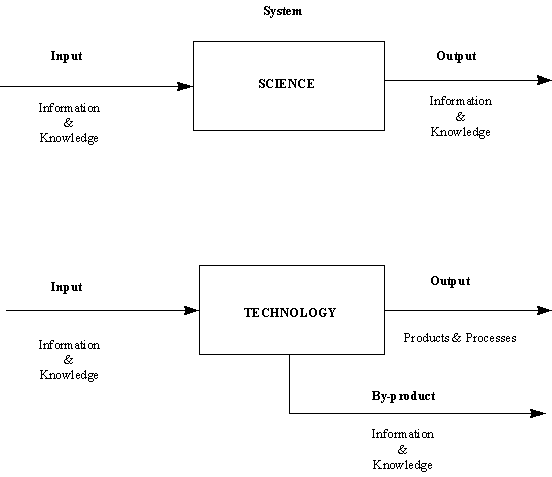
FIGURE
2:
Schumpeter’s
theory of heroic entrepreneurship
(based
on: The Theory of Economic Development,
1934 and Business Cycles, 1939)
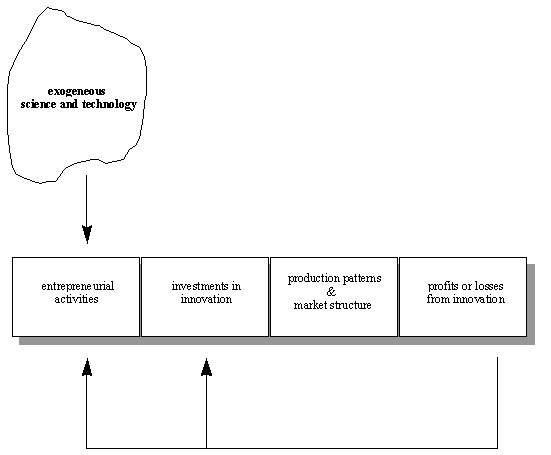
FIGURE
3:
Schumpeter’s
theory of endogenised R&D
(based
on: Capitalism, Socialism and Democarcy,
1942)
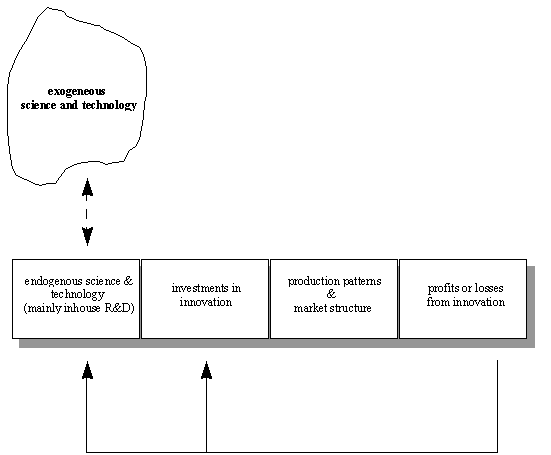
FIGURE
4:
A
general model of the technological innovation process
(based
on Roberts and Frohman, 1978)
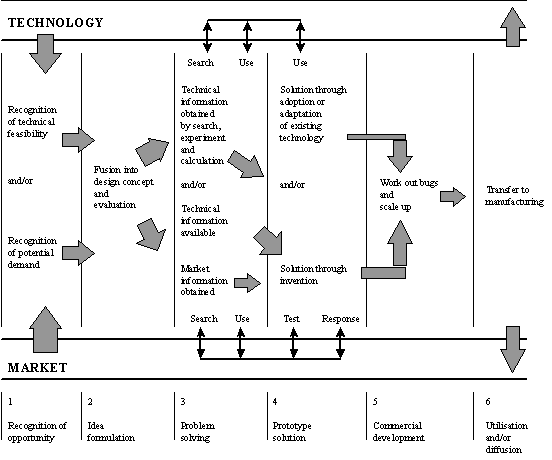
FIGURE
5:
Cumulative
cash flow during innovation projects
(source:
Twiss, 1992)
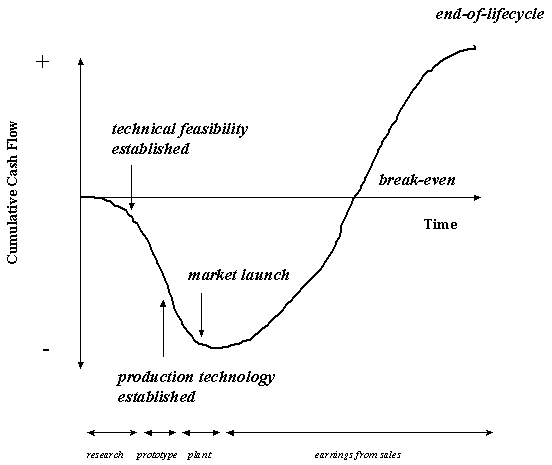
FIGURE
6:
A
dynamic model of product and process innovation in a productive unit
(source:
Abernathy, 1978)

FIGURE
7:
The
technological S-curve
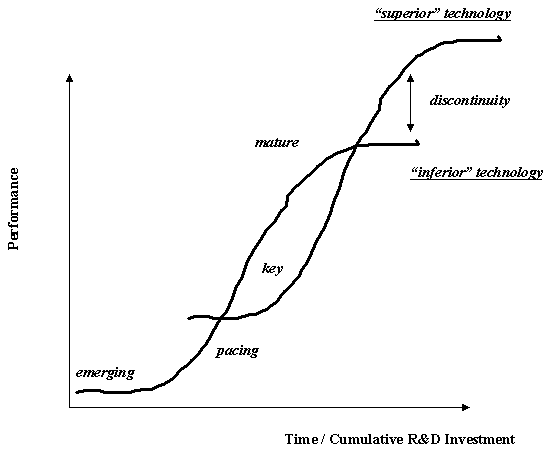
FIGURE
8:
Example
of a technology roadmap
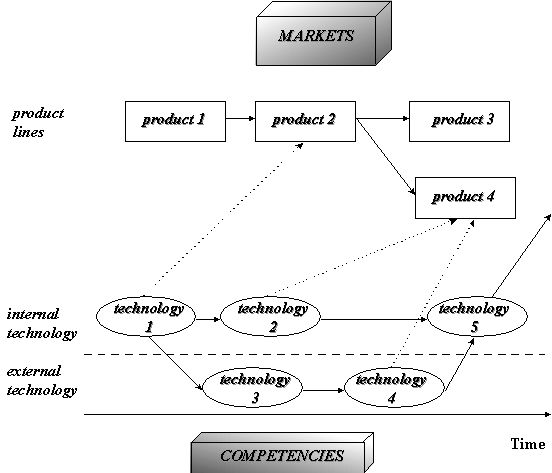
FIGURE
9:
The
innovation project portfolio as proposed by Wheelwright and Clark (1992)
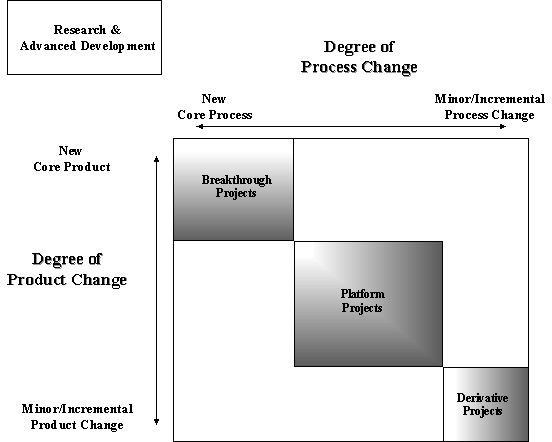
FIGURE
10:
In-house
scientific and technological functions of the firm according to
innovation
strategy followed
(source:
Freeman, 1982)
Range 1-5
indicates weak (or non-existent) to very strong
|
Type of
strategy |
Offensive |
Defensive |
Imitative |
Dependent |
Traditional |
Opportunist |
|
Fundamental
research |
4 |
2 |
1 |
1 |
1 |
1 |
|
Applied
research |
5 |
3 |
2 |
1 |
1 |
1 |
|
Experimental
development |
5 |
5 |
3 |
2 |
1 |
1 |
|
Design
engineering |
5 |
5 |
4 |
3 |
1 |
1 |
|
Production
engineering/quality control |
4 |
4 |
5 |
5 |
5 |
1 |
|
Technical
services |
5 |
3 |
2 |
1 |
1 |
1 |
|
Patents |
5 |
4 |
2 |
1 |
1 |
1 |
|
Scientific
and technical information |
4 |
5 |
5 |
3 |
1 |
5 |
|
Education
and training |
5 |
4 |
3 |
3 |
1 |
1 |
|
Long-range
forecasting and product planning |
5 |
4 |
3 |
2 |
1 |
5 |
FIGURE
11:
Choice
between functional and project organisation forms
(based
on Allen, 1977)
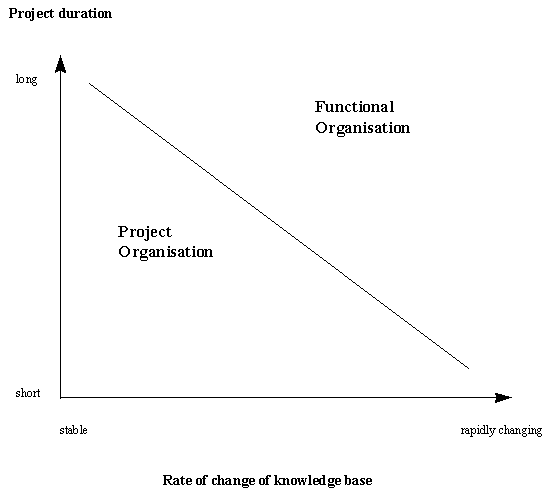
FIGURE
12:
The
knowledge economy of the innovative organisation,
hypothetical
example for R&D 26 staff members
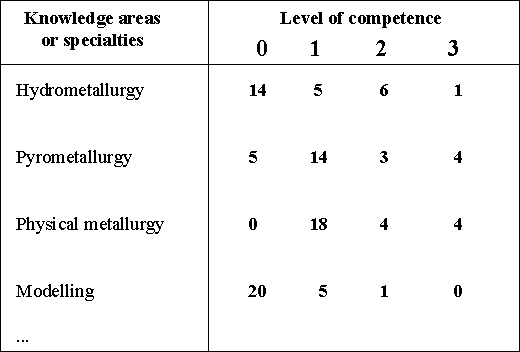
Note: This knowledge map shows the hypothetical
distribution of specialities among 26 scientific staff and engineers of a
metallurgical R&D centre.
Four
different competence levels are considered:
(1)
Level 0 indicates that a person has
no competence at all in the designated area;
(2)
Level 1 indicates that the person
has an understanding of basic principles in the specific knowledge area
considered;
(3)
Level 2 indicates that a person is
able to collaborate on a task of activity in that area;
(4)
Level 3 indicates that a person is
able to conduct an independent problem-definition and problem-solving activity
in the particular area.
The
example shows that the group is particularly vulnerable in the “Modelling”
field.