


A class of Discrete Event Systems (DES) can be described by linear models,
provided that the usual addition is replaced by maximization (denoted by
 ) and multiplication by addition (denoted by otimes). The resulting
algebraic structure is called the max-algebra.
The minimal realization problem in the max-algebra is the following: Find matrices A,B,C, where the dimension of A should be as small as possible, such that the impulse response of a Discrete Event System, described by

is equal to a given sequence  of Markov parameters.
In other words, find matrices A,B,C such that
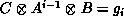 for
 . It has been shown that
this problem can be formulated as an Extended Linear Complementarity Problem.
With this approach solutions can be found.
In conventional systems theory it is always possible to find a state transformation between two different minimal realizations of the same sequence of Markov parameters. It is investigated whether a similar statement holds true in the max-algebraic systems theory of DES. Several possible state transformations are investigated. It turns out that in some cases state transformations exist. A problem in finding transformations for more general cases is that in the max-algebra the inverse of a matrix only exists for a small class of matrices.