Philippe Lemmerling, Sabine Van Huffel, Bart De Moor
The Structured Total Least Norm problem can be formulated as follows:

This is an extension of the well known Total Least Squares (TLS)
problem. For many signal processing applications, this extra
constraint is necessary for obtaining Maximum Likelihood estimates of
the perturbations and the parameter vector.
An example of a large scale STLN application is speech compression via
AR modelling. The speech signal is divided into different frames. The
data of one frame is stacked into a Hankel matrix  . By
applying STLN we obtain an AR model for that specific frame. From the
AR model parameters (x) and as many initial values as there are
model parameters, we can reconstruct the entire frame by applying the
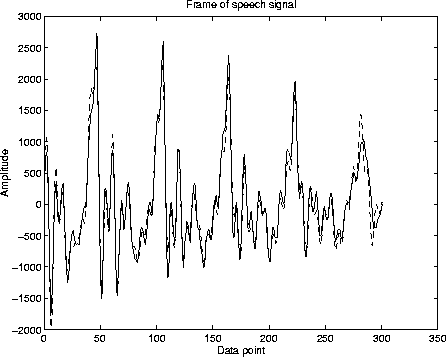
AR filter. In the figure we represent 1 frame of a speech signal,
consisting of 301 data points. The full line represents the original
data. The dashed line represents the signal reconstructed from the
parameters estimated by the STLN algorithm (16 model parameters are
used). As a result we only have to save 32 numbers (16 model
parameters and 16 initial values), a reduction of 9.4 compared to the
original 301 data samples. The Signal to Noise Ratio of the
reconstructed signal is 12.9 dB.