


Katleen Van Acker, Marc Moonen
New technologies, such as ADSL (Asymmetric Digital Subscriber Line), allow to provide high speed multimedia services over the existing telephone network. Frequencies up to 1.104 MHz are used to result in data rates up to 6 Mbps depending on the bridged distance. The transmission method that is selected for the ADSL standard is discrete multitone (DMT). DMT divides the used channel in 256 4-kHz-wide subchannels or tones. Depending on the quality of the tones (see figure), an amount of data and transmit energy is assigned to them. This offers a large flexibility. The modulation and demodulation are implemented with an IFFT respectively FFT. After modulation a cyclic prefix is added to a block of samples such that no inter-block interference can occur (whenever the length of the prefix is larger than the length of the channel impulse response). This results in a large overhead with respect to the data rate. An existing solution for this problem is to insert a time domain equalizer (TEQ) before demodulation such that the impulse response of the channel is shortened and data rate loss is minimized. Our aim is to find short and efficient algorithms that give the optimal coefficients of the TEQ. High bit rate transmission of data introduces also other problems which will be addressed, e.g. echo cancelation.
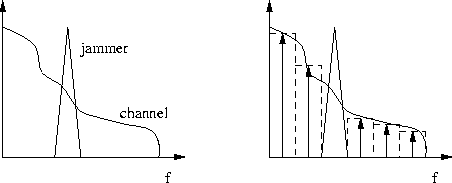
Figure 16: Discrete Multitone. The number of data assigned to each tone depends
on the attenuation caused by the channel and the presence of jammers.