


Peter Van Overschee, Bart De Moor
Identification of multi-input multi-output (MIMO) systems from a measured power spectrum is still considered to be a challenge. This type of data typically arises when modeling disturbances, in which case the frequency domain power spectrum is often easily obtained. The algorithm described in this paper determines a state space realization of this power spectrum. For disturbance modeling, the spectral factor of this power spectrum can then be used for instance in the design of an optimal disturbance rejection controller.
For time domain measurements, a vast number of state-space subspace identification algorithms is available. The major advantage of subspace identification algorithms over the classical prediction error methods is the absence of non-linear parametric optimization problems. Indeed, subspace identification algorithms are non-iterative, and thus never get stuck in local minima or suffer from convergence problems. In short, they always produce a (sub-optimal) result, which is often surprisingly good for practical data.
The problem addressed in this paper is the one of fitting a linear discrete time power spectrum through given measured frequency domain power spectrum samples. A parametric approach to this problem would consist of using a non-linear least squares criterion, that is then optimized using a non-linear search in the parameter space. However, the typical disadvantages of the time domain prediction error methods also carry through to this frequency domain setting i.e. an a-priori given parameterization is needed (which is especially hard to find for MIMO systems), non-linear parametric optimization is required and convergence problems could occur.
The major contributions of this paper are as follows. Firstly, we show how the inverse discrete Fourier transform of the given power spectrum can be expressed in function of the system matrices. A realization theory is then devised to obtain the system matrices from this inverse discrete Fourier transform. An important observation is that the computed singular value spectrum determines two times the system order (instead of once the system order for the classical realization algorithms). A detailed step by step description of the algorithm is provided. Secondly, we indicate that a given set of system matrices does not necessarily describe a valid power spectrum. Indeed, a power spectrum has to be positive real to be physically meaningful. We recognize this problem and solve it through a slight modification of the basic subspace power spectrum identification algorithm. The identified power spectrum is always positive real. Finally, we illustrate the practical relevance of the problem treated in this paper with two examples which solve an acceleration sensitivity and an acoustic power spectrum modeling problem. The first example is illustrated in this figure.
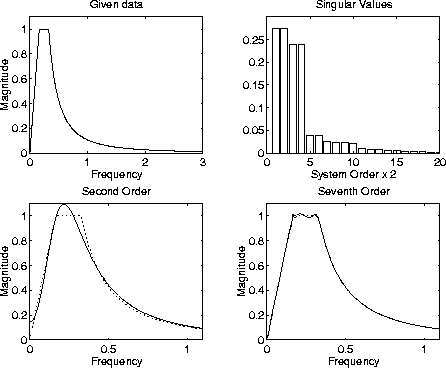
Figure 20: a/ Given road disturbance power spectrum. b/ Singular value
spectrum which determines two times the system order. We selected
order 2 and 7 (which corresponds to the bar at 4 and 14 in the
plot). c/ and d/ Second and seventh order fit (full line) and
original data (dotted line). Note that we cut the frequency axis
to zoom in on the more relevant part of the power spectrum. The
seventh order model fits the flat part of the spectrum very well.