


Leen Vanhamme, Sabine Van Huffel
We introduce AMARES, an improved method to accurately and efficiently estimate
the parameters of noisy
magnetic resonance spectroscopy (MRS) signals in the time domain.
As
a reference time domain method we take VARPRO. VARPRO uses a simple
Levenberg-Marquardt algorithm to minimize the variable projection
functional. This variable projection functional is derived from a
general functional, which minimizes the sum of squared differences
between the data and the model function. We have shown that
minimizing the general functional improves the robustness of MRS data quantification.
The newly developed algorithm uses a version of NL2SOL, a
sophisticated nonlinear least squares algorithm, to minimize the
general functional.
In the new algorithm a singlet approach enables to impose a priori
known relationships between any parameter of the same type. In VARPRO a
rigid multiplet structure only allows to impose relations between
groups of parameters.
As a result
the possibilities of the kind of prior knowledge that can be
invoked using AMARES are greatly extended. In addition, AMARES allows
to
fit Free Induction Decay signals, as well as echo signals, to different
types of model functions
(Lorentz, Gauss and Voigt).
As a result an algorithm is obtained which
outperforms VARPRO in terms of accuracy, robustness and flexibility.
AMARES is written in Fortran77. It can be used as a stand-alone
program, but it is also implemented within MRUI, a graphical user
interface to facilitate use of sophisticated spectral analysis
routines in biomedical/biochemical laboratories and the clinic. In
figure, the graphical result of the analysis of a simulated  P
spectrum is shown.
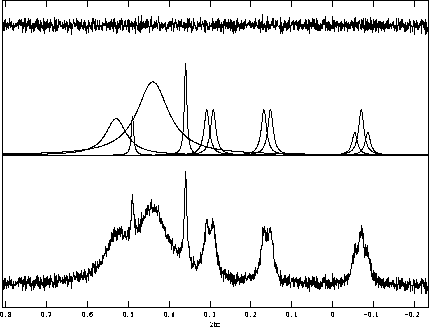
Figure 1: From bottom to top: the FT spectrum of the original signal, the
individual Lorentzians (FT of fitted sinusoids) and the residual,
which is the difference between the original signal and the
reconstructed signal.