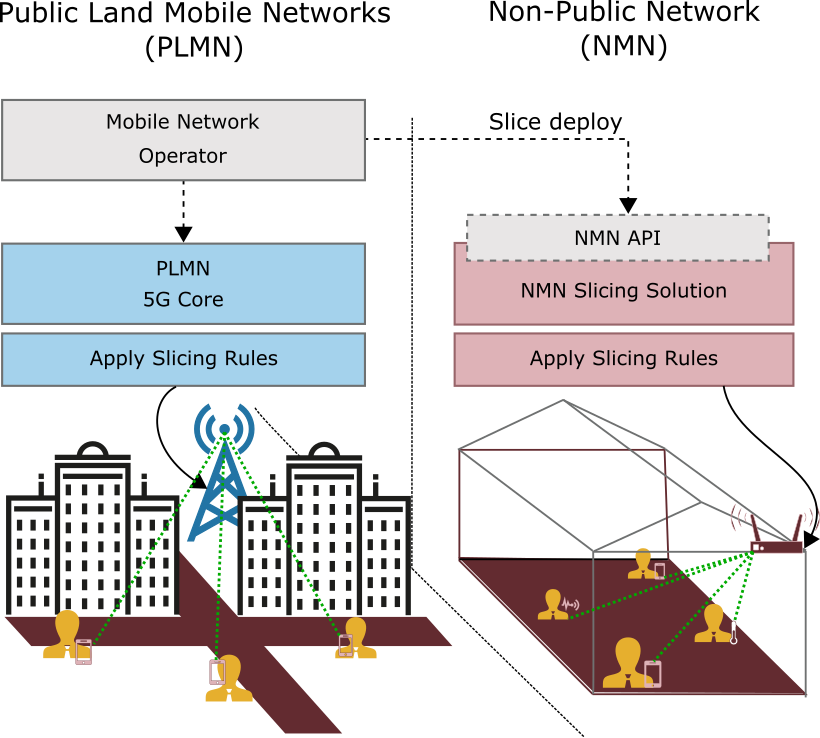
The 3rd Generation Partnership Project (3GPP), the organization that assesses the requisites for the new network infrastructures in the second phase of 5G networks (3GPP Rel-16 and beyond) [1], classifies the future 5G networks in two types: Public Land Mobile Networks (PLMNs) and Non-Public Networks (NPNs). The first type is the network provided directly by the Mobile Network Operator (MNO) infrastructure and will be able to address many service requisites. The second type are networks deployed for private reasons, such the ones created for indoor connectivity of sensors, robots, auto-guided vehicles, remote workers, IoT devices, wearable devices, etc [2]. Figure 1 presents a comparative between the two network types.
Hospitals networks are one example of NPN, because these networks are the medium to transmit indoor, highly sensitive information every day. Even more, to provide connectivity to indoor sensors and health services, hospitals will need to deploy a private network within their infrastructure. This private infrastructure will enable hospitals to prioritize network traffic and secure the information from the very edge of the network. In an European context, the use of a NPN is also mandatory in the hospitals’case because these e-health networks must comply with the General Data Protection Regulation(GDPR) [3]. However, to deploy an NPN, research on how to enable network slicing techniques is needed in order to evaluate heterogeneous radio technologies and integration with Public Land Mobile Networks (PLMNs).
Network slicing is the research topic that studies techniques to share resources and provide the expected Quality of Service (QoS) for connected clients [4]. A network slice can be defined as an expected network behavior for a specific service. ProTego project aims to develop a security toolkit to be applied in health environments even for low-cost hospitals that cannot afford expensive technologies to ensure its patients’ confidentiality. Among the components of the kit, network slicing is planned to provide both performance and privacy isolation for different slices in the network and enable the dynamic allocation and deallocation of slices in Non-Public Networks (NPNs).
To offer network slicing, ProTego’s team is developing techniques to manage the network parameters and increase hospital services quality. These techniques should provide differentiation of hospital services over a wireless network, the most common type of indoor network access and should provide strategies to isolate the services flows inside the local network. In order to provide secure and distributed management of such network slicing techniques, the use of blockchain technologies can be considered as a promising approach.
REFERENCES
[1] 3GPP, “Service requirements for the 5G system,” 3rd Generation Partnership Project (3GPP), Technical Specifification (TS) 22.261, 12 2019, version 16.10.0. [Online]. Available: https://portal.3gpp.org/desktopmodules/Specifications/SpecificationDetails.aspx?specificationId=3107
[2] J. Ordonez-Lucena, J. F. Chavarria, L. M. Contreras, and A. Pastor, “The use of 5g non-public networks to support industry 4.0 scenarios,” in 2019 IEEE Conference on Standards for Communications and Networking (CSCN), Oct 2019, pp. 1–7. [Online]. Available: https://doi.org/10.1109/CSCN.2019.8931325
[3] P. Voigt and A. Von dem Bussche, “The eu general data protection regulation (gdpr),” A Practical Guide, 1st Ed., Cham: Springer InternationalPublishing, 2017.
[4] A. Barakabitze, A. Ahmad, R. Mijumbi, and A. Hines, “5g network slicing using sdn and nfv: A survey of taxonomy, architectures and future challenges,” Computer Networks, vol. 167, 2020. [Online]. Available: https://doi.org/10.1016/j.comnet.2019.106984
This blog post was written for the ProTego project by Joao Paulo de Brito Gonçalves (imec).