


Next: Adaptive processing techniques for
Up: Signal Processing
Previous: A technique for higher-order-only
Koen Eneman, Marc Moonen
Modelling acoustic impulse responses with lengths up to 250 ms is required for
high quality echo cancelation in strongly reverberating environments. This
leads to FIR adaptive filters with several thousands of taps. Classical
LMS-based solutions then clearly fail as they exceed the computational
capabilities of present-day DSPs. This research
is focused on efficient adaptive algorithms for stand-alone and real-time
acoustic echo cancelation. Two approaches are studied here, as well as the
relation between them.
- A promising and cost-reducing alternative for fullband LMS is
subband adaptive filtering. All filtering and adaptation operations
are done independently in each frequency band at a downsampled rate.
Therefore, subband adaptive filters can have faster convergence and better
tracking if properly tuned. A main disadvantage with respect to LMS is the
presence of a residual error due to under-modelling.
A subband echo canceler requires a well designed filter bank. Filter
banks introduce aliasing errors, inherent delays and sometimes unacceptable
signal distortion. Oversampled DFT modulated filter banks have desirable
properties : cheap realizations are possible through polyphase decomposition
and fast signal transforms. Oversampling reduces the amount of inserted
aliasing. Furthermore, a perfect reconstruction filter bank set can be designed
based on iterative optimization on a subset of para-unitary polynomial
transfer function matrices. - An at first sight different approach is frequency-domain adaptive
filtering. Block LMS can be directly translated to frequency-domain leading
to very efficient long adaptive filters. In order to overcome the inherent
delay, which is typical for this approach, the adaptive filter is partitioned,
leading to the PBFDAF. PBFDAFs are cheap and widely used for adaptive
identification for their low delay and absence of residual errors.
It has been shown that the PBFDAF can be cast is the above-mentioned subband
approach, implementing a simple DFT filter bank with low frequency selectivity
and some extra projection operations.
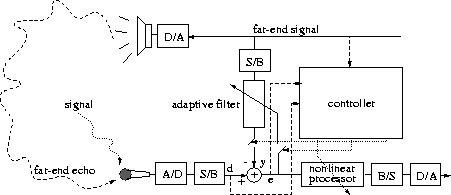
Figure 13: The echo cancelation setup.
Apart from an adaptive cancelation scheme also control and supervision
units have to be included for stand-alone operation (see figure). Double-talk
detection herein plays a crucial role. Exploiting the characteristics of
speech leads to cheap and satisfactory control.
A test environment in MATLAB and C has been set up to validate this approach
both on simulated data as well as on real recordings. Further activities
include a real-time implementation and testing in a parallel DSP environment.
Next: Adaptive processing techniques for
Up: Signal Processing
Previous: A technique for higher-order-only
Peter De Gersem
Thu Mar 27 15:21:50 MET 1997