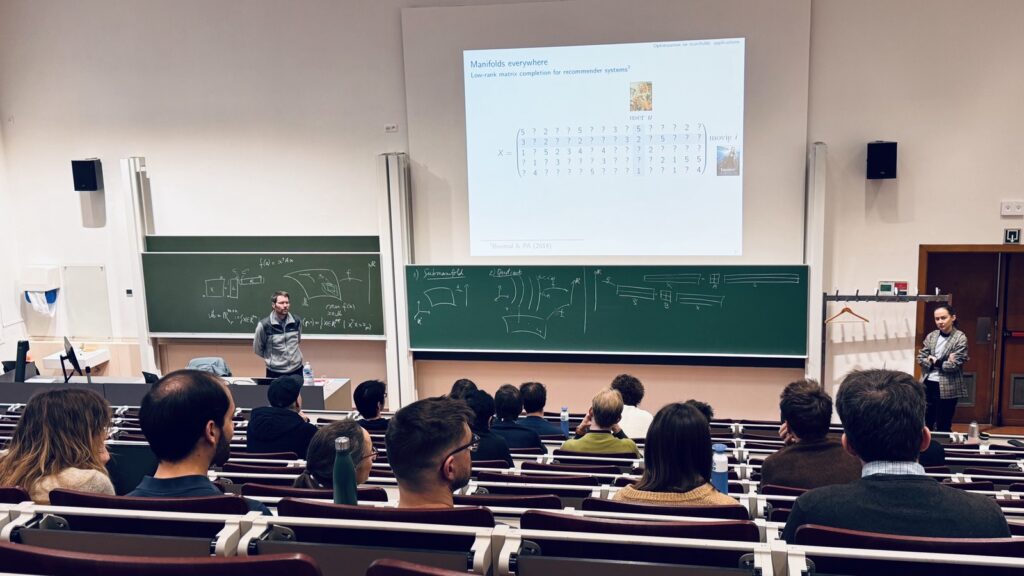
An Introduction to Optimization on Manifolds
Start: 27/11/2025, 10:00
Location: Aula R
Abstract: This talk gives an introduction to the area of optimization on manifolds – also termed Riemannian optimization – and its applications in engineering and the sciences. Such applications arise when the optimization problem can be formulated as finding an optimum of a real-valued cost function defined on a smooth nonlinear search space. Oftentimes, the search space is a “matrix manifold”, in the sense that its points admit natural representations in the form of matrices. In most cases, the matrix manifold structure is due either to the presence of nonlinear constraints (such as orthogonality or rank constraints), or to invariance properties in the cost function that need to be factored out in order to obtain a nondegenerate optimization problem. Manifolds that come up in applications include the rotation group SO(3) (e.g., for the generation of rigid body motions from sample points), the set of fixed-rank matrices (appearing for example in low-rank models for recommender systems), the set of 3×3 symmetric positive-definite matrices (e.g., for the interpolation and denoising of diffusion tensors in brain imaging), and the shape manifold (involved notably in morphing tasks).
In the recent years, the practical importance of optimization problems on manifolds has stimulated the development of geometric optimization algorithms that exploit the differential structure of the manifold search space. In this talk, we give an overview of geometric optimization algorithms and their applications, with an emphasis on the underlying geometric concepts.
Bio: Pierre-Antoine Absil is a professor of applied mathematics at the University of Louvain, Louvain-la-Neuve, Belgium. He received an engineering degree (ingénieur civil physicien, 1998) and a PhD in applied sciences (2003) from the University of Liège, Belgium. In 2003-2005, he was a Postdoctoral Associate with the School of Computational Science at Florida State University. He was a Research Fellow with Peterhouse, University of Cambridge (UK) in 2005-2006. His main research areas are in numerical optimization, with particular interests in algorithms on manifolds and biomedical applications.