STADIUS Biomedical Seminar
Date & Time: 30/03/2026, 14:00 – 16:00
Location: Aula van de Tweede Hoofdwet (TI 01.02)
Speakers: Axel Geysels, Alexandre Arnould, Thomas Vanhemel
Abstract:
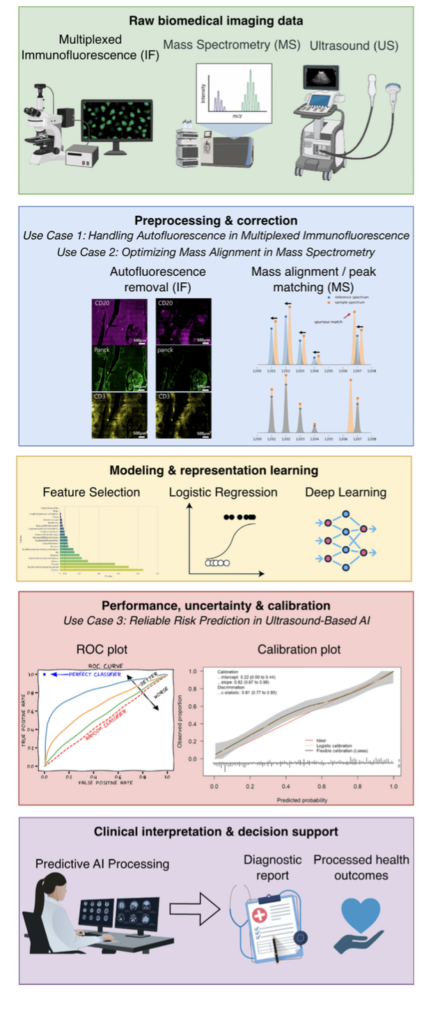
Biomedical artificial intelligence (AI) systems are increasingly used in both research and clinical settings, yet they fundamentally rely on multi-stage pipelines spanning data acquisition, preprocessing, modeling, performance evaluation, and clinical decision support (Figure 1). It is now well established that errors or biases introduced at any stage – such as data-quality limitations, inadequate preprocessing, or unreliable model evaluation – can propagate downstream and compromise scientific validity or clinical safety, even when individual components appear to perform well.
In this seminar, we illustrate these principles through three complementary case studies in multiplexed immunofluorescence imaging (IF), mass spectrometry (MS), and ultrasound (US)-based clinical AI. Together, these examples demonstrate how targeted interventions at different pipeline stages – ranging from preprocessing and alignment to calibration – can prevent error propagation, improve interpretability, and support trustworthy biomedical AI in both research and clinical practice.
Use Case 1 (IF):
Multiplexed imaging enables the spatial measurement of dozens to hundreds of proteins and RNA molecules at subcellular resolution, providing unprecedented insight into tissue composition and architecture in health and disease. Alongside advances in imaging technologies, robust bioinformatic methods are essential to reliably process and interpret the resulting high-dimensional data.
While many existing pipelines emphasize downstream analysis, less attention is paid to the pre-processing steps that critically determine data quality and biological interpretability. This use case introduces the key steps involved in pre-processing Cyclic Multiplexed Immunofluorescence (cMIF) data, showing how image quality directly impacts downstream quantification and cell phenotyping. Special emphasis will be placed on autofluorescence (AF) removal, a source of background signal arising from the intrinsic fluorescence of tissue components which can later confound the molecular quantifications at single-cell level.
Use Case 2 (MS)
Mass spectrometry is an analytical technique for measuring mass-to-charge ratios of ions, enabling the characterization of complex molecular mixtures. A single mass spectrometry measurement results in a mass spectrum, which consists of many peaks, each corresponding to ions of a specific mass-to-charge value and intensity. In practice, measurements suffer from instrumental drift, changes in experimental conditions and sample-dependent effects. This can lead to misaligned peaks across measurements. If left uncorrected, these discrepancies hinder downstream data analysis.
This use case will focus on a data-driven approach to relative mass alignment that addresses these challenges without relying on calibration compounds or predefined reference peaks. In this approach, a gradually changing warping function is computed by optimizing the similarity between a reference and a measured mass spectrum. It is shown that the described methodology reliably corrects small and large mass shifts.
Use Case 3 (US)
In clinical decision-making, predicted risks must be reliable, not merely rank patients correctly. While many machine learning models achieve strong discrimination, clinicians require well-calibrated probabilities to guide actions such as surgery, surveillance, or treatment. Poor calibration – systematic over- or underestimation of risk – can lead to overtreatment, delayed care, and patient harm, even when discrimination metrics such as accuracy or AUC are high.
Despite its central importance, calibration is often underreported and insufficiently evaluated in predictive modelling studies, particularly for complex machine learning approaches. In this use case, we discuss why calibration matters, illustrate common sources of miscalibration, and outline practical strategies for assessing, validating, and updating models to support safe and clinically meaningful risk prediction.
Figure 1 | End-to-end biomedical AI pipeline from raw data to clinical decision support
Schematic overview of a multi-stage biomedical AI pipeline, illustrating how data quality and modeling choices at each stage influence downstream reliability and clinical usability.