This is a post in COSIC’s Guide to Crypto! In this series, researchers from COSIC will be informally writing about different concepts in cryptography. Our aim is to introduce the reader to these concepts with explanations, illustrations and examples; so let’s get started!
[mathjax]
SECRET SHARING
Secret sharing refers to a cryptographic primitive which allows a secret to be distributed among a group of participants. Once the secret has been distributed, each of the participants holds a share of the secret. On its own, this share does not reveal any information about the original secret, unless combined with sufficient other shares of (a subset of) the participants. A bit more formally: a secret sharing scheme allows a dealer to distribute shares of a secret to \(n\) parties \(P_1, …, P_n \), such that only authorized subsets of these parties can reconstruct the secret, while any unauthorized subset of parties does not obtain any information about the secret. Secret sharing was invented independently, but in the same year (1979) by two different researchers: Adi Shamir, and George Blackley.
A threshold secret sharing scheme is a scheme where the authorized sets are all the sets whose size is at least some threshold value \(t\). If there are \(n\) parties participating in the secret sharing and any (\t\) (or more) of them form an authorized set then we say that the scheme realizes the \(t\)-out-of-\(n\) access structure, where \( 1 \leq t \leq n \) is an integer; and call it\( (t,n)-\)threshold secret sharing scheme. When all parties’ shares are required for the secret reconstruction, and no \(t = n – 1\) parties are able to obtain any useful information about the secret, we refer to the secret sharing scheme as a scheme for the \( (n,n)\)-threshold access structure.
TRIVIAL SECRET SHARING
Easy examples of secret sharing methods include the trivial secret sharing, where the threshold \(t=1\), and the secret is handed in its entirety to all \(n\) parties. Another straightforward example is that of splitting a secret phrase or word in blocks of letters of predetermined size, and then distributing each block to one party. Consider for instance that you wish to secret share the word “cryptography” to four parties, and you split it in the following way: “cry———“, “—pto——“, “——gra—“, “———phy“. In this case, an outsider possessing 0 shares has no information about our secret, other than that it consists of 12 letters. They would therefore need to guess the secret from the \(26^{12} \simeq 95.5\) quadrillion possible combinations. On the other hand, a party with one share has a lot of information about the secret, and only needs to guess 9 out of the 12 letters, which is \(26^9 \simeq 5.4\) trillion combinations. The more parties collude (and therefore combine their knowledge), the more the secret gets exposed. Clearly, these two examples of simple word concatenation, and trivial secret sharing are not secure. Strictly speaking, a secure secret sharing scheme distributes shares so that anyone with fewer than \(t\) shares has no more information about the secret than someone with 0 shares.
SECURE SECRET SHARING
In the cryptographic sense, we consider only secure secret sharing schemes. However, the level or type of security provided by each such secret sharing scheme differs. There are secret sharing schemes, such as Shamir’s secret sharing, providing information theoretic security, and thus satisfying the property of perfect secrecy, and secret sharing schemes providing computational security. This is related to the assumptions we make to prove the security of the secret sharing schemes, and concretely relates to the runtime dimension of the adversaries under consideration, as explained by Cyprien in this blog post (bounded vs. unbounded adversaries).
LINEAR SECRET SHARING
A secret sharing scheme is linear if the reconstruction of the secret from the shares is a linear mapping. In practice, this means that any linear operations performed on the individual shares translates to operations performed on the secret, upon reconstruction. This is a form of additive homomorphism, which allows meaningful (linear) operations to be performed indirectly on the secret, while actually being performed locally on the shares by each individual party, without requiring the exchange of additional information or other form of communication among the parties. It is this very property that makes linear secret sharing schemes so useful in applications such as secure computation.
SHAMIR’S SECRET SHARING
As the first to have been invented, but also satisfying strong security properties (namely perfect secrecy) along with the property of being linear, Shamir’s secret sharing scheme is perhaps the most popular secret sharing scheme to date. The goal of Shamir’s secret sharing is to divide a secret \(S\) into \(n\) shares \(S_1, …, S_n\), such that if you know \(t\) or more \(S_i\) shares, \(S\) is easy to reconstruct, while if you know \(t-1\) or fewer shares you gain no information about \(S\) over someone who possesses 0 shares. The intuition behind the scheme is that 2 points suffice to define a line, 3 points suffice to define a quadratic curve, 4 points suffice to define a cubic curve and so on. More generally, we need \(t\) points to define a \(t-1\) degree polynomial. For the scheme to be secure, the secret and shares are defined over a finite field \(\mathbb{F}\) of size \(p\), for \(p\) a prime number. To share a secret \(S\), we choose at random \(t-1\) field elements \(a_1, …, a_{t-1}\), and let \(a_0 = S\). We construct the polynomial \(f(x) = a_0 + a_1x + a_2x^2 + a_3x^3 + \dots + a_{t-1}x^{t-1}\). Then, we find any \(n\) distinct points on the curve (except for the point \((0, S)\), for instance by setting \(i=1, …, n\), and distributing to each party \(i\) the point \((i, f(i))\) (along with the public parameter \(p\) which defines the finite field). To reconstruct the secret we need any \(t\) of the points constructed in the previous step, and by using polynomial interpolation we can define the coefficients of the polynomial, including the constant term, which is the secret.
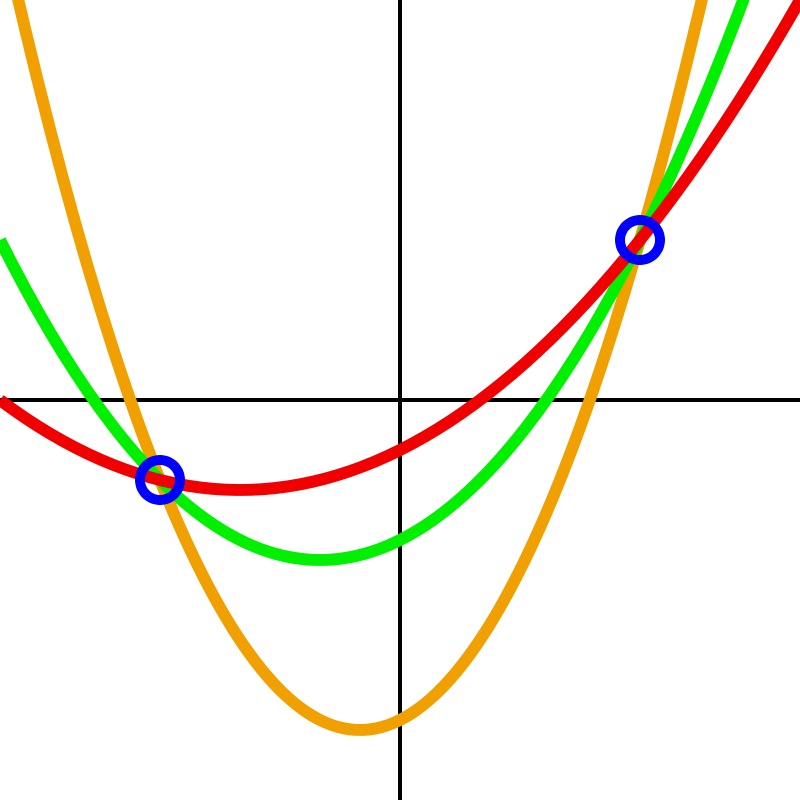
One can draw an infinite number of polynomials of degree 2 through 2 points. 3 points are required to define a unique polynomial of degree 2. This image is for illustration purposes only — Shamir’s scheme uses polynomials over a finite field, not representable on a 2-dimensional plane.
By Vlsergey – Own work, CC BY 3.0
ADDITIVE SECRET SHARING
Another example of a linear secret sharing scheme, which is widely used in secure computation nowadays is additive secret sharing. Additive secret sharing, unlike Shamir’s secret sharing is a scheme for the \( (n,n)\)-threshold access structure. Similarly to Shamir’s secret sharing scheme, for additive secret sharing the secret and shares are again defined over a finite field \(\mathbb{F}\) of size \(p\), for \(p\) a prime number. To split a secret \(S\) into \(n\) shares we choose at random \(n-1\) field elements \(S_1, …, S_{n-1}\), and let \(S_n = S – \sum_{i=1}^{n-1}S_i\). Each party then gets one of these shares. To reconstruct the secret all shares are required, and we simply need to add them to retrieve \(S\).
APPLICATIONS OF SECRET SHARING
Amos Beimel’s survey lists numerous cryptographic applications of secret sharing, including secure information storage, Byzantine agreement, threshold cryptography, access control, attribute-based encryption, and generalized oblivious transfer. However, the most prominent such application is, in my opinion, secure multiparty computation. Secure multiparty computation (MPC) allows a set of mutually distrusting parties to jointly compute a function on their inputs, without revealing anything about these inputs (other than what can be inferred from the function output itself). Entering the fascinating world of secure multiparty computation we can devise privacy-preserving protocols for a variety of real-life problems: from private genomics, to private machine learning applications. There is a plethora of MPC protocols to choose from, based on the scenario at hand, and the resources available. If you want to know more about how to choose the best fitting MPC protocol for your needs, stay tuned for Dragos’ follow-up blog post on “How to choose your MPC framework”. A nice read, if you wish to go deeper into MPC and secret sharing is the book Secure Multiparty Computation and Secret Sharing, by Ronald Cramer, Ivan Damgård, and Jesper Nielsen (Cambridge University Press, 2015).


