Designing a clock glitcher around the ZYNQ

The goal of clock glitching is to violate the critical path of the target device by temporarily overclocking it. The overclocking will cause violations against the setup and hold times for instance when data is moved over a bus or manipulated by the ALU. For a more detailed description of the effects of clock glitches […]
Dismantling DST80-based Immobiliser Systems

Car manufacturers deploy vehicle immobiliser systems in order to prevent car theft. However, in many cases the underlying cryptographic primitives used to authenticate a transponder are proprietary in nature and thus not open to public scrutiny. In 1995 Texas Instruments released the Digital Signature Transponder (DST),  the first cryptographic Radio Frequency IDentification tag [1]. These […]

Designing a side channel target board for the STM32

When reading through the side-channel literature everybody seems to have their own preferred setup for taking side-channel measurements. The most straightforward approach when targeting a new IC is to purchase the IC’s development board if available. The development board can then be modified to accommodate the desired measurement method or can be used as is. […]

Leakage Distribution Network for Masking Schemes

Masking schemes, such as Threshold Implementations (TI), are the most popular technique for countering side-channel attacks (SCA). They decorrelate  the computation from the resulting physical emanations by splitting the target function into multiple shares. For example, a variable \(x\) can be shared into \(N\) shares by randomly generating \(N-1\) values \(x_1\), …, \(x_{N-1}\) and calculating \(x_N\) such […]

Hardware-Based Trusted Computing Architectures for Isolation and Attestation

Electronic devices pervade our daily lives, both visibly through the devices that we interact with daily, but also invisibly as control industrial control systems and critical infrastructure that we rely on. At the same time, these devices have become increasingly connected, exposing them to remote attackers. The fact that these systems can be exploited is […]

Hare and Tortoise race in post-quantum cryptography: Using SIMD and Just-In-Time for fast and compact key encapsulation mechanism

It has been more than a year since the submission of candidates for the first round of NIST’s post-quantum cryptography started (Candidates qualifying for 2nd round announced on 30th January 2019 ). During this period, we have seen extensive and enthusiastic discussions, analysis and debates among researchers working in this field which has led to […]

Security Evaluations lab

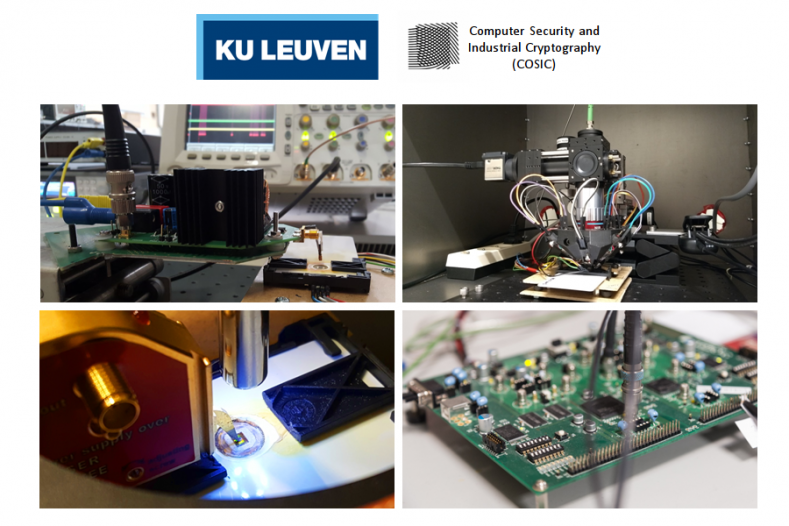
On March 1st 2018, the COSIC research group at KU Leuven officially opened its brand new Security Evaluations Lab. The opening was the culmination of a five-year upgrade project sponsored by a 400k EUR grant from the Hercules Foundation. The Need for Embedded Security Embedded electronic devices are becoming mobile and interconnected. They are omnipresent, […]

Constant-time discrete Gaussian sampling for lattice-based cryptography

Since the inception of Lattice based cryptography, discrete Gaussian sampling has been an integral part of it. Recently there are some efforts to replace discrete Gaussian sampling with centered Binomial distributions. These methods work fine for public-key encryption or key-exchange schemes, but for digital signature and trapdoor constructions, discrete Gaussian distributed noise is necessary to […]