ERC Starting Grant 2026 for COSIC Researcher Tim Beyne

We are proud to announce that COSIC researcher Tim Beyne has been awarded an ERC Starting Grant 2026 for his project RECRYPT (Reshaping the Security Analysis of Symmetric Cryptography). ERC Starting Grants support outstanding early-career researchers with ambitious and innovative research programmes. The grants provide funding for up to five years and are among the […]

New COSIC spin-off Belfort enables secure real-time processing of encrypted data

Belfort has launched a hardware accelerator for encrypted compute. This innovation makes it possible to compute directly on encrypted data without ever decrypting it, ensuring both security and privacy. The spin-off, founded out of the cryptographic expertise of KU Leuven’s COSIC research group, has raised €5 million in seed funding.  This innovation addresses one of […]

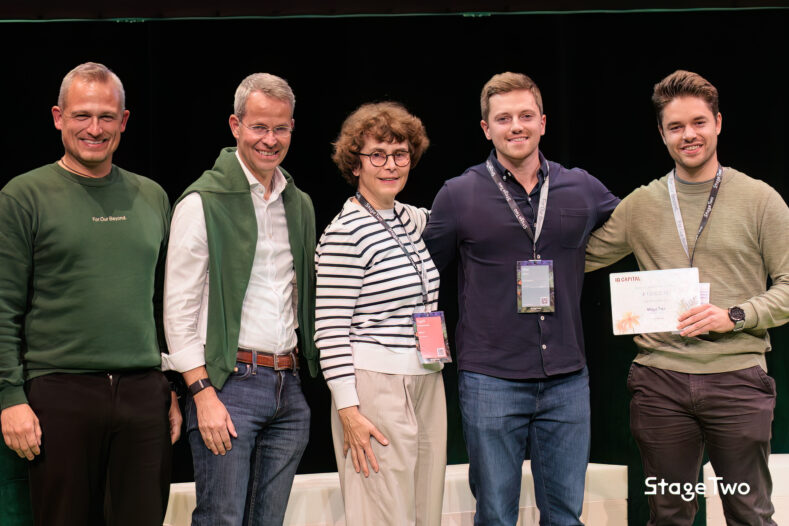
Belfort wins at Stage Two

Startup Belfort emerged as the big winner among 50+ startups from 40+ universities at Stage Two in Berlin last week. Stage Two is the largest pan-European startup competition for the best startups spinning out of leading universities. The team pitched twice: once in the semi-finals and once in the finals, and went home with 4 […]

ERC Consolidator Grant for Kris Myny

Kris Myny, Associate Professor Faculty of Engineering Technology (Diepenbeek Campus); Department of Electrical Engineering (ESAT), has received an ERC Consolidator Grant for developing a universal chip platform. Myny wants to develop a new chip platform by combining the technology of the classical (non-complex) computer chip with thin-film transistors used in flexible electronics.  More information about […]

Designing a clock glitcher around the ZYNQ

The goal of clock glitching is to violate the critical path of the target device by temporarily overclocking it. The overclocking will cause violations against the setup and hold times for instance when data is moved over a bus or manipulated by the ALU. For a more detailed description of the effects of clock glitches […]

Dismantling DST80-based Immobiliser Systems

Car manufacturers deploy vehicle immobiliser systems in order to prevent car theft. However, in many cases the underlying cryptographic primitives used to authenticate a transponder are proprietary in nature and thus not open to public scrutiny. In 1995 Texas Instruments released the Digital Signature Transponder (DST),  the first cryptographic Radio Frequency IDentification tag [1]. These […]

Designing a side channel target board for the STM32

When reading through the side-channel literature everybody seems to have their own preferred setup for taking side-channel measurements. The most straightforward approach when targeting a new IC is to purchase the IC’s development board if available. The development board can then be modified to accommodate the desired measurement method or can be used as is. […]

Leakage Distribution Network for Masking Schemes

Masking schemes, such as Threshold Implementations (TI), are the most popular technique for countering side-channel attacks (SCA). They decorrelate  the computation from the resulting physical emanations by splitting the target function into multiple shares. For example, a variable \(x\) can be shared into \(N\) shares by randomly generating \(N-1\) values \(x_1\), …, \(x_{N-1}\) and calculating \(x_N\) such […]

Hardware-Based Trusted Computing Architectures for Isolation and Attestation

Electronic devices pervade our daily lives, both visibly through the devices that we interact with daily, but also invisibly as control industrial control systems and critical infrastructure that we rely on. At the same time, these devices have become increasingly connected, exposing them to remote attackers. The fact that these systems can be exploited is […]