Anonymous Credentials (AC)
What are anonymous credentials? They let users authenticate to service providers without revealing unnecessary personal information. Service providers typically enforce policies (e.g., age, nationality), and users want to disclose only what’s required, while providers need assurance that the disclosed information is truthful.
Anonymous credentials solve this by introducing an issuer that generates credentials for users’ attributes using public-key cryptography. The issuer holds a secret/public key pair and uses its secret key to create credentials that are unforgeable. Users then employ zero-knowledge proofs to convince a verifier (the service provider) that they possess a valid credential for certain attributes — revealing only what’s necessary (e.g., “age > 18”). The verifier checks the proof using the issuer’s public key, so the scheme is publicly verifiable: anyone holding that public key can check a proof, no special relationship with the issuer required. These credentials also achieve multi-show unlinkability: any number of proofs derived from the same credential remain unlinkable, even to a colluding issuer and verifiers.

That’s close to a perfect solution: multi-show unlinkable, publicly verifiable tokens. The catch is how you get there. The most efficient constructions rely on pairing-based cryptography during verification, and curves supporting pairings are not widely standardized and lack hardware support.
Keyed-Verification Anonymous Credentials (KVAC)
The need for pairing-based operations arises because the verifier typically doesn’t have access to the issuer’s secret key and must rely on the issuer’s public key for verification. But what if the issuer and verifier trust each other — or are the same entity? This happens in scenarios like public transportation systems, where the issuer generates a credential (a ticket) for the user, and the user later proves possession of it to the vehicle. Unlinkable proofs still matter here, to protect the user from being tracked across rides.
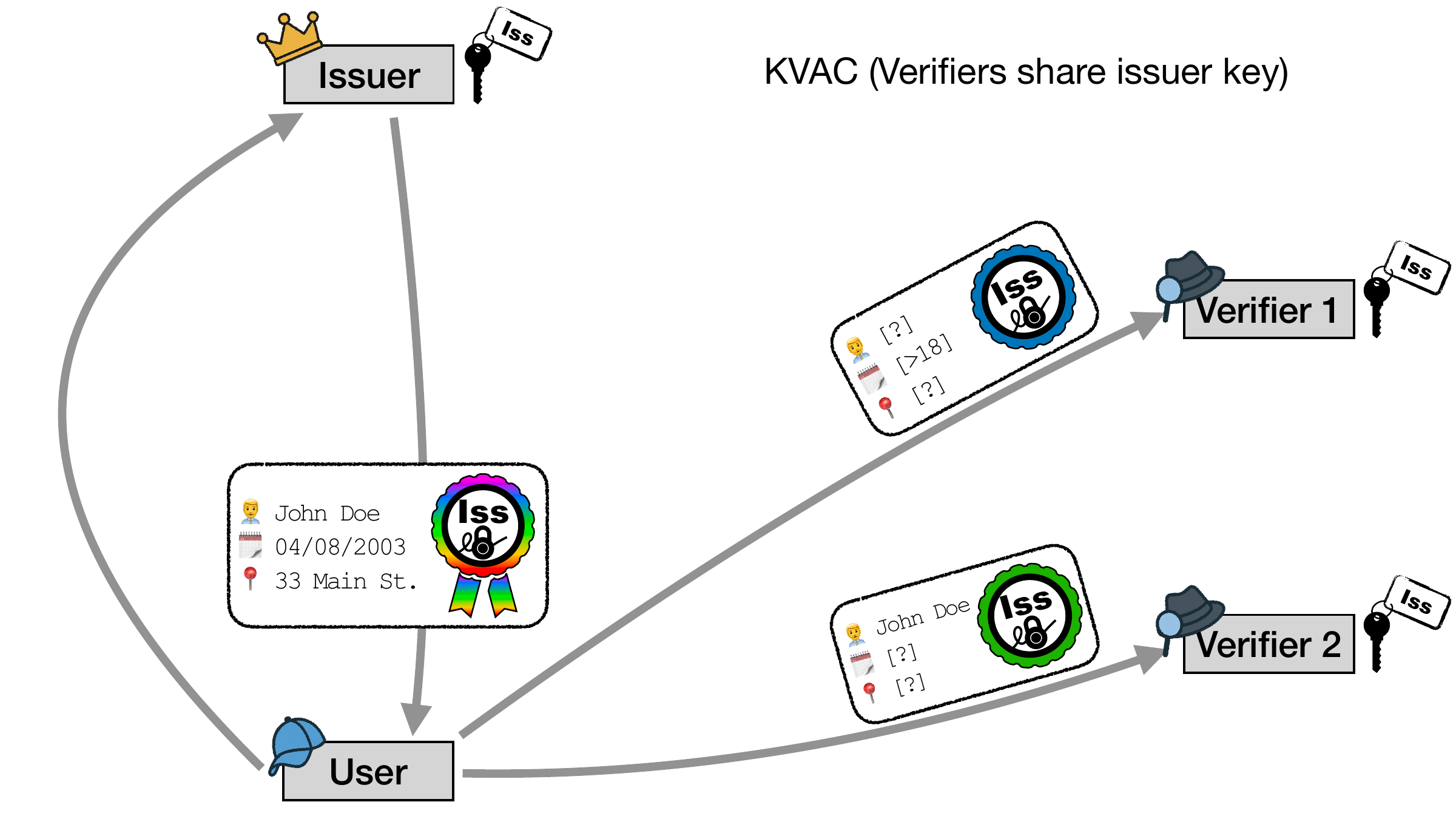
Since the issuer and verifier can share a secret key in this setting, we get a more efficient construction called Keyed-Verification Anonymous Credentials (KVAC). KVAC avoids pairing-based operations during verification entirely, making it faster and easier to deploy: multi-show unlinkable tokens, but for a designated verifier who shares a key with the issuer.
That designation is also the problem, in two ways.
First, it limits where KVAC applies at all: it only works when the issuer already fully trusts the verifier, or is the same entity as the verifier, as in a single-operator transit system. That doesn’t generalize to open ecosystems with many independent service providers who have no such relationship with the issuer.
Second, even within a single trust domain, sharing one key across every verifier is fragile. What happens when a verifier is compromised or acts maliciously? If Verifier 1 leaks or misuses the shared key, it can forge credentials that other verifiers will accept as genuine — one bad or breached verifier breaks soundness for everyone else.
Fixing both of these problems while staying pairing-free is exactly the gap mKVAC closes, and we’ll come back to it below.
Server-Aided Anonymous Credentials (SAAC)
So far we’ve seen two extremes: publicly verifiable anonymous credentials that need pairings, and pairing-free KVAC that needs a designated, trusted verifier. Neither fits a setting with many verifiers who don’t share a key with the issuer, don’t necessarily trust each other, and still need to check a proof without pairing support on their end. Is there a way to get pairing-free, publicly verifiable proofs without picking one verifier to designate in advance?
This is where SAAC (Server-Aided Anonymous Credentials), introduced by Chairattana-Apirom, Harding, Lysyanskaya, and Tessaro, comes in. By sacrificing multi-show unlinkability and building on KVAC, SAAC makes public verifiability possible without pairings. Here’s how it works:
- The user first receives a KVAC credential from the issuer.
- Whenever the user needs to give a proof to a verifier, they request assistance from the issuer.
- With this help, the user derives a one-time, publicly verifiable proof.
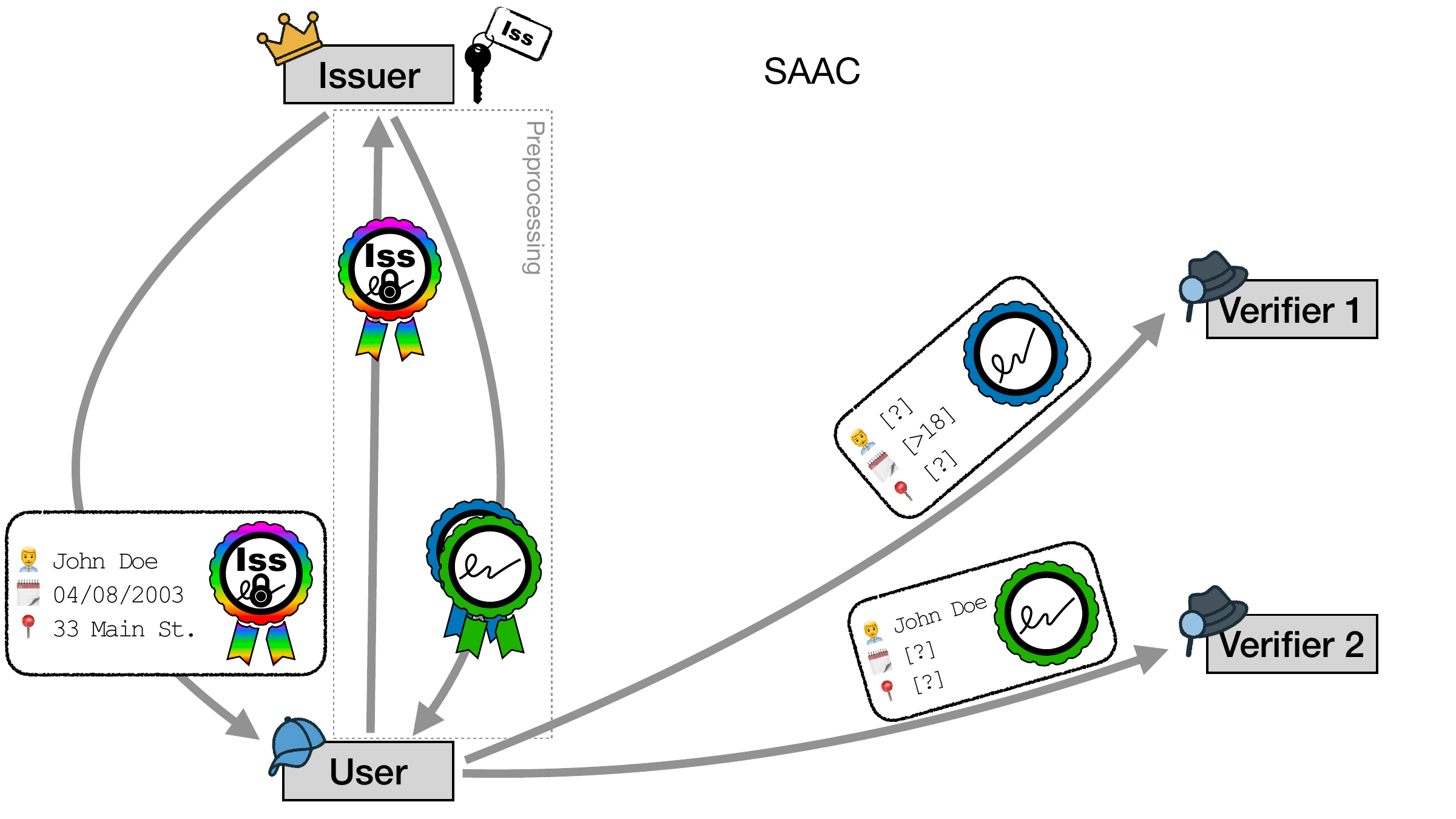
In effect, SAAC converts a designated-verifier, multi-show unlinkable token into a set of single-show, publicly verifiable tokens. That’s a good fit when the set of verifiers is diverse and not known in advance: the user requests a batch of one-time-use tokens from the issuer ahead of time and manages them, discarding each after use. It’s a poor fit when verifiers are known, don’t trust each other, and the user interacts with them repeatedly — there, having to collect and track a fresh single-use token for every single interaction becomes a real burden, and multi-show unlinkability is worth having back.
That second setting — known, mutually distrusting verifiers, frequent repeat interactions — is exactly what our Multi-Verifier Keyed-Verification Anonymous Credentials (mKVAC) targets.
mKVAC
How can we design a system that sits between publicly verifiable and keyed-verification constructions, getting the best of both? Concretely, we want a scheme that:
- Doesn’t let one verifier forge credentials accepted by others.
- Supports multi-show unlinkability for privacy.
- Avoids pairing operations, for efficiency and hardware compatibility.
- Allows credential issuance for different verifiers that don’t trust each other, similar to publicly verifiable schemes.
One simple solution: have the issuer share a different secret key with each verifier. When a user needs a credential for a specific verifier, they request it from the issuer, who uses the key it shares with that verifier and applies KVAC to generate the credential.
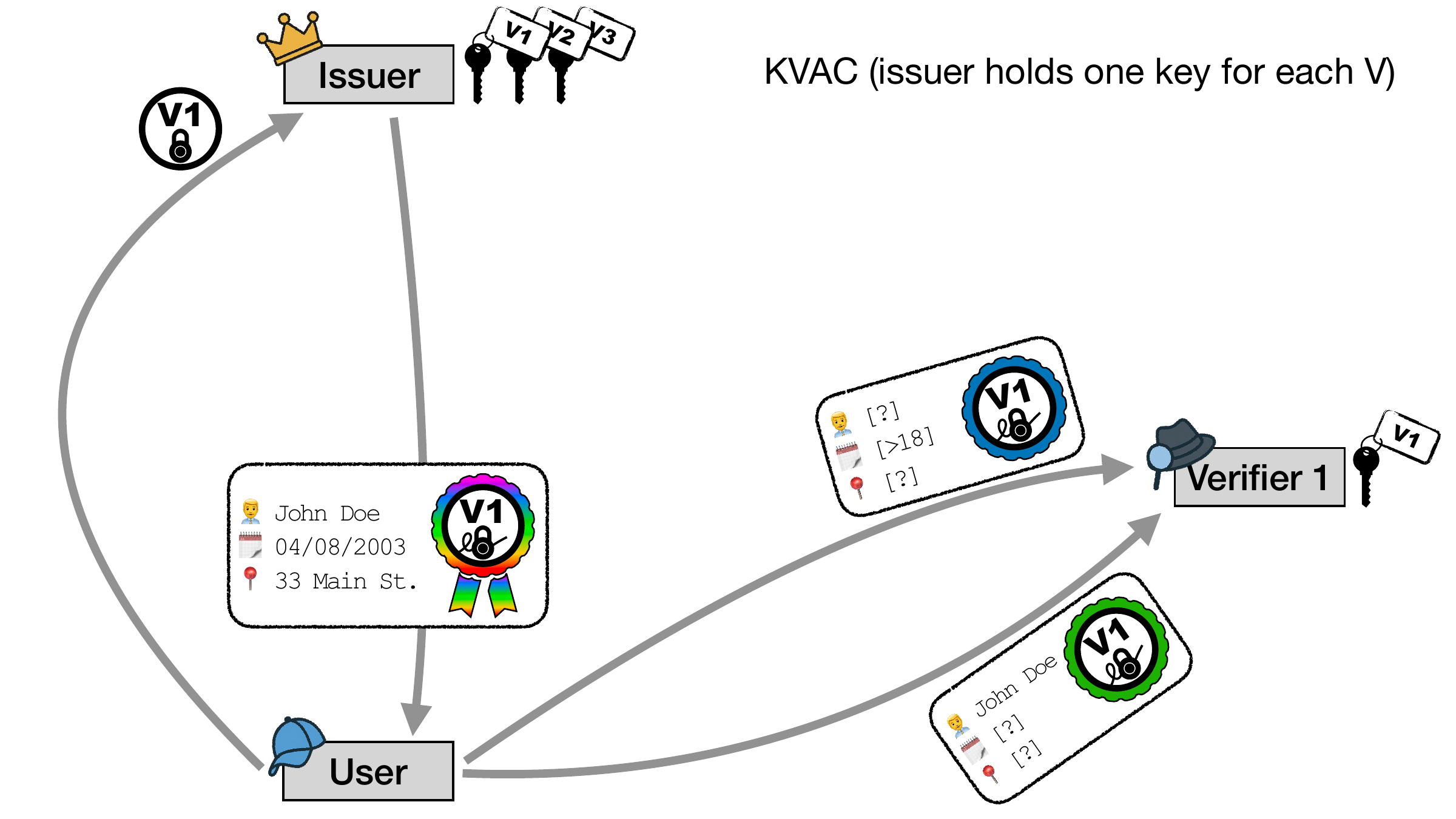
This technically meets the four requirements above, but at a real cost: the user has to reveal which service provider they intend to interact with to the issuer. That undermines the core promise of anonymity, and it also saddles the issuer with a key-management burden — a separate secret key for every verifier, which doesn’t scale.
Our Multi-Verifier Keyed-Verification Anonymous Credentials (mKVAC) scheme fixes this. Both the issuer and each verifier have their own independent public/secret key pair. The magic is in issuance: the user can request a credential for a specific verifier without revealing to the issuer which verifier that is — the privacy loss above simply doesn’t happen. From there:
- The user computes multi-show unlinkable proofs from these credentials.
- Verifiers check proofs with their own secret key, so no pairing operations are needed anywhere.
- The issuer no longer manages a separate secret key per verifier, so key management stays simple as the number of verifiers grows.
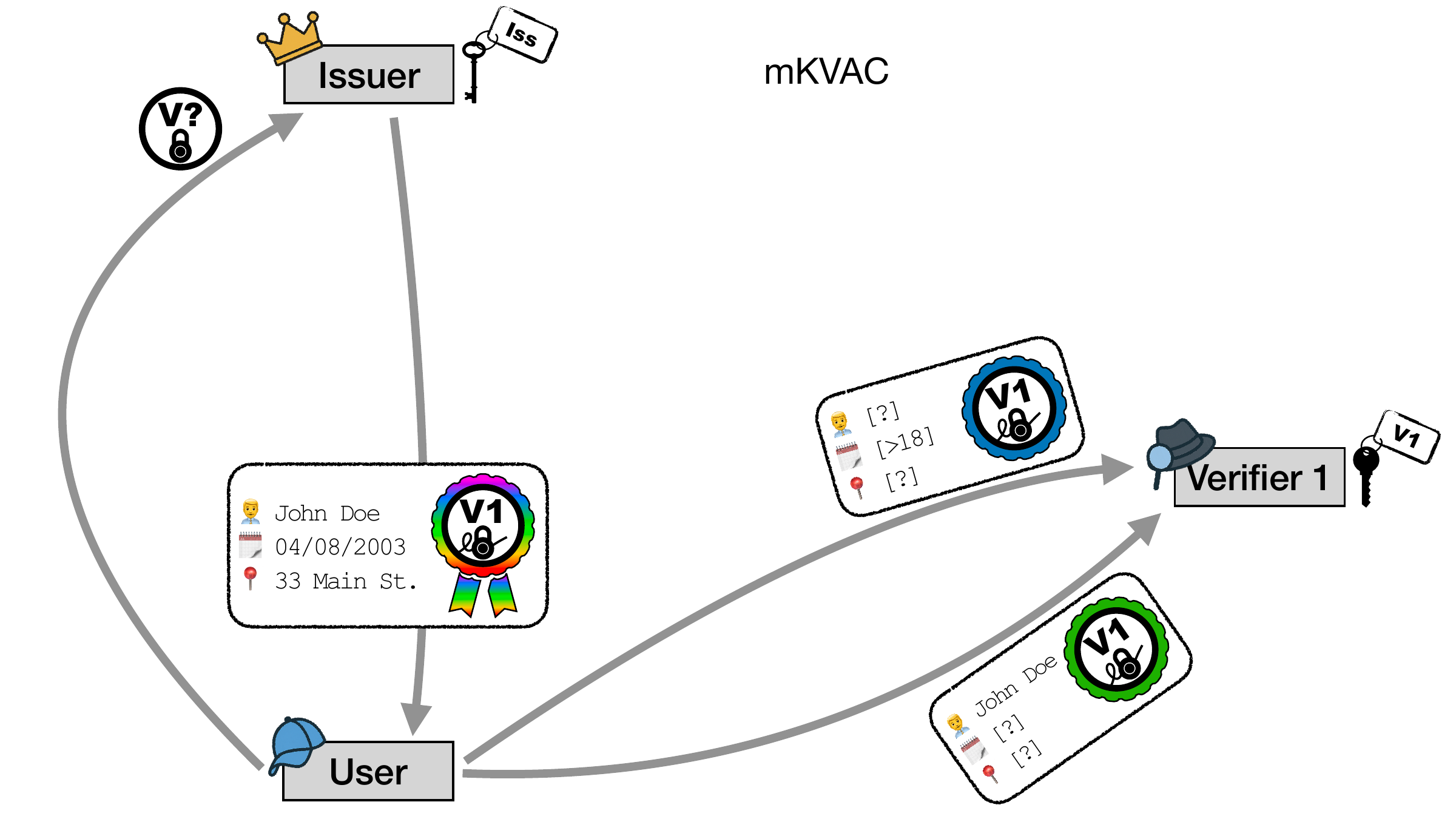
The result is a designated-verifier, multi-show unlinkable credential where the designation itself stays hidden from the issuer — a practical, privacy-preserving, and efficient scheme for real-world deployments with many mutually distrusting verifiers.
Where this fits: intermediaries in the EUDI Wallet
This setting isn’t hypothetical. The EU Digital Identity (EUDI) Wallet’s Architecture and Reference Framework defines intermediaries: parties that connect to wallets and request attributes on behalf of a set of end service providers, rather than each service provider talking to the wallet directly. This creates a diverse, known set of verifiers that a user may visit repeatedly, which is exactly the setting targeted by mKVAC. Each intermediary gets its own verifier key, so a leaked key at one doesn’t let anyone forge credentials another accepts, users still get unlinkable proofs across repeat visits, and the issuer never learns which end service provider or intermediary a given credential is for.
Summary and Conclusion
Looking at the properties of the tokens that users use for presentation, we can see that the approaches listed above present different trade-offs, summarized as follows.
| Schemes | Setting | Issuance | Verifiability | Unlinkability |
|---|---|---|---|---|
| AC | ❌ Pairings | ✅ Hidden verifier | ✅ Publicly verifiable | ✅ Multi-show |
| KVAC | ✅ No pairing | ❌ Known verifier | ❌ Verifier-specific | ✅ Multi-show |
| SAAC | ✅ No pairing | ✅ Hidden verifier | ✅ Publicly verifiable | ❌ Single-show |
| mKVAC | ✅ No pairing | ✅ Hidden verifier | ❌ Verifier-specific | ✅ Multi-show |
Our mKVAC represents a new trade-off that improves the situation when no pairing is available and users often present their credentials to the same verifier many times.
Want to learn more? Read our full paper, or watch the COSIC Seminar talk on this work.
This blog post was written by Omid Mirzamohammadi and Jan Bobolz based on their paper “Multi-Verifier Keyed-Verification Anonymous Credentials,” co-authored by Emad Heydari Beni, Anja Lehmann, Cavit Özbay, and Mahdi Sedaghat.


