Literature Review: The Basketball Analysis Problem

Basketball is no longer only studied through box scores, shooting percentages, or simple event counts. Modern basketball analysis increasingly depends on understanding how players move, space, react, respond under pressure, and make decisions in relation to one another. This matters because basketball is a dynamic invasion sport: one player’s decision is shaped by teammates, defenders, […]
Spiking Neural Networks

This blogpost was inspired by a recent keynote I attended at the DCOSS-IOT conference: “6G NTN Communication and Edge Computing for Satellite IoT” by Prof. Symeon Chatzinotas [1]. While discussing the massive logistical hurdles of deploying AI in space—where computing power and battery life are strictly limited—he mentioned a technology I had never encountered: Spiking […]

Eurocrypt 2026: Traceable Secret Sharing Revisited

When Adding One Share Breaks Everything A simple question with a worrying answer Cryptographers have spent decades figuring out how to split a secret among a group of people so that only the right coalitions can put it back together. But what happens when one of those people quietly sells their piece on the side? […]

Eurocrypt 2026: Traceable Secret Sharing Schemes for General Access Structures

Catching the Leaker: Traceable Secret Sharing for Any Rule The problem: a secret, a betrayal, no consequences Imagine a company’s master encryption key, split among five executives so that any three together can reconstruct it. This is secret sharing, invented by Shamir and Blakley in 1979, and it’s everywhere in modern cryptography; from blockchain custody […]

Free papers, get your free papers here!

All right: Are you a struggling/flourishing/all-together-ok academic on the look-out for that extra paper? Or merely messing around with some polynomials modulo \(X^{p}+1\) (or \(X^{p}-1\))? Here’s your ticket to a free paper: Ok fine, I’ll give a bit more explanation The NTT I’m talking about here is the Number Theoretic Transform. For non-cryptographers: it’s a […]

Eurocrypt 2025: MPC with Publicly Identifiable Abort from Pseudorandomness and Homomorphic Encryption

By Shahla Atapoor, May 6, 2025 Introduction Secure Multiparty Computation (MPC) allows multiple parties to compute a function over private inputs while keeping those inputs secret. Over the years, MPC protocols have become more efficient and robust, but one persistent challenge remains: what happens when the protocol fails? Most actively secure protocols can detect misbehavior […]

Exploiting Electronic Noise to Create Random Bits

This post explores how electronic noise can be put to good use as a source of randomness in integrated circuits and introduces our work presented recently at CHES 2024. A previous post discussed the importance of high-quality random numbers in modern cryptography and explored several methods of post-processing to improve the statistical quality of generated […]

Blind zkSNARKs

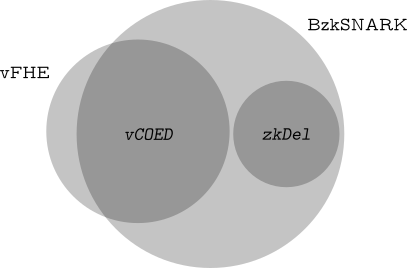
This blog post serves as a basic introduction to a recent paper, in which my colleagues from COSIC and I coin the term blind zkSNARKs. We demonstrate that this new cryptographic primitive shows great potential for advancing many zk-related applications. This post only requires knowledge of rudimentary cryptography and the concepts outlined in the background […]

CHES 2024: Fast Transciphering Via Reconfigurable And Batched LUT Evaluation

Three weeks ago, the conference on Cryptographic Hardware and Embedded Systems (CHES) took place in Halifax, Canada. In this blog post, we give a high-level summary of the main contribution of the paper “Fast Transciphering Via Reconfigurable And Batched LUT Evaluation” that was presented by Leonard Schild at CHES 2024. Lookup tables (LUTs) are multi-dimensional […]

Fast Evaluation of S-boxes with Garbled Circuits

This blog post summarizes our contribution and main ideas of the paper “Fast Evaluation of S-boxes with Garbled Circuits” published in IEEE Transactions on Information Forensics and Security (paper link, eprint). This is joint work with Aysajan Abidin and Bart Preneel. This post requires some background knowledge on garbled circuits. Some introductory articles can be […]