CO6GC: Homomorphic encryption (part 1): computing with secrets

This is a post in COSIC’s Guide to Crypto! A series of blog posts in which the researchers at COSIC introduce you to the wonderful world of cryptography. Today we will tell you about homomorphic encryption. This blogpost was written by Charlotte Bonte and Ilaria Chillotti When it comes to protecting data, cryptography is the […]
Asiacrypt’19 – Numerical Method for Comparison on Homomorphically Encrypted Numbers

One of the Asiacrypt 2019 papers invited to submit to Journal of Cryptology has been presented in the Homomorphic Encryption session. The paper, by Jung Hee Cheon, Dongwoo Kim, Duhyeong Kim, Hun Hee Lee and Keewoo Lee, presents new numerical methods to evaluate homomorphically the min/max and the comparison functions. These functions can be largely […]

Asiacrypt’19 – Order-LWE and the Hardness of Ring-LWE with Entropic Secrets

The Learning With Errors (LWE) problem is a well-known hard lattice problem, largely used to build cryptographic post-quantum schemes. The problem, proposed by Regev in 2005, has been extended to its Polynomial (PLWE) and Ring (RLWE) versions by Stehlé et al. in 2009 and by Lyubashevsky et al. in 2010, respectively. In this work, presented […]

Asiacrypt’19 – A Novel CCA Attack using Decryption Errors against LAC

The NIST Post-Quantum Cryptography Standardization process is already at its phase 2: only 26 schemes over the 69 proposed in phase 1 have accessed this phase and a large amount of them are lattice-based constructions. Between them, the LAC construction, an LWE based PKE/KEM, is adopting an extreme design, by choosing very small modulus q=251. […]

PPML’19 – Garbled Neural Networks are Practical

The work presented at the PPML 2019 workshop by Mike Rosulek, in collaboration with Marshall Ball, Brent Carmer, Tal Malkin, and Nichole Shimanski, challenges a conventional thought about the non-efficiency of Garbled Circuits (GC) in Neural Network evaluations. Imagine a scenario with two parties: the model owner, who holds a trained Machine Learning (ML) model […]

CCS’19 – “I don’t see why I would ever want to use it”: Analyzing the Usability of Popular Smartphone Password Managers

The work by Sunyoung Seiler-Hwang, Patricia Arias-Cabarcos, Andrés Marín, Florina Almenares, Daniel Díaz-Sánchez and Christian Becker presented at CCS 2019 investigates the usability of popular smartphone Password Manager (PM) applications. Many users struggle in creating and remembering strong passwords. PMs can help them in this task and manage passwords in personal devices. The use pf […]

CCS’19 – Practical Fully Secure Three-Party Computation via Sublinear Distributed Zero-Knowledge Proofs

When we talk about multi-party computation (MPC) we intend a set of techniques allowing multiple parties to jointly compute a function on their inputs, while keeping these inputs private. MPC is very efficient if a small number of parties in involved in the computation. The most efficient solutions are proposed in a semi-honest security model, […]

Sparse-secret LWE at WAHC’19

On Monday a bunch of COSIC researchers attended the WAHC workshop, which stands for Workshop on Encrypted Computing & Applied Homomorphic Cryptography. Two COSIC correspondents, Ilaria and Ilia, share their feelings about some of the talks presented at this venue. Ilia: Ilaria, what was the first talk about? Ilaria: Thanks, Ilia. Let me give you […]

iDASH 2019 – KU Leuven among the winners

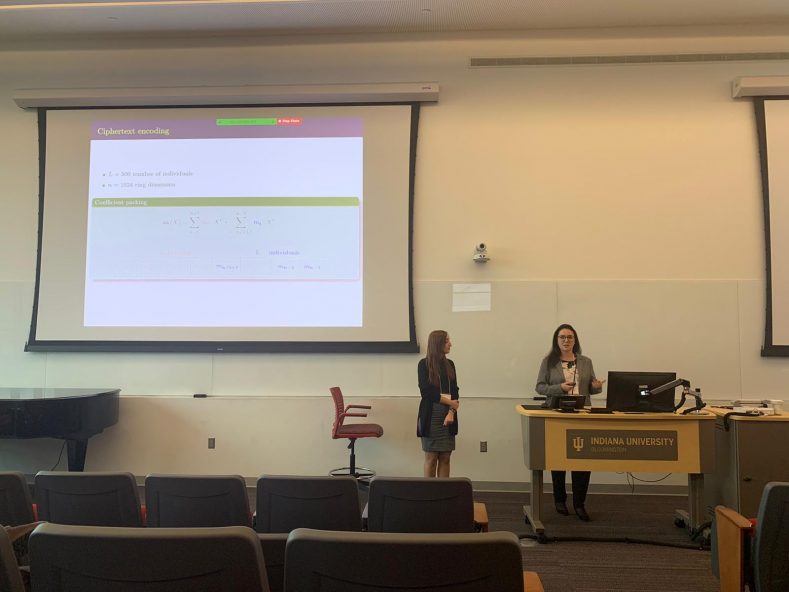
iDASH (Privacy & Security workshop) is a competition that revolves around the secure analysis of genomic data, organized by the Department of Biomedical Informatics at UCSD, the School of Biomedical Informatics at UTHealth and the School of Informatics and Computing at Indiana University. The competition have taken place every year since 2014 with the goal […]

The Three Musketeers of Secure Computation: MPC, FHE and FE

From the beginning, cryptography took care of the protection of data. At first the data to be protected consisted of messages in transit, that had to be hidden from adversaries trying to intercept a communication. Lately, with the advent of modern computers and portable memory devices, cryptography also had to protect the data in storage. […]