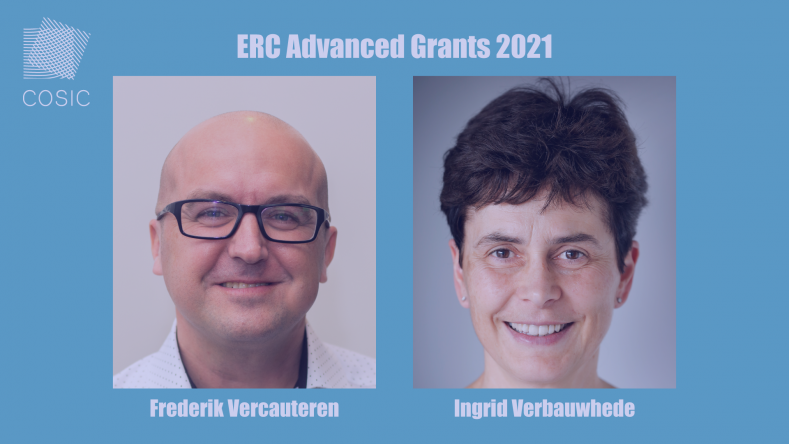
We are proud to announce that two COSIC professors were awarded the prestigious ERC Advanced Grant.
“The European Research Council has today announced the winners of its 2020 Advanced Grants competition. The funding, worth in total €507 million, will go to 209 leading researchers across Europe. Their work is set to provide new insights into many subjects, such as the links between obesity and pancreatic cancer, threats from wildlife viruses, brain-inspired neural network computer chips, and new ways for architects to design the buildings of the future.” (ERC)
Frederik Vercauteren’s ERC Advanced Grant ISOCRYPT focuses on Isogeny-based Toolbox for Post-quantum Cryptography:
“Cryptography, or the science to secure communications, has many everyday applications, from online banking to Internet browsing. But the mathematical problems that underlie these algorithms and consequently the cryptography built on top of them become easy for a new type of computer called a quantum computer. Quantum computers are currently not powerful enough to pose an immediate threat to classical cryptography, but they will have devastating impact on security in the medium to long term. We want to design new cryptosystems that are secure enough to withstand attacks by a quantum computer. We will do this by looking for other mathematical problems that remain hard even for quantum computers. We will focus on one, still fairly immature type of post-quantum cryptography.” (KU Leuven news)
Ingrid Verbauwhede’s ERC Advanced Grant is called BELFORT and centers around Hardware Acceleration for Computing on Encrypted Data:
“Huge amounts of data are currently generated by electronics used in medical devices, financial transactions, self-driving cars, our online behaviour and so on. This data sits, encrypted, in cloud servers. Performing calculations on such ciphered data to discover interesting trends or patterns calls for very time and computation-intensive mathematics. I will build specialised electronics – in others words, new computer architectures – to accelerate operations on encrypted data. They will make it possible to perform calculations on very privacy-sensitive data shared by companies or individuals, while being able to guarantee those companies and individuals that the data they share will remain encrypted at all times.” (KU Leuven news)
ERC press release
KU Leuven press release