Stock market trend analysis, consumer behavior prediction and research on genomic datasets are some examples of operations involving large private datasets that are frequently updated. The privacy of this sensitive data can be preserved by using private set intersection (PSI), a protocol that allows mistrustful parties to compute the intersection of their private sets without revealing anything other than the intersection itself. The growth of cloud computing calls for a delegated version of PSI, where parties can store their private sets in a cloud server that can obliviously compute their intersection. While there are delegated PSI protocols which allow for repeated computation on the outsourced data without requiring the clients to re-encode it, they are designed for static data sets and become computationally expensive when considering more than two clients, limiting their applicability in the aforementioned areas.
Feather
This blog post covers the paper Multi-party Updatable Delegated Private Set Intersection, published by Aydin Abadi, Changyu Dong, Steven J. Murdoch and Sotirios Terzis at Financial Cryptography and Data Security 2022. The authors present Feather, a delegated PSI scheme that is efficient in the multiple client setting, allows for repeated computations on the outsourced data and also supports efficient updates on the outsourced sets. Some of the techniques used to surpass the limitations of previous protocols included having the clients perform some of the computations previously performed by the server, replacing the item padding used for error detection by Bloom filters and using Horner’s method for efficient polynomial evaluation.
A brief description of Feather’s subprotocols is given below.
Setup
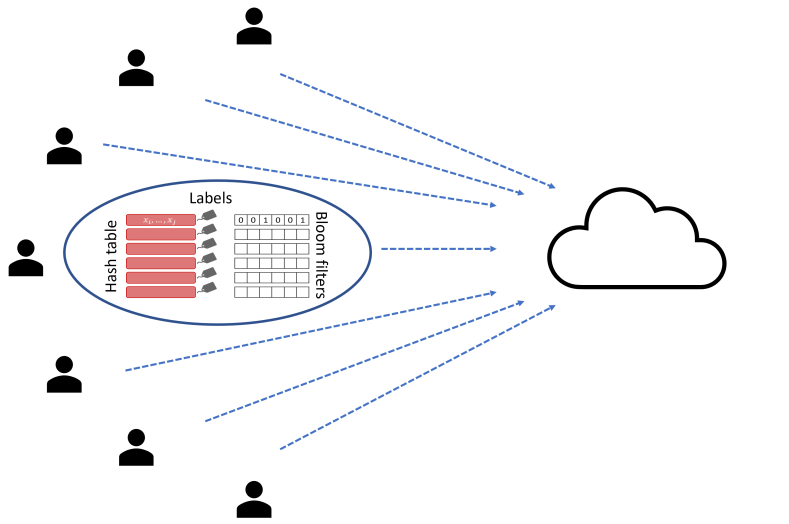
The cloud: publishes a set of public parameters (such as an upper bound on the number of items per client, the length of the hash table used to store the items and the size of each bin in the table).
The clients: insert their items into a hash table and then encode the table as a set of polynomials, each of them representing one of the table’s bins. These polynomials will have as roots the items in the corresponding bin, as well as a set of dummy roots. To later distinguish between the actual items and the dummy roots, a Bloom filter is created where only the set elements are inserted. The polynomials’ coordinates and the Bloom filters are blinded with pseudorandom values and a pseudorandom label is assigned to each bin. Finally, the labeled hash table and the Bloom filters are shuffled and sent to the cloud.
Update
To insert or delete an item, the client only needs to retrieve the bin to which the item belongs and not the whole set. The client determines the correct bin and sends the corresponding label to the cloud, and the cloud replies with the bin and the associated Bloom filter. The client can then locally update the bin and the Bloom filter and return them to the cloud with fresh blinding values.
PSI computation
The clients ask the cloud to compute the intersection of their sets and send the result to a certain client.
The cloud uses the bins from all the clients to calculate polynomials whose roots include the intersection of the sets (as well as some dummy roots that the result recipient client discards after checking the Bloom filter). The authors refer two main challenges faced during the design of this protocol:
- Challenge 1: Hash tables from different clients are permuted under different keys, and polynomials from different clients are encrypted under different keys. How can the cloud correctly combine the data for computing the intersection?
This problem is addressed by using a permutation mapping which tells the server how to combine bins from different clients without leaking their original order. Additionally, at the beginning of the computation, the clients provide information to the server that allows it to oblivious switch the blinding values of each client to ones that can be removed by the recipient client. - Challenge 2: During an update, a bin’s content is blinded with fresh random values. How can the client regenerate the most recent masks with a single key?
To solve this, the authors use resettable counters. The clients keep track of how many times they updated a certain bin, and the counter is used when generating the new blinding values after an update. Thus, a client can use the counter’s current value to regenerate the most recent mask for that bin.
The presented cost analysis of Feather shows that updates on a set of a million items are over 1000 times faster than with the previous fastest delegated PSI, while PSI computations are over 2 times faster. Additionally, Feather takes 4.7 seconds to run PSI with 1000 clients, where each client has \(2^{11}\) elements.
Feather’s source code is available here.


