Private information retrieval (PIR) solves the problem where a client wants to fetch a record from a database server, without revealing which record she received.
The naive solution would be to let her download the entire database, but that might not always be feasible with increasing database size. Hence, the need for an efficient protocol arises.
Applications of this protocol include privacy preserving advertising, private media consumption, etc.
The requirements for a PIR protocol are simple: correctness (the client will receive the records it queried) and malicious security (even if the server does not follow the protocol, it will gain no information about the clients queries).
The paper discussed in this blogpost describes a new PIR protocol that relies on a single server, can accomodate adaptive queries, and runs in sublinear time for both the server and the client. This is a major step forward in the development of practical PIR protocols, as prior work only supported one adaptive query.
The main trick they use to achieve a sublinear performance is an offline phase that can be amortized over the next Q queries it facilitates. They will generate hints, that can be used later on, in the online phase.
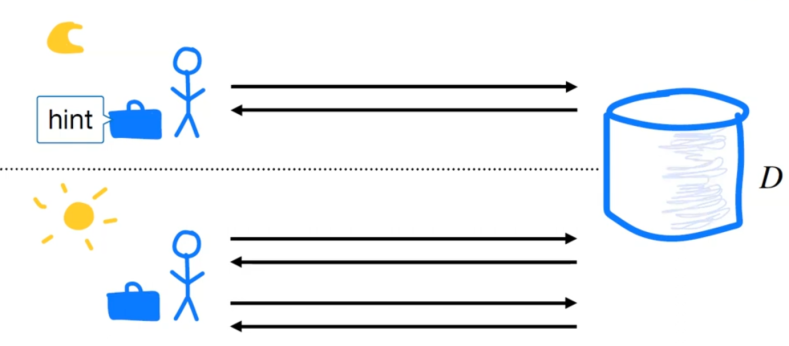
‘Offline’ here does not mean that the client and server don’t communicate, it rather means that this phase is independent of the queries the client will do later on.
In this offline phase, the server permutes the database and divides it into Q chunks. With overwhelming probability, the client will later query at most λ records from each chunk.
Then, the client receives λ hints about every chunk (that makes Q*λ hints in total).
During the online phase, the client performs a query in the following way. She selects one of the λ hints for the chunk her query is in. The server will respond with Q records, with respect to each of the Q chunks. This conceals the clients query.
Upon receiving the reply, the client stashes it (as it could contain a future query), and discards the used hint. She can then perform the next query, using a fresh hint.
While this research is a very nice step towards practical PIR, the protocol is not quite efficient enough for use in practice yet. We look forward to more progress on this very interesting topic.
The full paper can be found at https://eprint.iacr.org/2022/081


