This year I presented our work Provable Secure Reflection Ciphers at CRYPTO 2022 (jointly with Tim Beyne). Since we looked at reflection ciphers from a provable security point of view, I will try to keep the required background knowledge about provable security limited.
Cryptographers have long been fascinated by self-inverse, or almost self-inverse, encryption schemes. For example, the Enigma rotor machine has the surprising property that its encryption and decryption operations are identical. This feature, enabled by the middle reflector or Umkehrwalze, made the encryption device considerably more compact.
Feistel Ciphers
Although the reflector ultimately contributed to the demise of Enigma, the use of self-inverse structures was not abandoned and persists in modern cryptography. An example is Feistel ciphers, one of the oldest structures used to design block ciphers. In the early 1970s, IBM developed the Data Encryption Standard (DES) based on the Feistel structure with the help of the National Security Agency (NSA). Intensive research into the Feistel network followed soon after the NIST approved this encryption standard. For ciphers based on the Feistel network, both encryption and decryption consist of iteratively executing the underlying round function on the right part of the input bit string, xoring the output to the left part, and swapping the left part with the right part.

Feistel networks have the following property: decryption is the same as encryption using reverted keys. An important advantage of this property is that one can always perform the decryption operation, even if the underlying round functions themself are not invertible. As a result, there is more flexibility in the choice of the round functions and less constraints in hardware for encryption and decryption, as the round functions do not have to be invertible.
Key-Alternating Ciphers
In addition to the Feistel network, there is another important design structure which many block ciphers, including the famous Advanced Encryption Standard (AES), are based on. The advanced version of the design structure used in the AES block cipher is shown below, and is called the key-alternating cipher (KAC).
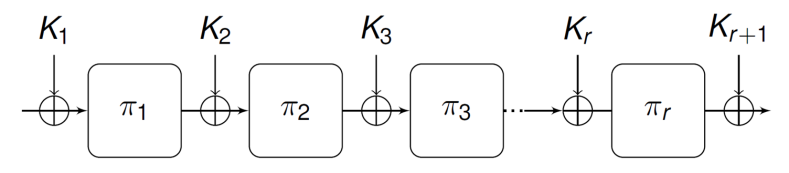
Ciphers based on the KAC structure usually require less rounds than Feistel ciphers. On the other hand, KACs require the underlying primitives to be invertible in order to perform decryption, while Feistel ciphers do not have such restriction on the inner round functions.
Both Feistel ciphers and key-alternating ciphers have their own specific advantages. Block ciphers based on the KAC design structure require fewer rounds to achieve sufficient security. However, KACs do not have the self-inverse property that can be found in Feistel-like ciphers. We wonder whether we can maintain the KAC design structure while minimizing the overhead of supporting both efficient encryption and decryption.
Reflection Ciphers
The solution to this problem is given by Borghoff et al. at ASIACRYPT 2012, where they introduced the block cipher PRINCE, which has the following reflection property: decryption is the same as encryption using a related key. This feature is achieved by using the following, which we will call the key-alternating reflection cipher (KARC).

Although the use of both permutations and inverse risks increasing area requirements, this is not a concern for the low-latency use-case that PRINCE aims for. Indeed, PRINCE targets fully unrolled hardware implementations that encrypt a plaintext in a single cycle.
Generic Security of Block Ciphers
Although reflection ciphers have already received a lot of dedicated analysis in the past year, unlike the case of Feistel ciphers and key-alternating ciphers, no results are known about the generic security. In this work, we initiate the study of the generic security of key-alternating reflection ciphers. Before we do that, we first want to explain how the generic security is measured for block ciphers. To formulate the definition of security precisely, we need to describe an attack game. At the beginning of the game, one of the two worlds is chosen, the real world or the ideal world. In each of the two worlds, there is a construction oracle. The attacker \(\mathcal{A}\) gets \(q\) queries to send to the construction oracle. In the real world, this oracle is our proposed block cipher, while in the ideal world it is a random permutation. In addition, the attacker also gets \(p\) queries to send to each of the underlying primitives which the proposed block cipher is based on, these primitives are modeled as random. We expect that the attacker never asks the same query, because that makes no sense since both worlds will return the same results as before. After communicating with the oracle, the attacker should state which world it was given, the security of the proposed block cipher is measured by the probability that the attacker can distinguish the two worlds, hence the attacker is also called a distinguisher. We clearly see that the advantage of the attacker increases when it gains more query access to the construction/primitive oracles, hence the attacker’s probability is a function that depends on the number of construction queries \(q\) and the number of primitive queries \(p\). If this probability function is negligible for given \(q\) and \(p\), then we deduce the given scheme is a secure block cipher. Here the security of the block ciphers is measured, like many cases in provable security, in the idealized model. The assumption that the primitive is ideal will never be satisfied in practice. For this reason, it is good practice to complement the provable security analysis (which rules out generic attacks) with dedicated cryptanalysis when all components are instantiated.
First Contribution: Key-Alternating Reflection Ciphers
In our first contribution, we analyze the security of the two-round variant of the general key-alternating reflection cipher construction. Specifically, our results focus on the case with a linear reflector \(\mathcal{R}\) and two alternating round keys \(K_1\) and \(K_2\).
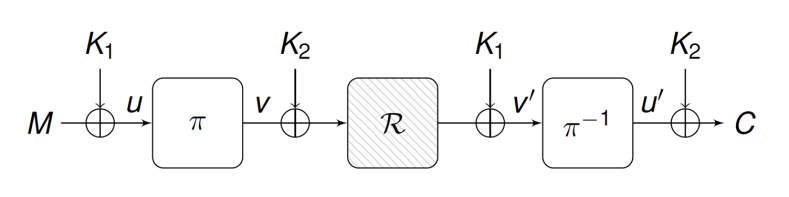
Decryption is then the same as encryption up to swapping of the keys \(K_1\) and \(K_2\). We show that any adaptive distinguisher making p primitive queries and q construction queries to this construction achieves an advantage of at most \(O(p^2q/2^{2n} + q^2/2^n)\). We also show that our security bound is tight for general choices of the reflector \(\mathcal{R}\), by providing two matching generic attacks showing that neither of the two terms in the security boundary can be avoided in general. Although this may suggest that the reflector \(\mathcal{R}\) is not that important from a generic viewpoint, it is important from the viewpoint of dedicated cryptanalysis (when all permutations are instantiated).
Second Contribution: Key-Length Extender
PRINCE and MANTIS use a variant of the \(FX\) construction to extend the key-length of its 64-bit core reflection cipher from 64 to 128 bits using an external 64-bit key \(K\). This construction is shown below.

The designers of PRINCE proved that the resulting construction is secure up to the tradeoff curve \(pq = 2^{128}\) with \(p\) the number of queries to \(E^∗\) and \(q\) the number of construction queries. Recently, PRINCE v2 was proposed with the explicit goal of obtaining improved security with minimal changes to the original design. The approach taken by PRINCE v2 is to use alternating round keys and slightly modification of the reflector \(\mathcal{R}\).
Our second contribution is a general method to extend the key-length of reflections ciphers, but achieving much better security then the above mentioned \(FX\) method. Specifically, our proposal is to add the keys \(K\) and \(\sigma(K)\) again before and after the reflector \(\mathcal{R}\) respectively.

We show that any distinguisher making adaptively chosen plaintext and ciphertext queries to this construction achieves an advantage of at most \(O(p\sqrt{q}/2^{n+k})\), with \(n\) the block size and \(k\) the key-length of the underlying cipher. When applied to PRINCE or MANTIS, we obtain a reflection cipher with an optimal tradeoff of \(p^2q = 2^{256}\). This should be compared to the tradeoff curve \(pq = 2^{128}\) for the \(FX\) construction. Hence, our construction can tolerate far more construction queries before becoming insecure. Compared to the dedicated construction PRINCE v2, it has the advantage of introducing a more minimalist change.


