The purpose of this blog post is to offer a comprehensive summary of the research paper presented at the Deep Learning Security and Privacy (DLSP) 2023 workshop. The paper “On the Brittleness of Robust Features: An Exploratory Analysis of Model Robustness and Illusionary Robust Features” was honored with the prestigious best paper award in DLSP 2023. The workshop was held in conjunction with the 44th IEEE Symposium on Security and Privacy.
The presentation explored the concept of robust features and their intriguing fragility, uncovering the presence of illusionary robust features that exhibit a high correlation with incorrect labels. These findings extended the explanations of previous papers on the existence of robust and non-robust features. This study reveals that models relying on such features are vulnerable when exposed to perturbed datasets resulting from attacks on robust models.
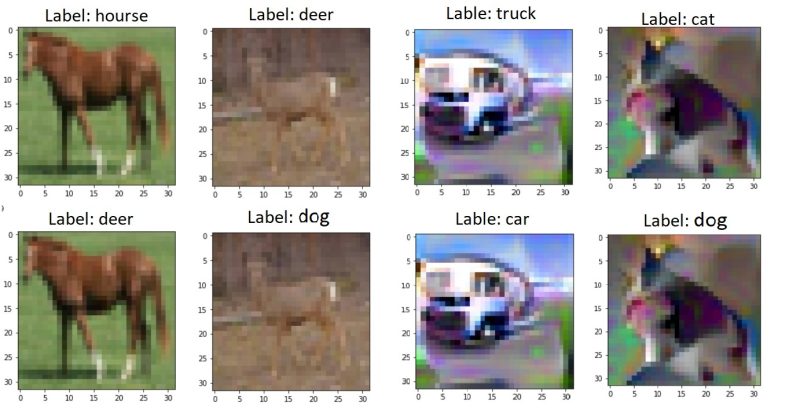
Accordingly, the main contribution of this presentation can be summarized as follows:
- Models trained on robust features only are vulnerable to small perturbations in their inputs when we perturbed them by attacking the robust model.
- Image perturbation by attacking robust models changes the less robust features. The remaining unchanged, more robust features are highly correlated with incorrect labels; this makes robust classifiers vulnerable to changing the less robust features when they are presented with small perturbations in their input attacking robust model.
- The non-robust features entangled with less robust features can help increase the robustness of the DNNs when an attacker tries to change only robust features. That is why the standard model classifies more accurately than the robust model when presented with the perturbations mentioned above.
Our hypothesis also has been illustrated with images of a car and a truck; this conceptual diagram showes how a more robust feature could cause an illusion. For example, consider the wheel shape a more robust feature for the ‘car’ class. This feature is highly correlated with the correct label; however, this feature is a more robust feature for an incorrect class such as the ‘truck’ class. This high correlation between the more robust feature and the incorrect label can mislead the robust classifier, which uses only more and less robust features against a robust attack that changes less robust features.

[DLSP](6th Deep Learning Security and Privacy Workshop (DLSP 2023) (ieee-security.org))


