This blog post is based on the paper “Quantum-access Security of Hash-based Signature Schemes” [1] presented by Quan Yuan at ACISP 2023, in Brisbane, Australia.

Following the groundbreaking analysis by Shor [2] regarding the vulnerabilities of Factoring and Discrete Logarithm (DL) problems to quantum attacks, a significant surge in research has ensued. This renewed attention has directed researchers’ efforts toward the investigation of post-quantum cryptographic techniques that can develop primitives and protocols capable of withstanding the formidable threat posed by quantum adversaries. One of the attractive ones is hash-based signature (HBS) schemes, due to having weak underlying assumptions. An HBS scheme uses a one-time signature scheme (OTS), where each key pair is only used for signing a single message. If an OTS key pair signs multiple messages, it becomes vulnerable to signature forgery. HBS schemes employ hash functions as their core component, offering efficiency, versatility, and suitability for diverse applications.
There are two practical stateless HBS schemes: SPHINCS [3] and SPHINCS+ [4]. SPHINCS is based on HORST, a stateless HBS scheme with a limited number of signing operations. On the other hand, SPHINCS+ is an enhanced variant built on improved components like few-time signatures and tweakable hash functions. SPHINCS+ outperforms SPHINCS in signature size, efficiency, security proof, and maximum signing executions. Note that, recently SPHINCS+ is selected as one of the NIST post-quantum cryptography standardization.
Digital signatures must meet the crucial security requirement of being resistant to Existential Unforgeability under a Chosen-Message Attack (EUF-CMA). We visually depict the corresponding game in Figure 1. In this game, given the public key pk, to the adversary A, it can send multiple signing queries for different messages to the signing algorithm and receive the corresponding signatures back.

In the realm of post-quantum secure digital signatures, they encounter two distinct concepts of security, which we elucidate through visual depictions presented in Fig. 2 and Fig. 3, below.
- Q1 Security or Post-Quantum Security: the first concept involves the adversary utilizing the capabilities of quantum computers to execute offline algorithms or evaluate specific functions. The adversary then proceeds to submit classical queries to the online oracles.

- Q2 Security or Quantum-Access Security: the second concept encompasses the adversary’s access to quantum computers as well as the utilization of superposition in their queries to the oracles.
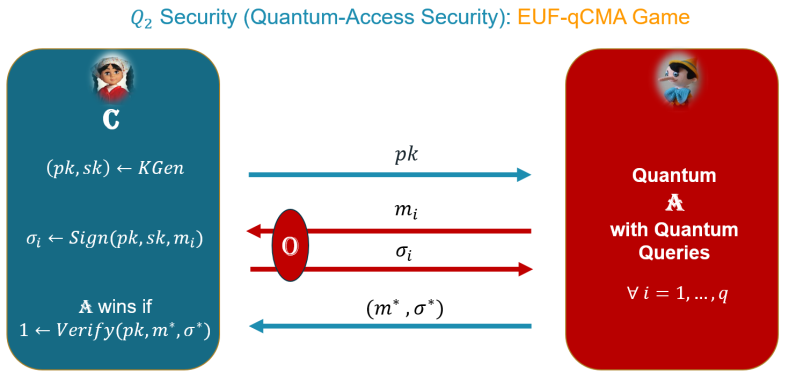
In 2013, Boneh and Zhandry [3] introduced a security concept known as “Existential Unforgeability under Quantum Chosen Message Attacks” (EUF-qCMA) which can be counted in the second concept of security, mentioned above. According to this notion, the adversary is tasked with producing (q +1) forgeries for different messages subsequent to q quantum signing queries. In Figure 4, we present a visual depiction of the EUF-qCMA game.

While most existing HBS schemes have been proven secure against post-quantum chosen message attacks, there is a need to explore their security in the context of quantum-access attacks. This paper presents three key results:
- The authors demonstrate the vulnerability of two HBS schemes, SPHINCS and SPHINCS+, to quantum-chosen message attacks (qCMAs). They establish that the complexity of these attacks is significantly lower than the classical security level. This finding highlights the greater threat posed by qCMAs compared to classical CMAs for these two schemes.
- The authors propose SPHINCS-FORS, a simplified version of SPHINCS+, which offers provable quantum-access security. They provide a formal security proof and concrete security measures in terms of EUF-CMA and EUF-qCMA. This scheme is claimed to be the first practical stateless HBS scheme with provable security against qCMAs.
Technical highlight about the contributions:
The attack on both SPHINCS and SPHINCS+ revolves around a fundamental concept. SPHINCS(+) introduces a stateful signature called HT and incorporates multiple instances of few-time signature key pairs (HORST in SPHINCS and FORS in SPHINCS+), with the number of instances being 2^q. HT is responsible for signing the public keys associated with the few-time signatures, while the few-time signatures themselves are used for signing the actual messages. During each signing operation, an index idx ∈ {0,1} is randomly chosen (or pseudo-randomly in some cases), and the corresponding few-time signature key pair is labelled idx is employed to sign the message. The objective of the attack is to gather a sufficient number of few-time signatures linked to a specific index, which can be accomplished by employing Grover’s algorithm and performing quantum signing queries. Once a satisfactory number of messages is obtained, the adversary can extract the secret key for HORST in SPHINCS and FORS in SPHINCS+, enabling them to forge signatures for any message.
The paper presents a provably secure Stateless Hash-Based Signature (HBS) Scheme that offers protection against Quantum Chosen Message Attacks (qCMAs). The focus of the paper is on analyzing the security of few-time signature schemes like HORS and FORS, which are related to subset resilient hash functions (SRH). To address the challenge of quantum-access security reduction to subset resilience, the authors propose a new notion called weak subset resilience (wSR). By applying the quantum query lemma, they establish the generic security of a randomized version of FORS (d) against r-time qCMAs, which can be upper-bounded. Moving on to many-time schemes, they mitigate insecurity by introducing additional randomness into index selection. By incorporating the message-independent random index known as rFORS and utilizing a stateful Hypertree-based Stateful HBS denoted by HT in SPHINCS+, the authors have introduced a novel variant named SPHINCS-FORS. This new variant, SPHINCS-FORS, offers protection against certain qCMAs, but necessitates a re-analysis of its EUF-CMA security. they apply the adaptive reprogramming lemma to evaluate the EUF-CMA security of rFORS, tightly reducing it to extended Target Subset Resilience (eTSR). Thus, SPHINCS-FORS represents an advancement in quantum-resistant HBS schemes.
In order to know more details, I refer the reader to read through the paper [1].
References:
[1] Quan Yuan, Mehdi Tibouchi and Masayuki Abe, Quantum-access Security of Hash-based Signature Schemes. Information Security and Privacy – 28th Australasian Conference, {ACISP}, 2023, Brisbane, QLD, Australia, July 5-7, 2023, Pages 343–380, Springer (2023). https://doi.org/10.1007/978-3-031-35486-1_16
[2] Peter W. Shor, Algorithms for Quantum Computation: Discrete Logarithms and Factoring. 35th Annual Symposium on Foundations of Computer Science, Santa Fe, New Mexico, USA, 20-22 November 1994, Pages 124–134, Springer (1994). https://doi.org/10.1109/SFCS.1994.365700
[3] D. J. Bernstein, D. Hopwood, A. Hülsing, T. Lange, R. Niederhagen, L. Papachristodoulou, M. S. Schwabe, and Z. Wilcox-O’Hearn. SPHINCS, Practical stateless hash-based signatures. In Advances in Cryptology – EUROCRYPT 2015, pages 368–397. Springer (2015). https://doi.org/10.1007/978-3-662-46800-5\_15
[4] J.-P. Aumasson, D. J. Bernstein, W. Beullens, C. Dobraunig, M. Eichlseder, S. Fluhrer, S.-L. Gazdag, A. Hülsing, P. Kampanakis, S. Kölbl, T. Lange, M. M. Lauridsen, F. Mendel, R. Niederhagen, C. Rechberger, J. Rijneveld, P. Schwabe, and B. Westerbaan. SPHINCS+. Proceedings of the 2019 {ACM} {SIGSAC} Conference on Computer and Communications Security, {CCS} 2019, London, UK, November 11-15, 2019, Pages 2129–2146, – submission to the nist post-quantum project v.3. 2020. https://doi.org/10.1145/3319535.3363229
[5] D. Boneh and M. Zhandry. Secure signatures and chosen ciphertext security in a quantum computing world. In Advances in Cryptology – CRYPTO 2013, volume 8043 of LNCS, pages 361–379. Springer (2013). https://doi.org/10.1007/978-3-642-40084-1\_21


