The weekend before Eurocrypt 2024, several affiliated events took place at ETH Zurich, among which the CrossFyre workshop. This blog post summarizes the paper “MPC With Delayed Parties Over Star-Like Networks”, which is joint work with Emad Heydari Beni, Emmanuela Orsini, Nigel Smart and Oliver Zajonc. This work was published in Asiacrypt 2023 and presented at CrossFyre as a poster.
This work looks into some of the major network constraints that can be found in deployed systems and proposes a new MPC scheme that takes them into account. Namely, our protocol addresses the two following assumptions, present in most existing MPC protocols:
- There is a direct and fast communication channel between each pair of parties.
- Parties stay online during the whole computation.
The first assumption means that the total number of established p2p channels grows quadratically with the number of parties, limiting the ability to instantiate large-scale protocols in practice. Additionally, corporate networks usually have restrictions for establishing new connections, thus restricting the practicality of MPC for commercial applications. The second assumption implies that the computation aborts and all the work already done is lost whenever a party goes offline. However, stable connections are not always easy to guarantee in practice.
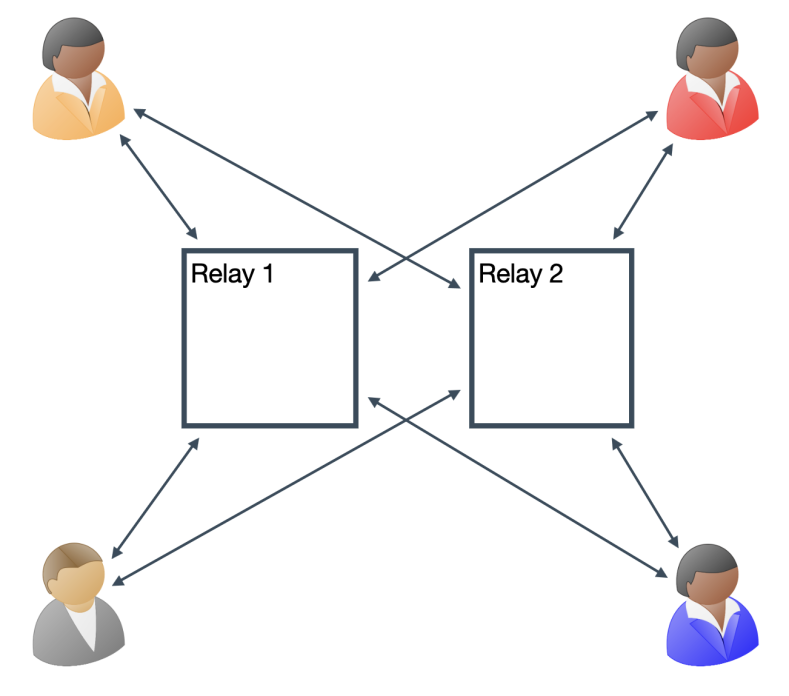
To achieve an MPC protocol that doesn’t rely on these assumptions, we consider a star-like network topology, where parties communicate through a small number of relay nodes:
The relays
The relays do not forward messages and work only as storage nodes. A party that is waiting for messages must query the relays for them and can tell the relay to delete them once they are no longer needed. The relays support two types of messages:
- p2p messages: To send a p2p message to party \(P_j\), party \(P_i\) encrypts it using a previously exchanged pairwise key \(k_{i,j}\). Then, party \(P_i\) sends the ciphertext to all the relays.
- broadcast messages: To send a broadcast message, party \(P_i\) sends it in plaintext form to all the relays.
Note that the procedure for sending messages is almost identical for both p2p and broadcast messages, except that in the broadcast case encryption is not needed, as everyone is supposed to receive it. Consequently, in a relay-based network, broadcast messages are cheaper than p2p messages, unlike what happens in traditional networks. This characteristic turns out to be quite useful when choosing a multiplication protocol with the security properties we are looking for, as we will see later.
The adversary
Regarding the number of relays in the network, fewer relays will of course imply less communication overall. However, we do assume that the adversary can also corrupt relays and thus we need at least 2 of them. Whenever parties query the relays for a given message, they should receive the same message from every relay. If not all responses are the same, then some relays must be behaving maliciously and the protocol aborts. As long as one relay remains honest, dishonest behaviour will always be detected.
Besides corrupting relays, the adversary can also corrupt MPC parties and introduce delays in the parties’ messages of up to \(\delta\) rounds. These delays model the fact that, in practice, some parties will execute the protocol slower than others, and might even need to go offline for some period of time. Note that the upper bound \(\delta\) on the number of delay rounds does not impact security, but it will affect the size of the state stored in the relays as well as the total number of rounds in the protocol.
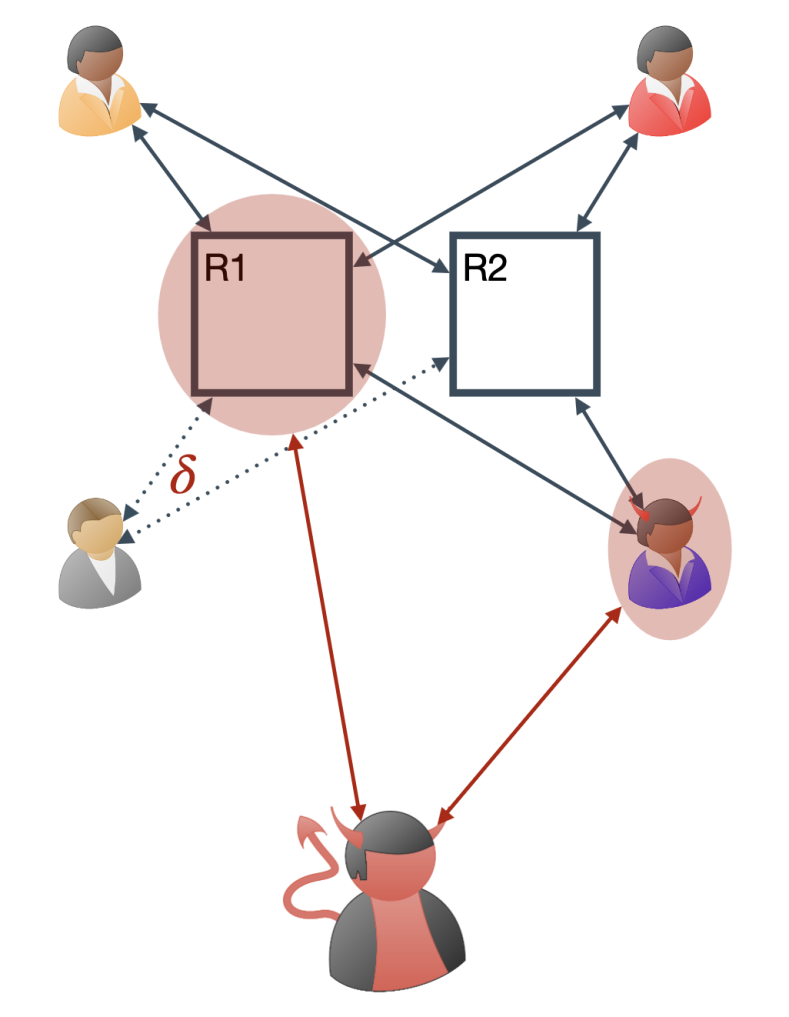
Our MPC protocol is based on Shamir Secret Sharing, an thus the adversary should only be able to corrupt up to \(t\) of the \(n\) parties with \(t\leq (n-1)/2\). In particular, we are interested in the strong honest majority setting, where \(t < (n-1)/2\). Since the parties only need \(2t+1\) shares to continue to the next computation round, faster parties can progress in the computation without waiting for delayed parties. This allows the computation to remain efficient even in the presence of delays.
The protocol
To obtain a protocol that is actively secure, we use the circuit compiler approach described in the work of [GIP+14]. If the original (passively secure) protocol is secure up to additive errors, then the compiler creates a robust circuit where these additive errors are detected. We adapt the definition of robust circuit to our setting and describe a compiler that generates such a circuit at the cost of a fourfold increase in the multiplicative width, as well as four additional rounds of multiplicative depth.
Yet, obtaining a protocol that is passively secure up to additive errors is not trivial in the strong honest majority setting. Maurer’s multiplication protocol allows parties to insert different additive errors in the shares belonging to different parties during the resharing step, leading different sets of parties to reconstruct different values without detecting adversarial behaviour. On the other hand, the Damgård-Nielsen (DN) protocol where one party plays the role of “king” is vulnerable to the so-called double-dipping attack in the strong honest majority setting. To circumvent this, we use a variant of the DN protocol where, essentially, all parties play the role of the king by using broadcast messages (recall that broadcast messages are actually cheaper than p2p messages in our network).
Experiments
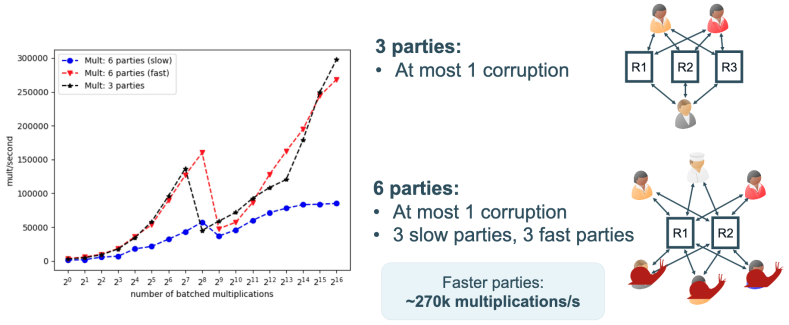
Finally, we perform experiments to evaluate our relay-based network, as well as the MPC protocol built on top of it. Here, for succinctness, we only present the latter set of experiments. To analyse the performance of our protocol, we examine the number of multiplications that can be computed per second. We benchmark both a 3 party as well as a 6 party instantiation of the protocol, both supporting at most one corruption. In the 3 party case, all parties are running on what we call the “fast machines” (Intel i9-9900 CPU and 128GB RAM), while in the 6 party case, 3 of the parties are instead running on “slow machines” (Intel i7-770 CPU and 32GB RAM). This allows us to simulate the effect of having delayed parties, and indeed we can see from the graph below that the faster parties in the 6 party computation can perform essentially the same amount of multiplications / second as the parties of the 3 party computation. This shows that adding more parties does not necessarily slow down the overall computation, even if some of the parties are running slower (though, of course, this also depends on the number of allowed corruptions). We note that these results are not based on a fully optimized implementation; we expect a throughput of around one million multiplications / second could be easily achieved with further optimizations.