During 5-9 August 2024, Eötvös Loránd University hosted in Budapest the conference “Mathematics for post-quantum cryptanalysis”, organized by KU Leuven and ELTE. The conference was structured around the four main mathematical themes in post-quantum cryptography: lattices, error-correcting codes, systems of non-linear equations and isogenies.
This blog post is based on Benjamin Wesolowski’s introductory talk “Foundations of isogeny-based cryptography”, about hardness assumptions behind isogeny-based cryptography and the relationships between them.
Hard problems in isogenies
The first part of the talk introduced most of the main hard problems underlying isogeny-based cryptography.
Given two elliptic curves \(E_1\), \(E_2\), finding an isogeny \(\phi: E_1 \to E_2\) — if there exists one — is a problem that is believed to be hard. An isogeny of degree \(N\) can always be decomposed into isogenies of degrees that multiplied together give \(N\), so we can focus on isogenies of prime-power degree \(\ell^n\). If \(\ell\) is not too big, isogenies of degree \(\ell\) are easy to compute, and we can then build graphs whose vertices are elliptic curves and edges represent \(\ell\)-isogenies between them. If we restrict ourselves to supersingular elliptic curves, the graph we obtain is \(\ell+1\) regular and connected. For every isogeny \(\phi\) from \(E_1\) to \(E_2\) there is an isogeny \(\hat \phi\), called the dual, going from \(E_2\) to \(E_1\), hence we can think of the graph as undirected.
Given supersingular elliptic curves \(E_1\) and \(E_2\), finding an \(\ell^n\)-isogeny between them means finding a path of length \(n\) from \(E_1\) to \(E_2\) in the supersingular \(\ell\)-isogeny graph. The best known ways to solve this task are generic path-finding algorithms, hence why the \(\ell\)-IsogenyPath problem is believed to be hard. The Charles-Goren-Lauter (CGL) hash function is an example of a cryptographic primitive whose properties relies on such problem.
The CGL function — let’s call it \(H\) — encodes an \(n\)-bits message into a path of length \(n\) in the supersingular \(2\)-isogeny graph, starting from a distinguished vertex \(E_0\). It then returns the end vertex of the path, namely an elliptic curve \(E\). The hardness of the \(\ell\)-isogeny path problem ensures that this function is preimage-resistant: given \(H(m) = E\), it is hard to find a message \(m\) translating into a \(2\)-isogeny path of length \(n\) from \(E_0\) to \(E\).


The property of collision-resitance of the CGL function is reduced to a variant of the \(\ell\)-isogeny path problem: finding one non-scalar endomorphism of a given supersingular elliptic curve \(E\), namely an isogeny \(\phi: E \to E\) that differs from a scalar multiplication. Indeed, imagine we can find two distinct messages \(m_1\), \(m_2\) such that \(H(m_1) = H(m_2) = E\). This means that we can find two distinct paths from \(E_0\) to \(E\) in the supersingular \(2\)-isogeny graph. By backtracking one of these two paths — i.e. taking the duals of the isogenies forming the path –, we can walk from \(E_0\) to \(E\) and then walk back to \(E_0\) through a different path. In other words, we found a non-trivial path from \(E_0\) to itself, corresponding to a non-scalar endomorphism. This is then a solution to the OneEnd problem on \(E_0\).

In a supersingular elliptic curve there are many non-scalar endomorphisms. To be precise, the endomorphisms form a ring \(\text{End}(E)\) — together whith the operations of point-wise addition and composition of isogenies — that is isomorphic to a \(4\)-rank lattice in a quaternion algebra. The EndRing problem consists in finding four endomorphisms that form a basis of \(\text{End}(E)\). On the other hand, one would like to understand the isomorphism between \(\text{End}(E)\) and quaternions: the MaxOrder problem consists precisely in finding such isomorphism.
OneEnd to find them all: reducing EndRing to OneEnd
After a widely accessible introduction, the second part of the talk was more research-oriented, and focused on reductions between hard problems in isogenies. The two problems that were mainly discussed were the supersingular endomorphism ring problem and the one endomorphism problem.
Recall that the supersingular endomorphism ring problem (EndRing) consists in finding all the endomorphisms of a given supersingular elliptic curve. On the other hand, the one endomorphism problem (OneEnd) only asks to find a single non-scalar endomorphism. Page and Wesolowski, in a recent paper, showed that these two problems are in fact equivalent.
The reduction
When we say that two problems are equivalent, we usually mean that if we have access to an oracle that solves one, we can use it to build an algorithm that solves the other in a time complexity that is a polynomial function of the first one. In this case, the most naive strategy to do so is very intuitive. If we can solve the OneEnd problem we have an oracle that given a (supersingular) curve returns a non-scalar endomorphism of that curve. We can then just query it again and again, and hope that it eventually gives us a basis of the whole endomorphism ring, solving our problem. Luckily, this basis does not need to be huge (in fact, two “good” endomorphisms are enough), so we may think we are good.
It turns out we are not. First of all, there is nothing that prevents our OneEnd oracle to always return the same endomorphism, making our algorithm completely hopeless. Fortunatley, the solution to this problem is quite direct, and was presented by Eisentraeger, Hallgren, Lauter, Morrison and Petit at Eurocrypt 2018. The main idea is: starting from the target curve \(E\), do a random walk to another curve \(F,\) and then query the OneEnd oracle on \(F\). If we compose the endomorphism on \(F\) that we obtain with the walk from \(E\) to \(F\) and the walk back from \(F\) to \(E\) we obtain an endomorphism on \(E\). By randomizing \(F\), we may now hope to obtain different independent endomorphisms on \(E\) that we can use to compute the endomorphism ring.
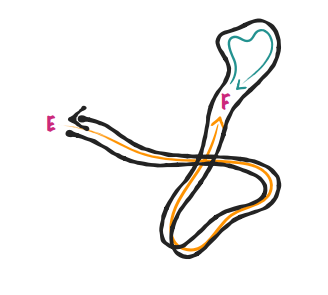
If the endomorphism ring \(\text{End}(E)\) we are after is “random enough”, this second method works in practice. However, we can still find oracles for which it does not even terminate. Here is where this new result comes in. The proof is unfortunatley very technical, but the method used by the authors is quite common and often fruitful in isogeny based cryptography. It is based on the Deuring correspondence, which translates the world of isogenies into the one of quaternions. This powerful trick allows them to tackle the problem from a different perspective and with different tools. By moving to quaternions (and eventually to modular forms), the authors finally designed an efficient algorithm that returns the endomorphism ring in polynomial time, for any given curve and OneEnd oracle.
Consequences
This result has many relevand consequences. First of all, collision resistance for the CGL hash function (focus of the first part of the talk) and soundness for SQIsign (recent isogeny-based NIST submission) are at least as hard as the OneEnd problem, and at most as hard as the EndRing problem. Since these problems are equivalent, we finally have a precise estimate of the security of these two protocols, and more.
Another consequence is an unconditional \(\tilde{O}(p^{1/2})\) algorithm for computing EndRing, whose existence was previously only known under the assumption of the Generalized Riemann hypothesis.
Final thoughts
Overall, the conference was very interesting. Gathering together mathematicians working on different areas of post-quantum cryptography can be extremely valuable, especially for young researchers. The conference format featured both introductory and more research-oriented talks. This allowed for people who are new to a certain research field to get a first impression of it; at the same time, researchers with more experience had the opportunity to discuss new ideas and research directions. Given the rapid growth of post-quantum cryptography in the recent years, and the wide variety of mathematical ideas involved, this workshop was definitely a great opportunity for the whole post-quantum community.
We thank Benjamin Wesolowski for agreeing to the use of pictures from his slides in this blog post.


