The 23rd International Conference on Cryptology And Network Security (CANS) 2024 in Cambridge, UK featured one session on Multi-Party Computation (MPC). In this blog post we will summarise the ideas behind the two MPC papers: our publication MaSTer: Maliciously Secure Truncation for Replicated Secret Sharing without Pre-Processing by Martin Zbudila, Erik Pohle, Aysajan Abidin and Bart Preneel and Efficient Secure Multi-Party Computation for Multi-Dimensional Arithmetics and Its Application in Privacy-Preserving Biometric Identification by Dongyu Wu, Bei Liang, Zijie Lu and Jintai Ding.
MaSTer: Maliciously Secure Truncation for Replicated Secret Sharing without Pre-processing
In the context of privacy-preserving machine learning (PPML) in MPC, in order to compute on decimal numbers efficiently, many frameworks employ fixed-point arithmetics. In fixed-point arithmetics, after every multiplication, the fixed-point precision is doubled, and the least significant bits need to be cut, or more formally, truncated.
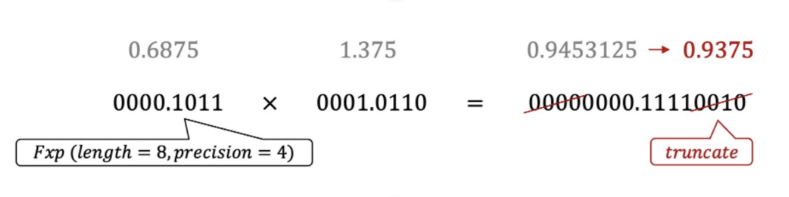
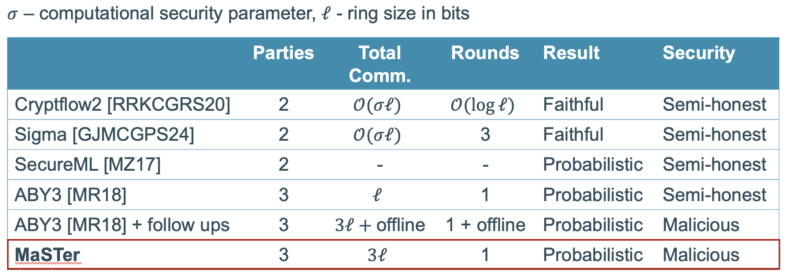
We distinguish two types of truncation protocols in the MPC literature. The more efficient protocols are probabilistic and result in the correct truncated result with a small error on LSB with certain probability. On the other hand, recently, faithful or precise truncation protocols have been proposed in the 2PC domain, however these rely on OTs (Oblivious Transfer) or function secret sharing and therefore incur large communication overhead offering security only against a semi-honest adversary.
SecureML is the state-of-the-art in 2PC probabilistic truncation secure against a semi-honest adversary. The two parties perform local operations on their additively split shares in a ring obtaining a probabilistic truncation result. In the 3PC domain, ABY3 proposes two different truncation protocols. In the semi-honest security, ABY3 extends the 2-party SecureML truncation to a 3-party setting, by having 2 parties compute the SecureML truncation followed by a re-sharing procedure to output 3-party secret-sharing of the final result. The re-sharing procedure requires a single ring element sent over one round. Furthermore, ABY3 proposes a maliciously secure truncation protocol that leverages pre-processing. In this protocol the parties pre-compute correlated randomness in the offline phase. In the online phase the parties open a masked value requiring three ring elements sent over one round and perform local operations to obtain the final result of the truncations. Many follow up works adapt the approach of ABY3, with main focus on optimising the offline phase. Nevertheless, the offline phase remains the main bottleneck of the maliciously secure truncation. MaSTer achieves malicious security at the same cost as ABY3 online phase, without requiring pre-processing.
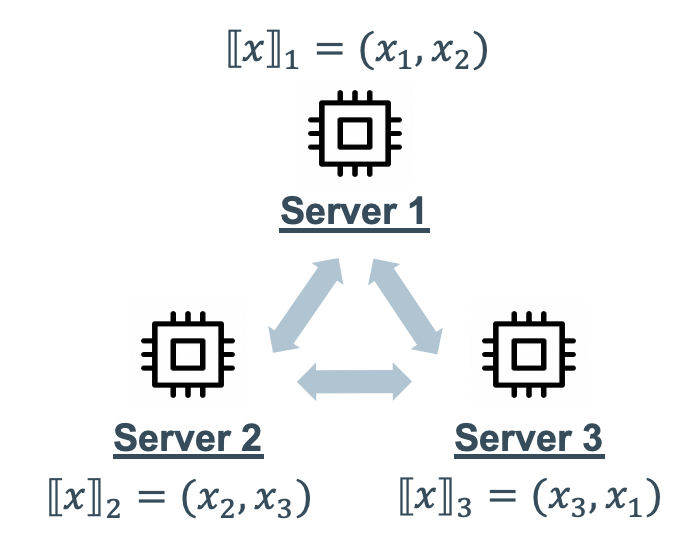
The MaSTer protocol is based in the 3-party honest majority setting, more specifically for 3PC replicated secret sharing (RSS). In RSS the secret is split into three uniformly random shares in a ring as \(x \equiv x_1 + x_2 x_3 \mod 2^\ell\) and each party is given two of them (see figure below). MaSTer makes use of two main properties of replicated secret sharing. Firstly, any two parties can reconstruct the secret, which implies any two parties can locally transform the 3-party sharing to a 2-party one. As an example consider parties 1&2 want to obtain a 2-party sharing. Party 1 sets its 2-party share as a sum of its RSS shares \(x_1+x_2\). Party 2 then defines its 2-party share as \(x_3\). Secondly, note that any value is held by exactly two parties. As a result, any value held by the adversary is also held by an honest party, which allows for simple detection of malicious behaviour in local operations.
The main building block of the MaSTer truncation is the ABY3 semi-honest truncation. The parties perform the 3-party ABY3 semi-honest truncation, which entails computing 2-party SecureML truncation with re-sharing afterwards as mentioned above. Note, that cheating in the local operations can easily be detected due to the nature of replicated secret sharing (by running a consistency check on the shares). To ensure detection of malicious behaviour, the parties then need to ensure the re-sharing procedure is executed honestly.

Note that the re-sharing entails party 1 sending an element to party 2 (see Figure below). To ensure correctness of the value sent, parties 2&3 convert their 3-party replicated secret sharing to a 2-party additive one locally and perform another truncation by running the SecureML protocol. To check the correctness of the truncated value formed by ABY3 protocol, the parties 2&3 compute the difference between the results of the two truncations. Note that if a party 2 or 3 attempts to cheat during the check, the honest parties will simply abort the protocol.
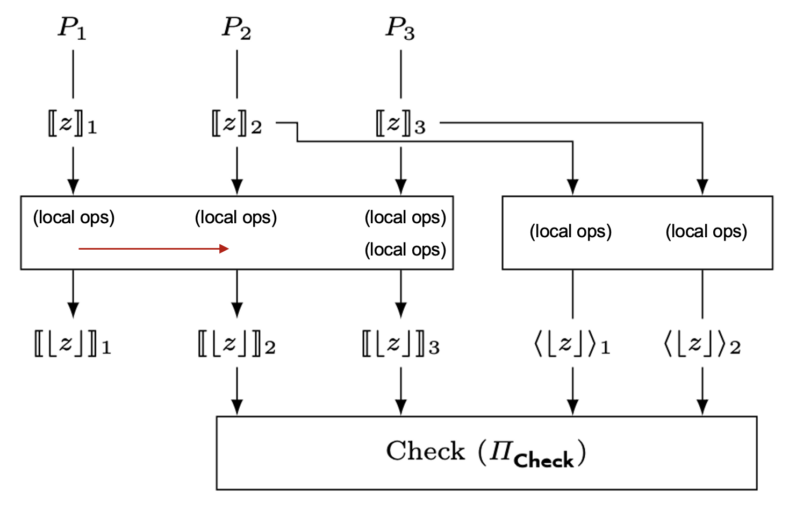
As mentioned above, to detect malicious behaviour in the form of an additive error added to value sent to party 2 during the execution of ABY3 protocol, the parties 2&3 perform a SecureML truncation and compute the difference between the two results. Due to the probabilistic nature of both of these truncations (incurring a small \(\pm 1\) error), the parties check whether the difference belongs in the set \(\{-1,0,1\}\). If they reconstruct a value outside of this range, the parties abort the execution of the protocol. This imposes a question whether a malicious adversary could introduce some error without getting detected by the check.
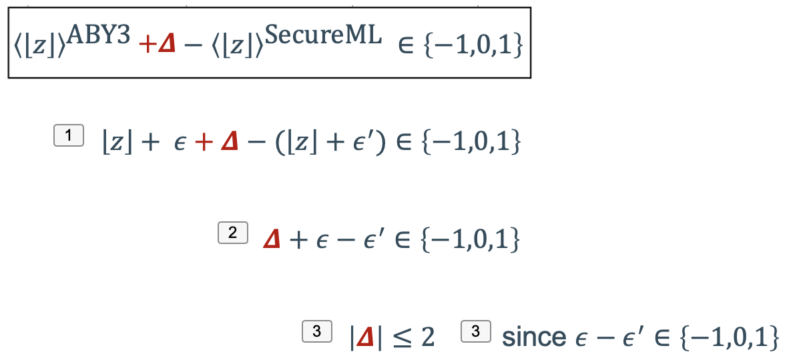
Suppose a malicious adversary attempts to cheat by adding an additive error \(\Delta\). The parties now hold shares of the probabilistic truncation result with the additive error. Upon having a closer look at the check procedure in the figure above, notice that the shares of the truncated values from both of the probabilistic protocols ABY3 and SecureML reconstruct to the truncated value with a small error \(\eta\). After cancelling the truncated value from the equation, we can deduce an adversary might be able to add \(\Delta\) in the interval \([-2,2]\) making the check pass. We note that if an adversary wants to succeed in adding an error of \(\pm 2\), it requires the honest check to evaluate to \(-1\) or \(1\) respectively. The probability of these edge cases depends on the sign of the input, its magnitude and the randomness in the shares. The probability of a malicious adversary succeeding in adding such error can be upper bounded by \(\frac{1}{4}\). The probability of detection thus grows exponentially in the number of attempted adversarial influences with \(\Delta = \pm 2\). Finally, note that in fixed-point representation of the input influencing the result by \(\Delta = \pm 1\) is equivalent to adding \(\pm 2^{-d}\), where \(d\) denotes the fixed-point precision. For more details about the adversarial influence we refer the reader to the full paper.
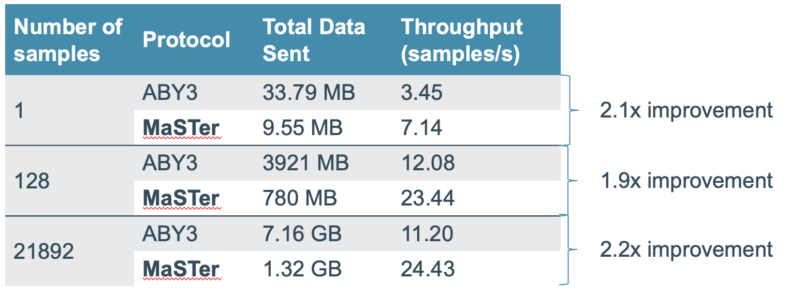
To evaluate the performance of MaSTer, we benchmarked our protocol by running an inference of a 5-layer dense neural network with ReLU and SoftMax activation functions. We compare the performance to the state-of-the-art malicious truncation of ABY3. In the table below we demonstrate that simply by replacing the truncation protocol with MaSTer, we were able to improve the total throughput by a factor of 2, consistently over experiments with different number of samples.
To summarise, MaSTer is the first MPC truncation protocol that achieves malicious security without any pre-processing needed, while maintaining the online cost comparable to the state-of-the-art malicious truncation online phases. To achieve this, MaSTer combines two semi-honest truncation protocols. The 3-party ABY3 semi-honest truncation is used to obtain the output of the truncation protocol, while the 2-party SecureML truncation is used to check correctness of the result obtained by ABY3, detecting any malicious behaviour. MaSTer further introduces a new adversarial model, where an adversary is allowed to deviate from the protocol by adding a small error of up to \(\pm 2\) without getting detected.
Efficient Secure Multiparty Computation for Multidimensional Arithmetics and Its Application in Privacy-Preserving Biometric Identification
We now briefly summarise the paper presented by Dongyu Wu. The authors aim to accelerate multi-dimensional arithmetics in MPC. As they pointed out, conventional approaches rely on standard scalar Beaver triple techniques which fail to scale efficiently for multi-dimensional arithmetics. Their main contribution is the introduction of a Tensor triple. Let \(K\) be the underlying finite field or ring, let \(\otimes\) denote the outer product of two vectors, let \( [x] \) denote the secret sharing of \(x\). They define a Tensor triple to be an (m,n)-triple \( ( \boldsymbol{u}, \boldsymbol{v}, \boldsymbol{W} ) \), where \(\boldsymbol{u} \in K^m\), \(\boldsymbol{v} \in K^n \) and \(W \in M_{m \times n}(K)\), such that \( \boldsymbol{u} \otimes \boldsymbol{v} = \boldsymbol{u}\boldsymbol{v}^T = W \).
Note that if \(m=n=1\), the Tensor triple simplifies to the standard Beaver triple. To multiply two vectors \(\boldsymbol{a},\boldsymbol{b} \in K^n \), the parties require an (n,n)-triple and compute the dot product as follows: the parties compute and open the values \(\boldsymbol{d} = \boldsymbol{a}-\boldsymbol{u}\), \(\boldsymbol{e} = \boldsymbol{b}-\boldsymbol{v}\). The parties then proceed to obtain the shares of the product by computing locally \( [\boldsymbol{a} \cdot \boldsymbol{b}] = \boldsymbol{de} + [\boldsymbol{u}]\boldsymbol{e} + [\boldsymbol{v}]\boldsymbol{d} + tr([W]) \).
In order to compute an outer product of two vectors \(\boldsymbol{a} \in K^m\), (\boldsymbol{b} \in K^n\), the parties require an (m,n)-triple. To parties proceed similarly as before, by opening \(\boldsymbol{d} = \boldsymbol{a}-\boldsymbol{u}\) and \(\boldsymbol{e} = \boldsymbol{b}-\boldsymbol{v}\). The parties then compute locally \( [\boldsymbol{a} \otimes \boldsymbol{b}] = \boldsymbol{d} \otimes \boldsymbol{e} + \boldsymbol{u} \otimes \boldsymbol{e} + \boldsymbol{v} \otimes \boldsymbol{d} + W \).
Now, let \( A \in M_{m\times k}(K) \), \( B \in M_{k\times n}(K) \). Let \( \boldsymbol{a}_i \) for \( i \in [1,k] \) denote the columns of the matrix \(A\) and let \( \boldsymbol{b}_i \) for \( i \in [1,k] \) denote the rows of the matrix \(B\). The parties can obtain shares of the matrix product by computing \( [AB] = \sum_{i=1}^k [\boldsymbol{a}_i \otimes \boldsymbol{b}_i] \).
As a result, consider the multiplication of the two matrices \( A \in M_{m\times k}(K) \), \( B \in M_{k\times n}(K) \). Using standard Beaver triple technique would require \(mkn\) multiplication triples, while using Tensor triple technique only requires \(k\) (m,n)-triples. Note that even though the communication and round complexity in the online phase remains the same in both techniques, the main advantage of Tensor triples comes in the offline phase. Furthermore, note the flexibility of Tensor triples. Any (n,n)-triple can be trimmed into an (s,t)-triple and (n-s,n-t)-triple for any \(s,t < n\).
To generate the Tensor triples in the pre-processing phase, the authors focus on the 2-party scenario with semi-honest security. The authors propose three ways of generating Tensor triples, extending the standard techniques for generating Beaver triples. The authors base their offline phase on the standard RLWE-AHE approach introduced by Rathee et al. and more efficient variants based on OTs, a COT-based approach adapted from ABY and a subfield vector oblivious linear evaluation (sVOLE)-based approach proposed by Boyle at al.
The authors implement the OT-based approaches only, as in general they are assumed to be more efficient. They note that for lower dimensions COT performs better, while for higher dimensions the sVOLE-based approach is more efficient.
The authors provide a comparison to previous work in their paper, nevertheless, they did not run the experiments under the same experimental setup. Furthermore, they note that their implementation is highly optimised, whereas many experiments from previous work were run in a single threat. The authors leave the generalisation of the pre-processing phase to larger number of parties as a future work.


