This blog post serves as a basic introduction to a recent paper, in which my colleagues from COSIC and I coin the term blind zkSNARKs. We demonstrate that this new cryptographic primitive shows great potential for advancing many zk-related applications. This post only requires knowledge of rudimentary cryptography and the concepts outlined in the background section below. For more details, I refer to the paper.
In his 1983 paper “Blind Signatures for Untraceable Payments“, David Chaum introduced the concept of blind signatures. Using this construction, one can ask some honest-but-curious entity to sign a given message without leaking its contents. Chaum used them to construct the first private electronic payment system by having a central entity sign coins blindly to prevent double-spending while having no ability to track payments. Nowadays, we have protocols that provide private electronic payments without a central entity by utilizing cryptographic proof systems. Using the techniques outlined in this post, blind zkSNARKs could be used to greatly improve their practicality.
Background
Blind zkSNARKs are constructed by combining zkSNARKs and Homomorphic Encryption (HE) such that the zkSNARK proof generation is computed homomorphically. Note that one can also combine them in reverse to construct verifiable FHE (vFHE). This primitive overlaps significantly with blind zkSNARKs in terms of applications but can not reach the same level of efficiency using current techniques. See my previous paper for more discussion about the complications of vFHE.
Homomorphic Encryption (HE)
An HE scheme is an encryption scheme that allows for computation on ciphertexts. In other words, besides the encryption and decryption algorithms \(\texttt{Enc}\)/\(\texttt{Dec}\), it also provides an algorithm for homomorphic evalution \(\texttt{HE}_\texttt{F}\) of a function \(\texttt{F}\) as illustrated below. Assume that both encryption and decryption are performed using the same secret key.
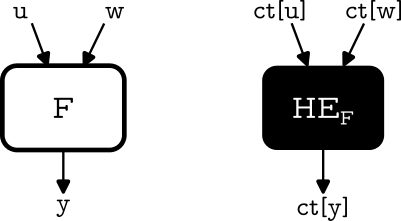
If the HE scheme is correct with respect to \(\texttt{F}\), then the homomorphic property states that \(\texttt{Dec(ct[y])}=\texttt{y}=\texttt{F(u,w)}\) if the input ciphertexts \(\texttt{ct[u]}, \texttt{ct[w]}\) were computed as encryptions of \(\texttt{u,w}\) respectively. Unlike the figure above, not all inputs values are required to be ciphertexts since the HE scheme can integrate plaintexts into its operations. There exist many HE constructions that differ in computational interfaces they provide but in this post we will consider only the rudimentary black-box described here.
zero-knowledge Succinct Non-interactive ARguments of Knowledge (zkSNARKs)
Any computation can be represented as a function \(\texttt{F}\) that takes in some inputs \(\texttt{u},\texttt{w}\) and returns some output \(\texttt{y}\). A zkSNARK allows one to prove that there exists a \(\texttt{w}\) such that \(\texttt{y}=\texttt{F}(\texttt{u},\texttt{w})\) for some \(\texttt{u}\) and \(\texttt{y}\). This is achieved by using the algorithm \(\texttt{Prove}_\texttt{F}\) to construct a proof \(\pi\) which can be verified by the algorithm \(\texttt{Verify}\). Below we have illustrated a zkSNARK being used between a verifier and a prover entity. Crucial to upcoming discussions is that the proving algorithm is costly and requires computing the output \(\texttt{y}\) using the input \(\texttt{u}\).
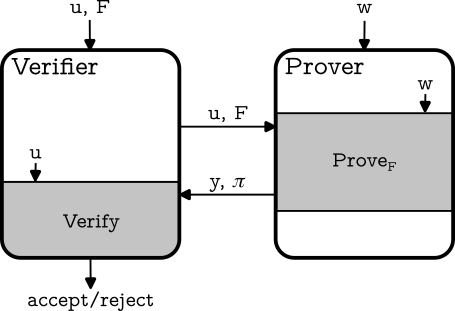
A zkSNARK must be succint, meaning the verification algorithm requires less work than computing \(\texttt{F}\) itself. This makes zkSNARKs useful in Verifiable Computation (VC) applications, where a client uses them to outsource computations to some server without having to assume the server performs the computations as expected. A zkSNARK must also be zero-knowledge, meaning the verification does not leak any information about the input \(\texttt{w}\). This makes zkSNARKs useful for Privacy Enhancing Technology (PET) applications, where a client uses them to prove some statement to another entity (e.g. a blockchain) without revealing some private information contained in \(\texttt{w}\). Note that in the described applications the client acts as the verifier and prover respectively.
Blind zkSNARKs (BzkSNARKs)
A blind zkSNARK is a proof system that is constructed by using an HE scheme to homomorphically compute (most of the) operations in the proving algorithm of a zkSNARK. We have coined it a blind zkSNARK since performing \(\texttt{HE}_{\texttt{Prove}_\texttt{F}}\) results in (an encryption of ) a valid zkSNARK proof that some values are the inputs and outputs of \(\texttt{F}\) while only utilizing encryptions of those values. Remark the similarity with a blind signature scheme. The following sections apply blind zkSNARKs to the two categories of applications of zkSNARKs described previously.
BzkSNARKs for VC → vCOED
In VC applications, the client acts as the verifier and the server acts as the prover. Unfortunately, this requires the prover to have access to the values on which \(\texttt{F}\) was computed and therefore the client always leaks which computation is being outsourced. Note that leaking the inputs of outsourced computations can be avoided using a concept called Computation Over Encrypted Data (aka COED, of which HE is an instance). However, COED lacks the integrity guarantee that VC provides. One can combine these properties into a concept called verifiable COED (vCOED). Blind zkSNARKs achieve vCOED by having the server compute the proving algorithm homomorphically using an encryption of the inputs. Compare the figure below to the figure describing zkSNARKs above.
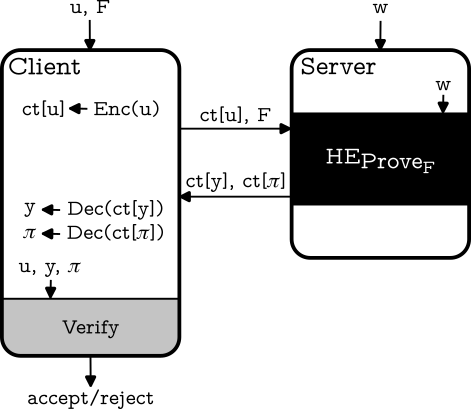
Note that vCOED is a very powerful concept which can be considered the cryptographic version of a Trusted Execution Environment (TEE) that replaces TEE’s unrealistic hardware security assumptions by cryptographic security assumptions. In some sense, vCOED can be regarded as the holy grail of cryptography since it provides privacy, security and integrity all at once. For example when applied to AI chatbots, it allows one to query the server running the chatbot without revealing your prompt and simultaneously being guaranteed the quality of the output (i.e. combining privacy-preserving ML with zkML). Note that BzkSNARKs also easily retain the zero-knowledge property of the zkSNARK (in our example this means the server is not leaking the model weights by providing integrity).
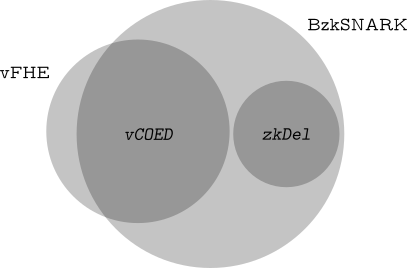
Remark that vFHE also achieves vCOED by proving the homomorphic computation of \(\texttt{F}\), in other words, performing \(\texttt{Prove}_{\texttt{HE}_\texttt{F}}\). As previously discussed, our paper shows that state-of-the-art vFHE is a lot less efficient for achieving vCOED compared to BzkSNARKs. This can be understood intuitively by noticing that vFHE proves integrity of ciphertext space computations which implies integrity of the underlying plaintext operations while vCOED only necessitates integrity of those underlying plaintext operations. BzkSNARKs on the other hand only provide integrity on the plaintext space.
BzkSNARKs for PETs → zkDel
In PET applications, the client acts as the prover and others act as the verifier (for simplicity here modelled as the server). Unfortunately, proving is often a very costly operation requiring much memory which limits the usage of zkSNARKs for PETs. Resolving this issue by delegating the proof generation to some other party nullifies the privacy of the private input \(\texttt{w}\) that is given by the zero-knowledge property. Using BzkSNARKs, one can achieve private proof delegation (zkDel) by sending an encryption of the private input as described in the figure below. Note that this replaces the expensive proving operations by HE encryptions and decryptions. However, unlike the vCOED setting, the party doing verification is not the owner of the secret keys used in the HE schemes. This leads to a technicality where the client needs to append a Proof of Decyption (PoD) of some ciphertexts to make the proof publicly verifiable. Therefore, as seen in the figure below, any party can verify the constructed proof.
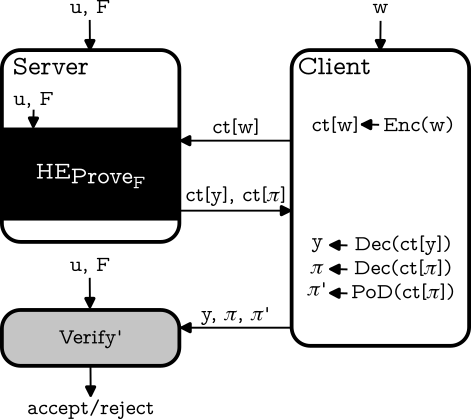
Protocols for zkDel based on Multi-Party Computation (MPC) have also been proposed. However, similar to TEEs in the case of vCOED, they achieve better performance at the cost of making additional security assumptions. In contrast, BzkSNARKs achieve zkDel to only one server that can be completely untrusted. An example application of zkDel are the decentralized private payment systems mentioned in the introduction. They require a user to compute an expensive proof in order to privately post a transaction to the network. Efficient zkDel using BzkSNARKs can be used to decrease user transaction times by delegating proof generation to a server while also retaining privacy from that server. More broadly, BzkSNARKs could be applied to any proof system based PET.
Our contributions
In our paper, we address the many questions left unanswered by previous research on homomorphic computation of zkSNARKs by answering/solving them with concrete proofs and implementations. Our contributions can be listed as follows.
- We present a theoretical framework for construction BzkSNARKs from BCS-based zkSNARKs by proving they achieve soundness and zero-knowledge given certain restrictions.
- We present optimized algorithms and parameter sets for efficiently computing BzkSNARK proofs specifically for a BzkSNARK constructed from the Fractal zkSNARK and a state-of-the-art HE scheme called GBFV recently introduced by colleagues at COSIC. We also give detailed estimations of proving times for this specific BzkSNARK which shows that they greatly outperform vFHE in the vCOED setting.
- We prove that BzkSNARKs can become publicly verifiable by appending Proofs of Decryption (PoDs) and construct a new batched PoD protocol optimized for the zkDel application using lattice-based zero-knowledge proofs that is of independent interest.
- We develop an optimized implementation of this PoD protocol and provide running times that show that BzkSNARKs can be used to decrease proving time from 10 minutes to mere seconds using zkDel.


