Catching the Leaker: Traceable Secret Sharing for Any Rule
The problem: a secret, a betrayal, no consequences
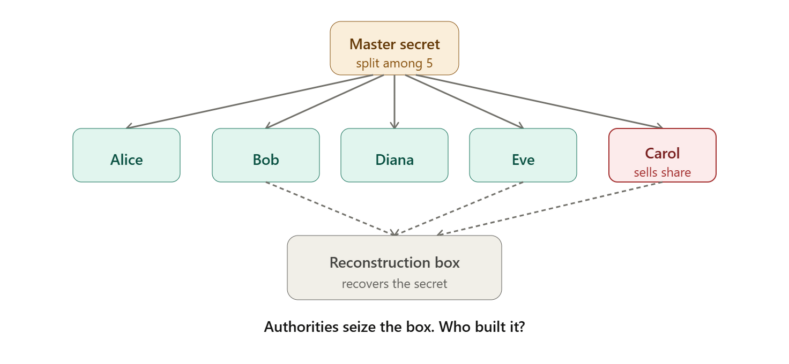
Imagine a company’s master encryption key, split among five executives so that any three together can reconstruct it. This is secret sharing, invented by Shamir and Blakley in 1979, and it’s everywhere in modern cryptography; from blockchain custody to multi-party computation. The scheme guarantees that no two executives can recover the key, but any three can.
Now imagine one of them quietly sells their share on a dark marketplace. The buyer combines it with two other purchased shares, builds a small program, a “reconstruction box”, and walks away with full access to the secret. The classical scheme has no way to point fingers. There’s no fingerprint, no audit trail, no consequence for the seller.
The goal: traceable secret sharing
In 2024, Boneh, Partap, and Rotem proposed a model for solving exactly this. The authorities eventually seize the reconstruction box and treat it as a black box: they feed it inputs, observe outputs, and from this alone must identify at least one party who contributed shares to building it. The scheme must satisfy two demands. Traceability: the tracer succeeds in pointing at a guilty party. Non-imputability: no honest party is ever falsely accused.
Their constructions worked beautifully — but only for threshold rules (“any t-out-of-n”). Real applications need richer rules: organizational hierarchies (a CEO plus any VP, or three managers), graph-based access (any two connected nodes), weighted voting (shareholders with different stakes). For these, traceability was an open problem.
In a paper appearing today at Eurocrypt 2026, Oriol Farràs and Miquel Guiot solve it. Their construction handles any monotone access rule, and does so without relying on any computational assumptions but polynomial-time queries to the secret reconstruction box.
The first surprise: anonymity is the price of tracing
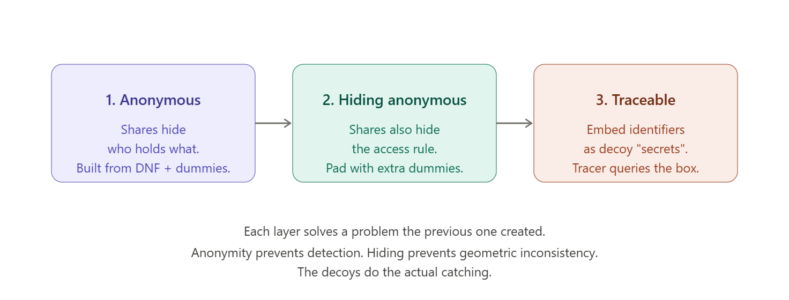
Here’s the counterintuitive heart of the result. To catch traitors, you must first make their shares anonymous, meaning a share carries no information about who owns it.
Why? Suppose shares were tagged with party identities. A reconstruction box built by Carol could simply inspect every incoming query: “does any share here belong to me?” If yes, the box knows it’s being tested by a tracer (Carol would never query her own box) and refuses to respond. The tracer is forced to guess query subsets that avoid all corrupted parties, a search that can take exponentially many tries when corruption is widespread.
So the first ingredient is an anonymous secret sharing scheme: shares look interchangeable, and even the reconstruction process leaks nothing about who participated.
The second surprise: hide the rule itself
Anonymity alone isn’t enough for general access rules. Here the authors prove a striking impossibility: if the access rule is public, you cannot trace all corrupted parties.
The reason is geometric. Tracing works by feeding the box decoy shares that, combined with the corrupted parties’ real shares, look like a minimal authorized set. But for general rules, some unauthorized subsets simply cannot be extended into a minimal authorized set — think of three vertices in a graph with no edges between them. The box detects the inconsistency and stays silent.
The fix is to hide the rule itself. Parties only know that their access structure belongs to some family of possible rules. The tracer can then pretend the corrupted set fits a different rule from the family — one in which it does form a minimal authorized subset.
How the trap is set
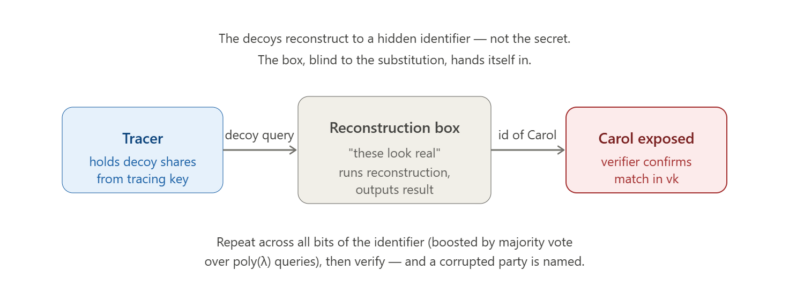
With those two ingredients, the actual tracing mechanism is almost playful. When the dealer hands out shares, they secretly embed a hidden identifier for every potentially-corruptible subset. The trick is that this identifier is shared using the same scheme as the real secret, which means, by anonymity, the reconstruction box cannot tell the two apart.
The dealer keeps a few “decoy” shares aside in a tracing key. During tracing, the authorities feed these decoys to the box along with simulated shares. To the box, the input looks like a legitimate authorized set asking it to reconstruct the real secret. So it does what reconstruction boxes do: it computes and outputs. But because of how the dealer wired the decoys, what comes out isn’t the secret, it’s the identifier of one of the parties who built the box.
Why this matters
Farràs and Guiot deliver the first traceable secret sharing scheme that works for arbitrary access structures, not just thresholds, and they do it in the information-theoretic setting, with no reliance on one-way functions or other cryptographic assumptions. The shares themselves are exponentially large (an unavoidable cost shared by all known information-theoretic schemes for general structures), but the tracing procedure runs in only a polynomial number of queries to the secret reconstruction box. For special families like “low slices,” even the share size collapses to polynomial.
Beyond the headline result, the paper enriches a young research area on its own terms. The notion of anonymous secret sharing, and the stronger hiding anonymous variant the authors introduce, clarifies a subtle definitional landscape and yields constructions that improve on prior work. The deeper lesson is structural: privacy and accountability, which sound opposed, turn out to be entangled. To catch the leaker, you must first ensure no one can recognise them by their share alone.
The big question still stands: is it possible to build traceable secret sharing protocols that only ping the reconstruction box once, or maybe just a constant number of times?
📄 Farràs & Guiot, “Traceable Secret Sharing Schemes for General Access Structures,” Eurocrypt 2026.


