When Adding One Share Breaks Everything
A simple question with a worrying answer
Cryptographers have spent decades figuring out how to split a secret among a group of people so that only the right coalitions can put it back together. But what happens when one of those people quietly sells their piece on the side? In 2021, Goyal, Song, and Srinivasan introduced traceable secret sharing to answer this question; a scheme where, if a coalition of leakers builds a “reconstruction box” that recovers the secret from purchased shares, authorities can trace the box back to at least one of them. A 2024 follow-up by Boneh, Partap, and Rotem refined the model, and several follow-up papers extended it. The field looked healthy.
In a paper presented today in EUROCRYPT 2026, Vipul Goyal, Abhishek Jain, and Aditi Partap revisit this entire story, and report that the foundations are quietly cracked.
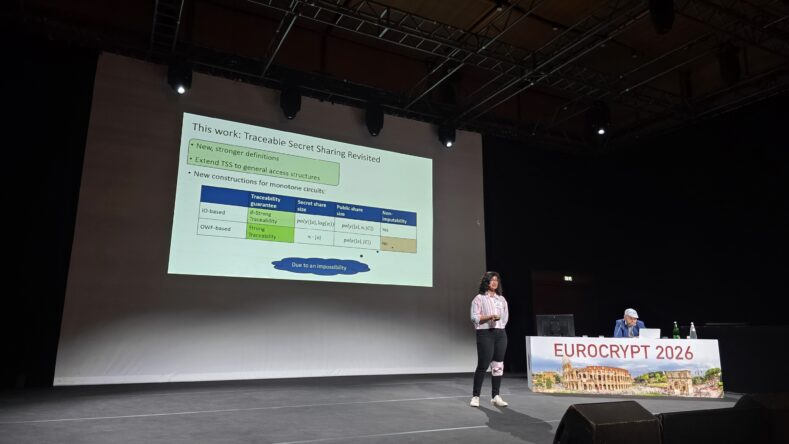
Every prior tracing scheme, they show, can be defeated by an adversary who does almost nothing clever: they just ask their reconstruction box to demand one extra share as input. That single change makes existing tracing algorithms fail completely. The paper rebuilds the theory from scratch with stronger definitions, extends traceability to general access rules for the first time in a meaningful way, and gives constructions that actually meet the new bar.
What was wrong with the old picture
In the prior model, a reconstruction box came labelled with a number f, the count of additional shares it needed before it would output the secret. The label always said, “Feed me exactly enough shares to reach the threshold.” No more, no less. This was convenient for proofs but unrealistic for adversaries.
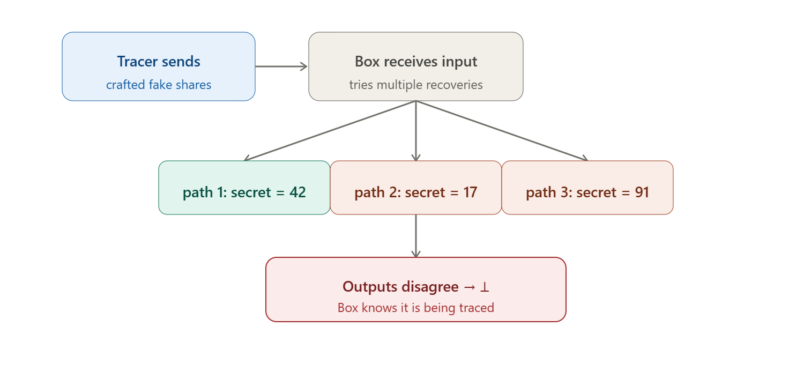
Why does asking for one more share break things? Because every prior tracing strategy works by feeding the box fake shares carefully crafted to look indistinguishable from real ones. With Shamir secret sharing, for instance, fake shares fit perfectly into a unique reconstruction polynomial when the input is exactly minimal, there’s only one way to interpolate. But add one more share, and now the box has multiple reconstruction paths to choose from. If the box runs two of them and the answers disagree, it knows it’s being tricked. It outputs ⊥ , and the tracer learns nothing.
Why this gets worse for general access rules
In threshold schemes (the only setting prior work handled), this is at least a fixable problem in principle. But Goyal, Jain, and Partap point out that for general access rules, hierarchies, weighted votes, anything more expressive, the old definition becomes outright vacuous. Take the rule (Alice or Bob) and (Carol or Dave). If Carol and Dave are both corrupt, every possible input set produces an over-authorized union. There’s no “minimal” extension at all. So the definition that all prior schemes met simply doesn’t say anything.
There’s a second problem the authors flag: most efficient secret sharing schemes for general rules let unauthorized parties do partial reconstruction, combining their shares into an intermediate value that loses any trace of who contributed it. A box built from such an intermediate value has nothing left to point a finger at. Both issues mean that traceability for general access structures requires fundamentally new techniques, not just a port of the threshold tools.
The new yardsticks
To replace the broken definition, the authors propose two stricter notions. The first, ∅-strong traceability, captures any reconstruction box that’s useful, meaning it gives back at least one bit of information about the secret on at least one input, as long as the input set and the corrupted set don’t overlap. Crucially, no minimality required. The second, strong traceability, drops even the no-overlap restriction, modelling boxes where the buyer might use shares from parties who also happen to be corrupted.
Both notions also demand the security guarantees prior work asked for: tracer secrecy (the secret stays hidden from a possibly-malicious tracer) and tracer non-imputability (no honest party can be framed). One of the paper’s striking results is that these properties don’t always coexist: strong traceability with non-imputability is impossible for large secrets. So the authors give two separate constructions: one for ∅-strong traceability with the full security suite, and one for strong traceability that gives up the malicious-tracer protections.
How the new construction works
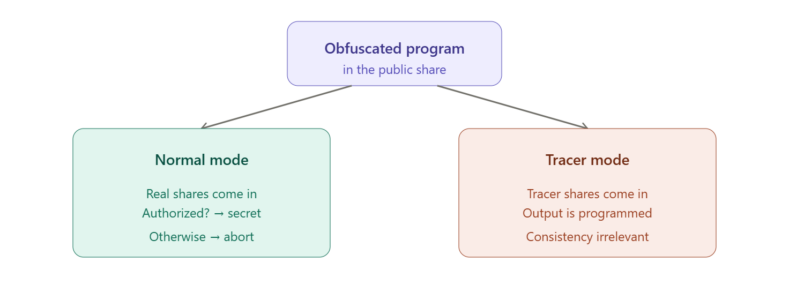
The key idea lies in sidestepping the “consistent fake shares” trap entirely. Instead of trying to make the tracer’s fake shares look real, the new scheme makes consistency irrelevant. It works in the public information model: alongside private shares, every party gets a public obfuscated program that handles reconstruction. This program has two computationally indistinguishable modes, a normal mode that returns the secret when given an authorized set, and a tracer mode that returns whatever the tracer programmed.
The actual catch: tracing by jumps
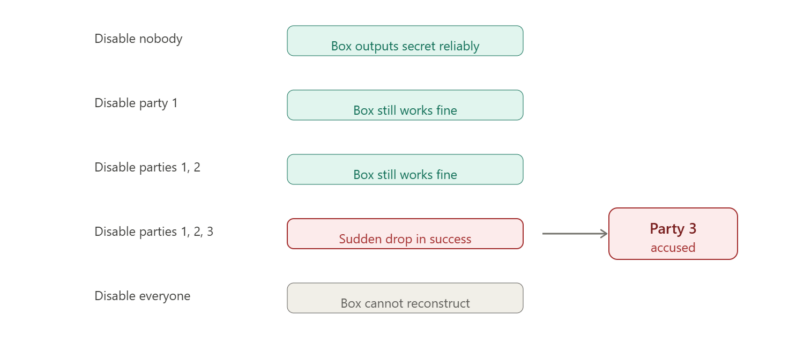
With the consistency problem gone, the authors borrow a tracing technique from traitor tracing, used to catch piracy of decryption keys. The idea is to selectively disable parties one at a time and watch the box’s behavior.
The tracer feeds the box queries that disable nobody, then party 1, then parties 1 and 2, and so on, until everyone is disabled. At one end of this sequence, the box answers correctly; at the other end, it cannot answer at all. So somewhere in the middle, the success rate must drop. The party at which the drop happens is one of the leakers; only their share could have caused that specific change in behaviour. To make this work for arbitrary input sets (not just contiguous ranges), the authors generalize the underlying primitive into something they call Private Set Broadcast Encryption, which lets the tracer disable any set of parties without revealing which set was targeted.
What you get, and what it costs
The result is the first traceable secret sharing scheme that handles any access rule expressible as a monotone circuit, covering essentially everything secret sharing is used for in practice. Private shares are tiny: just poly(λ, log n) bits regardless of how complex the rule is. The public information is larger (it scales with the access structure size), but the authors show it can be reused across many secrets shared by the same dealer. There’s also a useful corollary: the same techniques compile any secret-key encryption into a traceable one for general access rules, with tracing that even works on decryption boxes that leak only a single bit at a time, a capability prior schemes couldn’t offer at all.
What does it cost? Indistinguishability obfuscation, the heaviest hammer in the cryptographer’s toolbox. The authors show that a separate construction based only on one-way functions can achieve strong traceability, but only by giving up secrecy and non-imputability against malicious tracers. Whether obfuscation is genuinely necessary, or whether something lighter would suffice, remains a beautiful open question. What isn’t open anymore is the underlying lesson: a definition that fails against an attacker who adds one extra share is not a definition worth proving theorems about. This paper retires that definition and replaces it with one that the field can build on.
The big question still stands: is it possible to build traceable secret sharing protocols that only ping the reconstruction box once, or maybe just a constant number of times?
📄 Goyal, Jain, Partap. “Traceable Secret Sharing Revisited.” March 2026.


