This year, I had the pleasure of attending the IEEE Symposium on Security and Privacy (S&P) conference, held in San Francisco from 18 to 21 May. While we were there presenting our own paper, “One Tap to Hijack Them All: A Security Analysis of the Google Fast Pair Protocol” (which you can read more about at our project website, whisperpair.eu), another piece of work caught my attention.
The paper I want to discuss in this blog post is titled “RadKey: An LLM-Guided RF Backscatter System for Through-Wall Keystroke Inference” by Qijun Wang, Chunqi Qian, and Huacheng Zeng from Michigan State University. This post summarises the key points of their work, which introduces a novel keystroke inference attack that cleverly combines solid-borne vibrations and air-borne acoustics via passive Radio Frequency (RF) sensing. In this blog post, I refer to the authors’ figures and findings, and encourage readers to consult the full paper for a detailed understanding.
Key Contributions
At a glance, RadKey introduces three major advancements that elevate it above traditional keystroke eavesdropping attacks:
- A Passive, Interference-Free RF Tag: The authors designed a tiny, batteryless tag (under 2.5 cm wide) that can be covertly hidden underneath the victim’s desk. Because the tag has no battery, it relies on an external RF reader operated by the attacker (from up to 8 metres away or behind a wall) which beams a wireless radio signal to power it. RadKey’s clever tag design ensures that the incoming power signal from the attacker doesn’t drown out the weak, bounced-back data signal, completely removing self-interference and vastly extending the attack range.
- Dual-Path Sensing (Vibrations + Acoustics): Instead of relying on a single side-channel, the tag simultaneously captures solid-borne vibrations travelling through the desk and air-borne acoustics travelling through the air. Measuring the physical time delay between these two paths creates a distinct signature that works incredibly well across different users and keyboards without needing victim-specific training.
- LLM-Guided “In-the-Loop” Learning: Rather than using a Large Language Model (LLM) just as a spellchecker to fix typos at the very end of the process, RadKey uses the LLM to actively train and update the underlying keystroke classifier during runtime. When the victim types natural text, the LLM evaluates the semantic meaning, fixes the classifier’s mistakes, and uses those corrections to upgrade the classifier on the fly. This makes the system smart enough to adapt to the specific setup and accurately intercept subsequent non-semantic text, like passwords.
What is RF Backscatter?
To understand how RadKey works, it is important to first grasp its core physical mechanism: Radio Frequency (RF) Backscatter. Traditional wireless devices (like your smartphone or a Wi-Fi router) are active transmitters; they require a battery to generate their own radio signals.
Backscatter takes a completely different approach. Instead of generating a new signal from scratch, a passive backscatter tag simply re-uses radio waves that are already in the air.
You can think of it like a flashlight and a mirror:
- The Reader (The Flashlight): This is the attacker’s active, powered transceiver setup. It beams a continuous radio signal toward the target.
- The Tag (The Mirror): This is the tiny, batteryless device hidden under the desk. It catches the incoming beam from the reader and reflects it back.
By rapidly changing its properties based on the keyboard’s physical vibrations, the tag alters the reflection before it bounces back. The reader then captures this modified reflection and translates it into typed characters.
In standard backscatter systems (like office RFID keycards), there is a massive engineering hurdle called self-interference. Because the tag bounces back a signal on the exact same frequency that the reader is beaming out, the intense glare of the reader often drowns out the weak reflection coming from the tag. This usually limits the range to just a few centimetres or metres.
RadKey completely bypasses this limitation. Its tag acts like a special mirror that takes in one specific frequency from the reader and instantly flips it to a completely different frequency before reflecting it back. Because the reader’s incoming signal and the tag’s outgoing reflection are on entirely separate frequencies, self-interference is completely eliminated. This is exactly what allows the attacker to steal keystrokes from up to 8 metres away, even through a solid concrete wall.
Dual-Path Sensing: Vibrations and Thin Air
The second pillar of RadKey’s success lies in how it captures the physical act of typing. Traditional keystroke eavesdropping attacks usually focus on a single side-channel. For example, they might use a nearby smartphone microphone to record the sound of the keys clicking, or an accelerometer to measure the desk shaking.
RadKey combines these two worlds by simultaneously exploiting two distinct physical paths generated by a single keypress:
- The Solid-Borne Path (Vibrations): When your finger hits a keycap, it forces the underlying switch to collapse and bottom out. This mechanical impact sends localised, structural shockwaves travelling directly through the body of the keyboard and out into the rigid surface of the desk.
- The Air-Borne Path (Acoustics): At the exact same time, the physical click of the switch mechanism and the impact of your finger compress the surrounding air molecules, launching a standard acoustic sound wave through the room.
Turning Distance into a Unique Fingerprint
Because the tiny tag under the desk features a highly sensitive piezoelectric sensor, it can pick up both the physical vibrations from the table and the acoustic sound waves from the air at the same time. This dual-path capture is where the clever security exploit happens.
Vibrations travel through solid materials (like a wooden or glass desk) significantly faster than sound waves travel through the air. By measuring the exact time gap between when the vibration hits the tag and when the acoustic click arrives, a metric known as the Time Difference of Arrival (TDoA), RadKey can map out a highly precise spatial signature for every single key on the keyboard.
Instead of treating this time delay as a simple numeric value, the system transforms the incoming data into a visual, image-like time-frequency map. Because these visual alignment differences depend heavily on the physical distance between the specific key and the hidden tag, they form an incredibly robust signature. This visual approach ensures the attack generalises beautifully across completely different typing styles, hand postures, and keyboard builds without requiring any user-specific training beforehand.
LLM-Guided Adaptation: In-the-Loop Learning
The final piece of RadKey’s pipeline introduces an intelligent twist on how artificial intelligence handles intercepted data. Traditional side-channel attacks usually use Large Language Models (LLMs) simply as post-hoc spellcheckers. In that traditional setup, the noisy text output from a keystroke classifier is passed to an LLM at the very end to correct typos based on grammar and context. While this works well for conversational sentences, it does nothing to improve the underlying classifier, making the system completely useless when the victim types non-semantic text like a password.
RadKey fundamentally shifts this paradigm by pulling a locally hosted LLM directly into the active training loop.
- Active Feedback: When the victim types coherent natural language, the LLM analyses the sentence structure, fixes any character classification mistakes, and generates highly accurate pseudo-labels.
- Real-Time Refinement: These labels are immediately fed back into the system to retrain and update the physical-layer keystroke classifier on the fly.
- Adapting to the Target: This constant runtime adjustment allows the classifier to rapidly adapt to the specific acoustics of the room, the material of the desk, and the unique typing rhythm of the user.
Crucially, because the underlying physical-layer classifier becomes significantly more accurate through this continuous training, its performance skyrockets across the board. Even when the victim stops typing standard sentences and switches to entering completely random character sequences, email addresses, or secure passwords, the newly optimised classifier can intercept them with high precision, long after the LLM has stopped assisting.
For the complete technical details on the underlying hybrid loss functions and convergence optimisation used in this training loop, I highly recommend reading the full paper.
Real-World Setup: Putting the Attack into Practice
To understand how this threat materialises outside of a laboratory, we have to look at how an adversary deploys RadKey in a realistic environment, such as an office, library, or shared co-working space. The beauty of this attack from the attacker’s perspective is that it requires zero modifications to the victim’s keyboard or computer and leaves no visible traces.
The attack unfolds in a straightforward, practical sequence:
- Concealing the Tag: The attacker requires only a brief moment of physical access to place the tiny, batteryless tag underneath the wooden, plastic, or glass desk supporting the target keyboard. Because the tag is passive and incredibly compact, it can remain hidden indefinitely without requiring battery replacements or regular maintenance.
- Setting up the Reader: The attacker positions their active RF reader, which comprises standard software-defined radio equipment and directional antennas, up to 8 metres away. As highlighted in the system configuration, this setup can easily operate from an adjacent room or corridor, completely bypassing line-of-sight constraints.
The Threat Model in Action
Figure 1 maps out the full end-to-end configuration of an active attack scenario:
Even if the room features acoustic isolation, visual blockages, or high-frequency millimetre-wave shielding, the low-frequency radio signal from the attacker’s reader easily penetrates a 15 cm concrete wall. The reader beams power to the concealed tag, which is actively vibrating in tandem with the user’s typing. The tag modulates these vibrations onto the reflected signal, allowing the attacker’s laptop to reconstruct the text and feed it into the self-updating LLM loop.
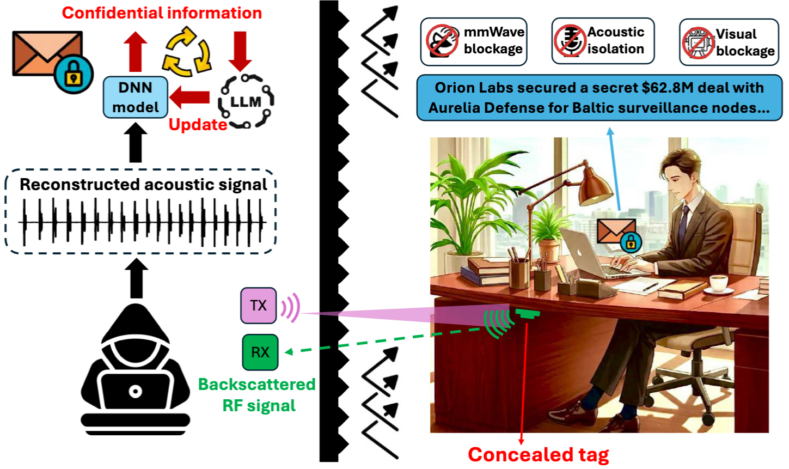
Figure 1: Threat model and system configuration.
The Underlying Propagation Mechanics
But how do these tiny keystrokes cross the gap to the tag in the first place? The physical mechanism relies on the dual-path propagation model shown in Figure 2:
Every single keypress creates a mechanical impulse. This simultaneously launches solid-borne mechanical vibrations ripping through the table structure, and air-borne acoustic waves compressing the air molecules.
When these dual signals strike the highly sensitive piezoelectric sensor on the tag, they deform the material to generate a time-varying signal voltage. As shown in the mathematical models within Figure 2, this analogue voltage directly shifts the resonant properties of the tag, encoding the exact timing difference between the solid shockwave and the aerial click into the bounced-back radio signal. For more details, I recommend reading the full paper.
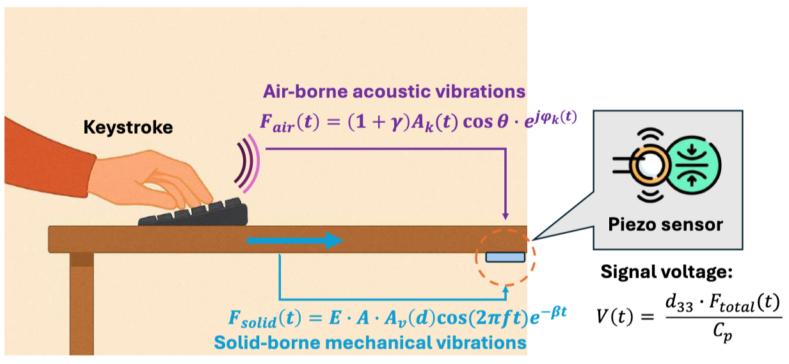
Figure 2: Keystroke-induced signal propagation model.
Experimental Evaluation: Comprehensive Testing
To show that RadKey is a viable threat in the real world, the authors conducted an extensive, over-the-air evaluation using a full physical prototype. They evaluated its performance across a wide variety of hardware, materials, and environmental setups to simulate an authentic deployment.
The rigorous evaluation took several critical practical variables into account:
- Keyboard and Switch Diversity: The authors tested the attack against three completely different switch architectures, rubber dome, scissor-switch, and mechanical mechanics, as seen in Figure 3.
- Real-World Device Form Factors: The experiments targeted five distinct physical typing devices, including three standalone external keyboards and two integrated laptops (a Windows laptop and an Apple laptop as shown in Figure 4).
- Varied Desktop Materials: Because structural vibration transmission varies with surface material, the setup was tested on glass, wood, and plastic tables.
- User Typing Dynamics: The system was evaluated across ten different participants with completely varied typing speeds, hand postures, and individual finger force profiles.
- Spatial and Obstruction Variations: Testing included changing the horizontal tag-to-keyboard distance to 120 cm, altering the tag’s physical orientation, extending the reader range to 8 metres, and achieving successful keystroke extraction completely non-line-of-sight through a 15 cm concrete wall.
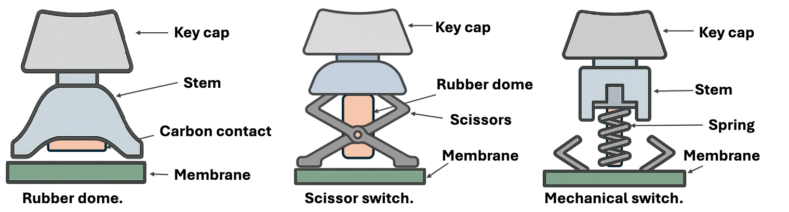
Figure 3: Three common keyboard switch types.
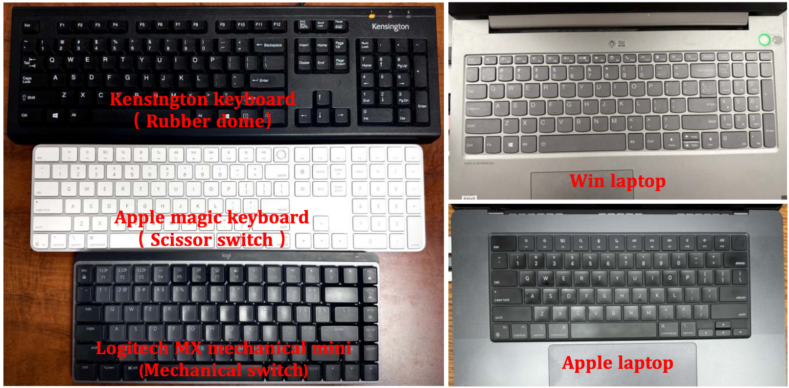
Figure 4: Keyboards and laptops.
The full physical attack prototype, alongside the hardware environments, can be seen in Figure 5. By validating the system against all of these real-world constraints, the paper demonstrates that RadKey maintains an incredibly high accuracy rate across the board, proving that its physical-layer dual-path design and self-updating software loop generalise remarkably well to the unpredictable environments of daily life.
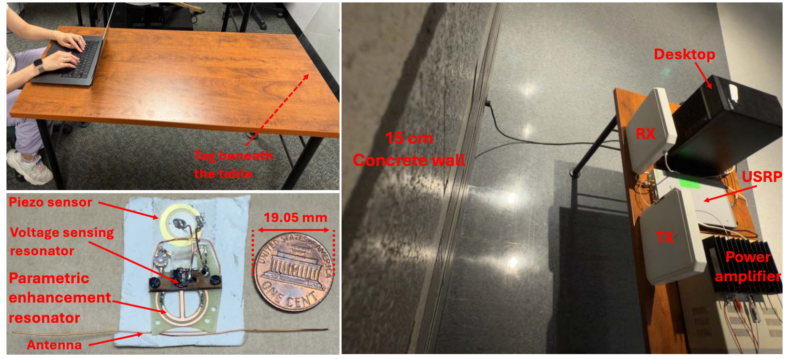
Figure 5: Experimental settings.
Ultimately, these extensive tests confirmed that RadKey achieves exceptional precision, frequently exceeding a 90% accuracy rate across all practical testing dimensions. While the unoptimised baseline model saw noticeable performance drops when dealing with heavy vibration damping (such as on plastic surfaces or the rigid chassis of an Apple laptop), or when user-dependent signal shifts occurred during cross-user testing, the integration of the LLM-guided online adaptation loop consistently erased these issues. By actively generating pseudo-labels from natural language streams, the self-updating loop successfully trained the underlying physical classifier to adapt to completely new environments and typing rhythms on the fly. This runtime optimisation boosted standard linguistic text classification to an impressive 97.7% accuracy, while simultaneously raising subsequent non-linguistic password interception to 88.3% without requiring a single shred of victim-specific training data.
Conclusion
In conclusion, RadKey highlights a fascinating yet alarming shift in how physical side-channel attacks are evolving. By cleverly bypassing the traditional constraints of self-interference and deployment-specific training, it proves that covert, through-wall keystroke tracking is highly practical in modern shared spaces. It serves as a stark reminder that as our post-processing models get smarter, our physical-layer privacy defences must adapt to match them.
If you want to dive deeper into the full system design or explore the extensive experimental data, I highly recommend visiting the official RadKey Project Website and reading their full IEEE S&P paper.


