A few weeks ago, I attended my first conference as a member of COSIC: the Theory and Practice of Multi-Party Computation (TPMPC 2026), held in Aarhus, Denmark, from 18 to 22 May. As someone who has recently started working in Secure Multi-Party Computation (MPC), being surrounded by researchers actively pushing the field forward made for a genuinely exciting week — with no shortage of interesting talks and hallway discussions.
One paper in particular caught my attention before the talk even started, simply because of its title: “When Trying to Catch Cheaters Breaks the MPC: Breaking and Fixing Delayed Consistency Checks in Trident, Fantastic Four, SWIFT, and Quad” by Andreas Brüggemann and Thomas Schneider, published at Eurocrypt 2026. In this post, I give a high-level overview of the vulnerability the paper uncovers and the ideas behind the proposed fix. The paper itself is very accessible and well-written, so if this post sparked your curiosity, I encourage you to go read it.
Motivation and key contributions
Secure multi-party computation (MPC) protocols are designed to let a group of parties jointly compute a function without revealing their private inputs, even if some of them behave maliciously. Many modern constructions rely on consistency checks: parties compute redundant values so that any deviation from the protocol can be detected. A common optimization is to postpone and batch these checks until later in the execution, rather than verifying every step immediately. This is usually seen as a harmless efficiency trick — it saves communication rounds and makes the protocol faster. According to the authors this intuition is not always correct.
The authors identify a previously overlooked vulnerability in a family of efficient MPC protocols for 3 or 4 parties tolerating one active corruption, including Trident, Fantastic Four, SWIFT, and Quad — with real practical impact through Fantastic Four’s implementation in the widely used MP-SPDZ framework. They show that delaying consistency checks allows a malicious party to extract private information about intermediate wire values in the process. In particular, they construct concrete attacks that break the intended security guarantees of these protocols. On the positive side, the paper also proposes a clean and efficient fix: replacing the individual delayed checks with a single joint consistency check that reveals only whether the overall execution was valid, nothing more.
A running example: Trident
Trident is a four-party computation (4PC) protocol designed for the honest-majority setting, meaning that at most one of the four parties can be actively corrupted. We denote the three main parties as , and rename the fourth party as , since it acts as a helper party and is not directly involved in the attack.
Like many efficient MPC protocols, Trident is built on replicated secret sharing (RSS). To share a secret value \(v\), the protocol samples three random masking values \(\lambda_v^1\), \(\lambda_v^2\), \(\lambda_v^3 \leftarrow \mathcal{R}\) such that \(\lambda_v^1 + \lambda_v^2 + \lambda_v^3 = \lambda_v\), and sets the public value \(m_v = v + \lambda_v\). The share of \(v\) is then written as \( [\![v ]\!] = (m_v, \langle \lambda_v \rangle)\), where \(m_v\) is known to all parties, and \(\langle \lambda_v \rangle\) denotes that \(\lambda_v\) is itself distributed among the parties in a replicated fashion. Concretely, each party holds \(m_v\) together with two of the three mask components:
- \(P_1\) holds \((\lambda_v^2, \lambda_v^3)\)
- \(P_2\) holds \((\lambda_v^1, \lambda_v^3)\)
- \(P_3\) holds \((\lambda_v^1, \lambda_v^2)\)
- \(P_h\) holds \((\lambda_v^1, \lambda_v^2, \lambda_v^3)\)
The key structural property of this layout is that any two parties together hold enough information to reconstruct what a third honest party should have, and this redundancy is exactly what enables cheating detection.
Multiplication
At the heart of Trident lies its multiplication sub-protocol, which is also what makes it vulnerable to the attack presented in the paper. Let us see why.
To multiply two sharings \([\![ x ]\!]\) and \([\![ y ]\!]\), we expand:
\[ \langle x \cdot y \rangle = \langle (m_x – \lambda_x) \cdot (m_y – \lambda_y) \rangle = m_x \cdot m_y – m_x \cdot \langle \lambda_y \rangle – m_y \cdot \langle \lambda_x \rangle + \langle \lambda_x \cdot \lambda_y \rangle \]
In the preprocessing phase, the parties precompute \(\langle \gamma_{xy} \rangle\) where \(\gamma_{xy} = \lambda_x \cdot \lambda_y\). Thanks to the linearity of \(\langle \cdot \rangle\)-sharings, the entire expression above can then be evaluated non-interactively. The parties also non-interactively sample fresh random shares for a mask \(\langle \lambda_z \rangle\) using pre-shared keys. The goal is to obtain \(m_z’ = m_z – m_x \cdot m_y\), to which the parties can then locally add the public value \(m_x \cdot m_y\), finally recovering \(m_z = z + \lambda_z\) and therefore \([\![ z ]\!]=[\![ x ]\!]\cdot [\![ y ]\!]\).
The one interactive step in this process is opening the sharing \(\langle m_z’ \rangle\) to obtain \(m_z’\) in the clear. And this is where things can go wrong: a corrupted party could send an incorrect value, or no value at all. To guard against this, the protocol exploits the fact that each share of \(\langle m_z’ \rangle\) is held by two parties — so rather than relying on a single sender, the same value can be sent in both directions, introducing redundancy that makes deviations detectable.
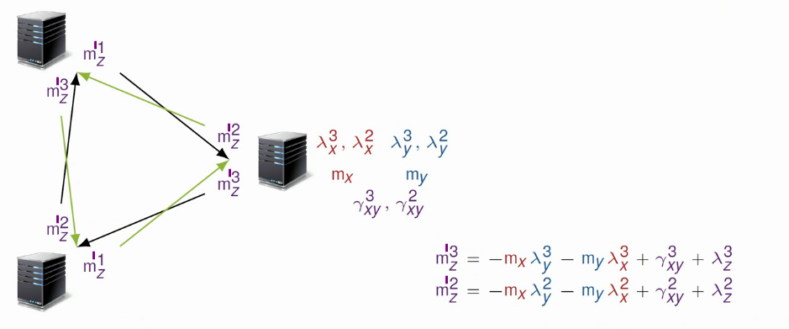
If either \(P_2\) or \(P_3\) is malicious and sends an incorrect value, then \(P_1\) will receive two different values and immediately know that something went wrong, and will abort. On the other hand, if the \(P_1\) is the malicious party, both senders provide the same correct value, and since it is perfectly masked by \(\lambda_z\), no additional information is leaked.
But Trident does not stop here. To save communication, it introduces a further optimization: rather than having both \(P_2\) and \(P_3\) send the full value, one of them sends the value in the clear while the other sends only a hash of it, using a collision-resistant hash function \(H\). The receiver can then hash the plain value it received and compare it against the hash, aborting in case of a mismatch.

Note also that this optimization scales nicely when parties need to compute many multiplications in parallel: instead of sending one hash per value, all the values can be appended together and hashed at once, compressing the entire batch into a single hash. The communication overhead is therefore amortised across all multiplications, making it essentially negligible.
Trident pushes this idea one step further, and this is where things get interesting. What if we do not send the hash at all during the multiplication, and instead delay it until the very end of the protocol execution, right before the output is revealed? At first glance, this seems like a reasonable trade-off: we temporarily lose the per-multiplication redundancy check, but we gain efficiency, and everything is still verified before any output is released. Surely nothing can go wrong?
The core issue: input privacy leakage
To achieve negligible amortized communication overhead, Trident batches many individual verification steps from multiple multiplications into a single verification at the end. More precisely, the protocol runs optimistically without any intermediate checks and performs a single batched verification immediately before any outputs are revealed. This makes the verification overhead completely independent of the size of the computed circuit, yielding zero amortized overhead per multiplication gate.
This optimization is, however, only described informally in the protocol specification and is never accounted for in the security proof. This gap between what is proven and what is actually implemented is not just a technicality — it breaks the security of the entire protocol. Let us see why.
To make things concrete, say we want to compute \(c = a \cdot b\) and then use the result to compute \(e = c \cdot d\). The figure below details the online phase of the two multiplications and the batched verification required to evaluate the circuit corresponding to these two operations.
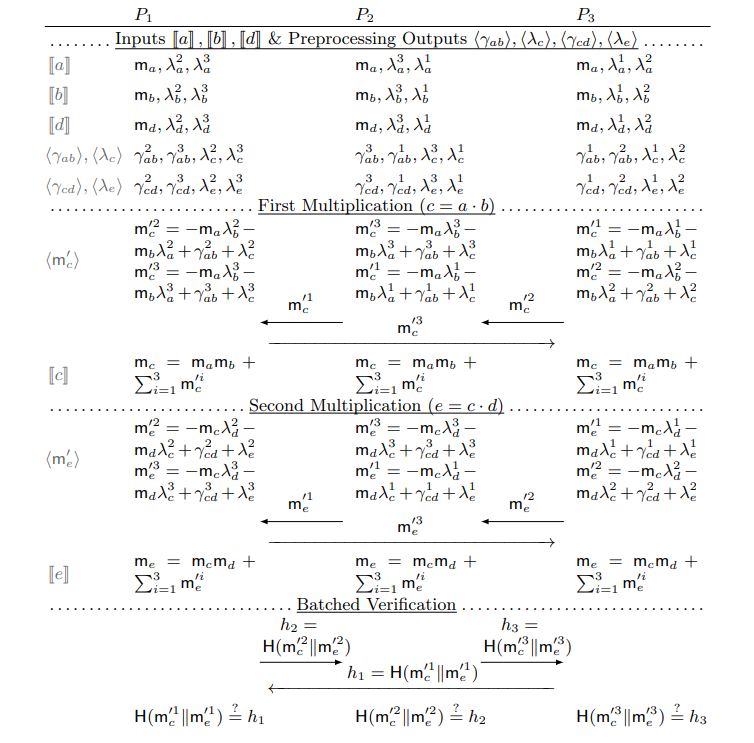
The batched verification remains sound, meaning that a cheating party will always be caught before any output is revealed. The problem is more subtle than that: it is about privacy.
Without an immediate check, a corrupt party can inject an incorrect value that goes undetected for now. This causes honest parties to compute their subsequent multiplications on a poisoned state, resulting in inconsistent internal values across parties. When the next multiplication comes around and honest parties send their values and hashes, the corrupt party can observe the mismatch between what it receives from each of them. That mismatch carries information about intermediate wire values — information the adversary was never supposed to learn. By the time the batched verification fires and the protocol aborts, the damage is already done. Let us be more concrete.
The attack
Since Trident is symmetric, we can assume without loss of generality that \(P_1\) is the corrupt party. In the setting of the two-multiplication example above, during the first multiplication \(P_1\) is supposed to send \(m_c^{\prime 3}\) to \(P_3\). The attack is simple: \(P_1\) sends \(m_c^{\prime 3} + 1\) instead. This causes \(P_3\) to reconstruct \(m_c + 1\) rather than the correct \(m_c\), poisoning its state for the second multiplication. The error does not propagate to \(P_2\) at this point, so during the batched verification \(P_3\) receives the correct hash from \(P_2\) but an inconsistent one from \(P_1\), and the cheating attempt is detected.
However, detection is not the end of the story. During verification, \(P_1\) receives from \(P_3\) the hash \(h_1 = H(m_c^{\prime 1} \vert \vert m_e^{\prime 1} – \lambda_d^1)\), which will not match what \(P_2\) provides, precisely because of the poisoned state. \(P_1\) can now perform an exhaustive search over all \(i \in \mathcal{R}\) to find a value satisfying \(H(m_c^{\prime 1}\vert\vert m_e^{\prime 1} – i) = h_1\). Barring a hash collision, this uniquely identifies \(i = \lambda_d^1\). Since \(P_1\) already knows \(m_d\), \(\lambda_d^2\), and \(\lambda_d^3\), it can now reconstruct the plaintext \(d\) — another party’s private input.
This brute-force search is only efficient when \(|\mathcal{R}| \ll 2^\kappa\), which holds for typical domains such as the binary domain or \(\mathbb{Z}_{2^{32}}\). Depending on the application, \(d\) may come from an even smaller subdomain, making the attack feasible on larger rings too. Attacks on more complex circuits are also possible. For the full details, I would like to refer the reader to the original paper.
The efficient fix
We have just seen that even when soundness holds, the outcome of individual consistency checks can still leak information. The fix proposed by the paper is elegant: instead of running three separate consistency checks whose individual outcomes are visible to the parties, a single secure sub-protocol executes all three checks jointly and reveals only their combined result. More precisely, the parties only learn whether all checks passed or at least one failed, but never which specific check was the culprit. The output is therefore always either “accept” or “reject”, and nothing more. A cheating party learns no additional information from the verification, closing the gap that the attack exploited.

The fix proposed by the authors relies on a joint consistency check functionality \(\mathcal{F}\), parametrized by a set of equality checks. Each involved party contributes a value, and the functionality outputs only a single bit: either all checks pass, or at least one fails, without revealing which one or by how much.
In the context of Trident, each party \(P_i\) locally computes a hash \(h_i^1\) over the values it received during the multiplication protocol, and receives a hash \(h_i^2\) from the previous party \(P_{i-1}\) to compare against. Rather than comparing these hashes directly, which is precisely what leaks information in the original protocol, both values are instead fed into \(\mathcal{F}\) as inputs to an equality check. The three individual checks are bundled into a single joint call to \(\mathcal{F}\), instantiated with the index set \(\{1, 2, 3\}\). The result is binary: either all three equalities hold and the protocol continues, or at least one fails and the protocol aborts. Crucially, a cheating party learns nothing beyond this single bit — it cannot use the outcome of any individual check to extract information about the honest parties’ intermediate values, which is exactly the leakage the original delayed verification enabled. This comes at essentially zero amortized overhead, preserving the efficiency advantage that motivated the optimization in the first place.
Conclusion
The paper we discussed today serves as a timely reminder that small, seemingly innocent optimizations can have serious security consequences. The vulnerability uncovered here followed a pattern that is probably more common than we would like to admit: a protocol is carefully designed and formally proven secure, and then an optimization is introduced that appears so harmless it is described only informally, in plain text, without updating the formal specification or providing a new security proof. In our case, the original proof, which was written for the unoptimized protocol, quietly stops applying, but nobody notices because the optimization looks obviously correct. As we have just learned, it wasn’t.
What makes this especially striking is that the vulnerability was not confined to a single protocol. A similar flawed pattern was inherited by Fantastic Four, SWIFT, and Quad, suggesting that once an optimization is introduced and goes unchallenged in one paper, it tends to be adopted by follow-up work without further scrutiny. The practical impact is real too: the attack affects implementations available in MP-SPDZ, one of the most widely used MPC frameworks.
The takeaway is clear: optimizations are not free. Every deviation from a formally proven protocol specification, no matter how minor it may seem, deserves its own careful analysis and, ideally, its own proof. This paper is a wake-up call for the MPC community to treat the gap between a protocol as proven and a protocol as implemented with the same seriousness as the original security argument itself.


