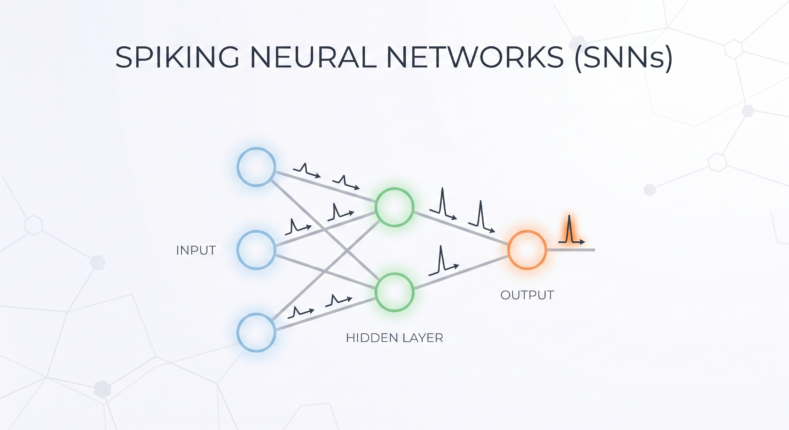
This blogpost was inspired by a recent keynote I attended at the DCOSS-IOT conference: “6G NTN Communication and Edge Computing for Satellite IoT” by Prof. Symeon Chatzinotas [1]. While discussing the massive logistical hurdles of deploying AI in space—where computing power and battery life are strictly limited—he mentioned a technology I had never encountered: Spiking Neural Networks. That passing mention sent me down a rabbit hole to understand exactly what SNNs are, why they are the future of low-power computing, and how to build one from scratch. Hope you enjoy the reading!
We are living in the golden age of Artificial Intelligence. From Large Language Models (LLMs) writing code to vision systems diagnosing diseases, Artificial Neural Networks (ANNs) have proven they can solve incredibly complex problems.
But this revolution has a massive, hidden cost: Electricity.
Standard deep learning models are incredibly power-hungry. Every time you ask an AI a question, the network doesn’t just “think”—it computes. Under the hood, standard ANNs rely on continuous, floating-point numbers. To make a single prediction, the computer must perform billions, or even trillions, of complex Multiply-Accumulate operations.
Multiplication is mathematically heavy and computationally expensive. As our models grow from billions to trillions of parameters, our data centers are quite literally hitting a thermal and energetic wall.
If we want AI to scale—especially on small, battery-powered edge devices like smartphones, drones, or pacemakers—we need a paradigm shift. We need to look at the most efficient supercomputer in the known universe: The Human Brain.
Our brain contains roughly 86 billion neurons and over 100 trillion synapses. It processes real-time audio, high-definition stereo vision, and complex motor control simultaneously. Yet, it does all of this running on about 20 watts of power—less energy than a standard refrigerator lightbulb.
How does the brain achieve this impossible efficiency? It doesn’t use continuous numbers, and it certainly doesn’t multiply floats.
The brain communicates in a completely different language. It uses discrete, electrical pulses over time. It uses Spikes. By reverse-engineering this biological trick, researchers and neuromorphic engineers have developed an entirely different paradigm of machine learning: Spiking Neural Networks (SNNs).
What Actually is an SNN?
To understand why Spiking Neural Networks are so efficient, we have to look at how they communicate compared to standard deep learning models.
As mentioned above, standard ANNs communicate using continuous, floating-point numbers. A neuron can output a 0.2, a 0.85, or a 3.14. Because these analog signals are constantly flowing and varying in intensity, the computer’s GPU has to constantly perform heavy, complex multiplication to process them.
Instead, SNNs communicate using binary pulses over time. In an SNN, a neuron only has two states: it is either completely silent (0), or it fires a brief electrical pulse called a spike (1). The actual shape or magnitude of the pulse doesn’t matter. All the information is encoded purely in the timing of the spikes.
The Power of Sparsity
Before diving into technical details, let’s discuss why is this binary system such a massive advantage? It comes down to a concept called Sparsity.
In a traditional ANN, even if a neuron’s output is close to zero (say, 0.001), the hardware still has to multiply that number across thousands of network connections. The GPU is doing heavy math constantly, everywhere, all at once.
However, in an SNN the network is mostly silent. If a neuron doesn’t receive enough stimulation to cross its threshold, it outputs exactly 0. And here is the magic of binary math: you don’t need to compute zeros. When an SNN is mostly silent, the hardware does no work. And when a neuron does fire a 1, the math becomes incredibly simple. You don’t need to multiply a weight by 1; you just add it. SNNs replace power-hungry Multiply-Accumulate operations with fast, cheap Addition-only operations.
Hardware that Speaks the Language
To truly unlock this efficiency, we need hardware that actually speaks this binary language. Traditional GPUs are designed to blast through dense, continuous matrices and aren’t well-suited for SNNs.
However, a new generation of processors, known as Neuromorphic Hardware (like Intel’s Loihi), are built specifically to mimic the brain’s architecture. They are designed to process sparse, asynchronous spikes. When a part of a neuromorphic chip isn’t actively processing a spike, it essentially powers down, leading to the massive energy savings that allows to run AI on a energy-constrained devices.
SNNs Under the Hood: Physics and Roadblocks
To build an SNN, we have to swap out the standard artificial neurons for something physically grounded.
Neuroscientists have given us a wide menu of mathematical models to choose from, ranging from incredibly complex to highly simplified. Here, I just briefly mention the options, but feel free to explore them deeper.
- The Hodgkin-Huxley Model: This is the biological “gold standard.” It perfectly models the complex flow of sodium and potassium ions in a real cell. However, the math is so heavy that trying to run a deep learning network with it would melt a GPU. It is great for biology, but terrible for scalable AI.
- The Integrate-and-Fire (IF) Model: This is the simplest extreme. It just adds up incoming signals until it hits a threshold and fires. It is computationally cheap, but it lacks any real sense of time—a signal from yesterday is treated the same as a signal from a millisecond ago.
- The Leaky Integrate-and-Fire (LIF) Model: This is the “Goldilocks” model. It strikes the perfect balance between biological realism and computational efficiency. It is the undisputed workhorse of Neuromorphic Engineering, and it is the exact neuron we are going to use today.
The Dead Gradient Problem
This physics engine sounds elegant, but it has a massive roadblock: The Dead Gradient Problem.
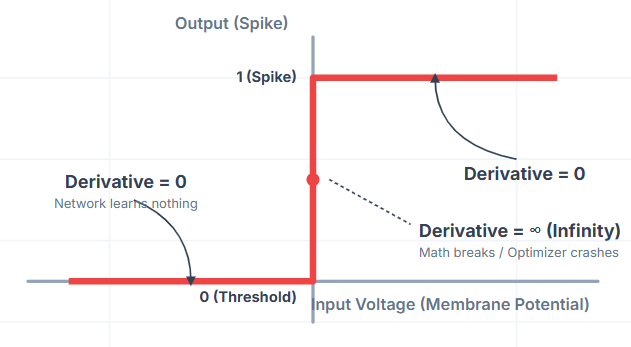
Modern neural networks learn by making mistakes and updating their weights using an algorithm called Backpropagation. Backpropagation relies on calculus—specifically, it needs to calculate the derivative of a neuron’s activation function to figure out how to adjust the weights.
Standard ANNs use smooth, continuous curves (like Sigmoid or ReLU), which allow to easily calculate their derivatives. But remember: an SNN spike is binary. It is exactly 0, and then it instantly jumps to 1. Mathematically, this is a vertical cliff.
- The derivative of a flat line (
0) is zero. - The derivative of a vertical cliff is infinity.
If you pass zero or infinity backward through a standard optimizer like Adam or SGD, the math instantly breaks. The network learns absolutely nothing. Training is dead on arrival.
Solving the Dead Gradient
To get around this mathematical roadblock there are a couple of approaches one might take. For the sake of keeping this blogpost reasonable size, I mention a couple of them without going deeply into the details.
- The Biological Way (STDP): Neuroscientists discovered that real brains learn through a process called Spike-Timing-Dependent Plasticity (STDP). In STDP, the brain doesn’t use calculus to update weights; it just looks at timing. If Neuron A fires right before Neuron B, their connection gets stronger. It is an “unsupervised” learning rule. It is great at finding basic patterns, but it is challenging to train those networks on supervised tasks.
- The Conversion Method (ANN-to-SNN) Another idea is to avoid training the SNN at all. Instead, we can train a continuous ANN using normal Backpropagation. Once the network is fully trained and highly accurate, we can “convert” it to SNN. However, to accurately mimic a continuous number using rate-coded spikes, the network has to run for hundreds of “time steps” during inference. While individual SNN operations are cheap, forcing the hardware to run 500 times just to classify a single image destroys the low-latency, low-energy benefits we wanted in the first place.
- The Deep Learning Hack (Surrogate Gradients): If we want to achieve state-of-the-art accuracy on labeled datasets, we have to find a way to make Backpropagation work. To do this, we use a mathematical trick called the Surrogate Gradient. We essentially give our neural network a split personality to trick the PyTorch optimizer:
- During the Forward Pass: We play by the strict biological rules. The network only ever sees true binary spikes (
0or1). The step function is a hard, vertical cliff. - During the Backward Pass: When it is time to calculate the errors and update the weights, we intercept the math. We tell the computer, “Pretend that vertical cliff was actually just a smooth, continuous hill.” By replacing the infinite derivative of a true spike with the smooth derivative of a fake curve, we give backpropagation the gentle slopes it needs to navigate down the mountain. The optimizer updates the weights successfully, and the network learns!
- During the Forward Pass: We play by the strict biological rules. The network only ever sees true binary spikes (
Now, that we know the theory, let’s discuss some problems-to-solve and challenges in developing SNNs.
Problems of SNNs
You might be thinking, if Spiking Neural Networks are so incredibly power-efficient, why isn’t every tech company on earth replacing their standard ANNs with SNNs today?
While the theoretical benefits are massive, Neuromorphic Engineering is currently battling a couple of major real-world bottlenecks.
1. The Hardware Mismatch
The biggest ironies of SNNs is that to test them, we usually have to run them on standard GPUs. GPUs are highly optimized to do one thing: multiply massive, dense matrices of continuous numbers together all at once.
When you force a GPU to run sparse, sequential computations, it is incredibly inefficient. Until true Neuromorphic chips become as cheap and widely available as consumer GPUs, SNNs cannot fully flex their power-saving muscles in production.
2. Training problems
Standard ANNs have had billions of dollars and decades of research poured into optimizing them. We know exactly how to scale them to trillions of parameters to build things like LLMs.
SNNs are still a developing science. While they are phenomenal at processing streams of sensory data (like audio or event-based cameras), getting them to match high accuracy of standard deep learning on complex, static tasks is mathematically difficult. Surrogate gradients are a brilliant hack, but they are still an approximation, which makes training deep SNNs unstable.
Despite these hurdles, the energy wall is approaching fast. The researchers who figure out how to scale SNNs effectively will dictate the next decade of AI hardware. And to do that, we need more engineers who understand how the underlying physics actually work.
Building It Yourself: From Math to Code
Theory and biological metaphors are great, but in machine learning, you don’t truly understand a concept until you can compile it. To see exactly how this biological ticking works, we are going to build a Spiking Neural Network to solve a classic machine learning problem: Classifying Palmer Penguins.
👇 Dive into the code below!
https://colab.research.google.com/drive/1ArbsAE3WZKmbEQTxD5jxg8kyj0e8jiLj?usp=sharing
References
[1] S. Chatzinotas, “6G NTN Communication and Edge Computing for Satellite IoT,” Keynote presentation at DCOSS-IoT, 2026. Available: https://sites.google.com/view/symeonchatzinotas/education/talks?authuser=0
[2] I. Semenov and D. Nikitin, “Advantages and Disadvantages of Spiking Neural Networks Compared to Classical Artificial Neural Networks,” in 2023 Seminar on Information Computing and Processing (ICP), Saint Petersburg, Russian Federation, 2023, pp. 192-194. doi: 10.1109/ICP60417.2023.10397433. Available: https://ieeexplore.ieee.org/document/10397433
[3] M. Pfeiffer and T. Pfeil, “Deep Learning With Spiking Neurons: Opportunities and Challenges,” Frontiers in Neuroscience, vol. 12, 2018, Art. no. 774. doi: 10.3389/fnins.2018.00774. Available: https://www.frontiersin.org/journals/neuroscience/articles/10.3389/fnins.2018.00774/full
[4] H. Gao et al., “High-accuracy deep ANN-to-SNN conversion using quantization-aware training framework and calcium-gated bipolar leaky integrate and fire neuron,” Frontiers in Neuroscience, vol. 17, Mar. 2023, Art. no. 1141701. doi: 10.3389/fnins.2023.1141701. Available: https://pmc.ncbi.nlm.nih.gov/articles/PMC10030499/
[5] C. Eliasmith, “Spiking Neural Networks for More Efficient AI Algorithms,” YouTube, Waterloo Centre for Theoretical Neuroscience. Available: https://www.youtube.com/watch?v=PeW-TN3P1hk
[6] tapwi93, “First steps in Spiking Neural Networks,” Medium. Available: https://medium.com/@tapwi93/first-steps-in-spiking-neural-networks-da3c82f538ad
[7] “Spiking Network Simulation,” YouTube. Available: https://www.youtube.com/watch?v=oG0PTP3ogCA


