This blog post summarises the key ideas from the full paper “Secure Wi-Fi Ranging Today: Security and Adoption of IEEE 802.11az/bk” by Nikola Antonijević et al., presented at ARES 2026 in Linköping, Sweden. The ARES proceedings will be available soon from Springer. In the meantime, the accepted version of the paper is available on arXiv.
The paper examines the security and practical deployment of secure Wi-Fi ranging introduced by IEEE 802.11az and extended by IEEE 802.11bk, combining standards analysis, simulations, and measurements on commercial and development hardware.
What is Wi-Fi ranging?
Most of us think of Wi-Fi simply as a way to connect devices to the Internet. However, the radio signals exchanged between Wi-Fi devices can also be used to estimate how far apart those devices are.
This is especially useful indoors. The Global Positioning System (GPS) works well outdoors, but its signals are often weak or unavailable inside buildings. Wi-Fi access points, on the other hand, are already present in homes, offices, airports, shopping centres, and many other indoor environments. This makes Wi-Fi an attractive basis for indoor positioning and ranging.
Early Wi-Fi positioning systems often estimated distance from the received signal strength. In simple terms, a weaker signal was assumed to come from farther away. The problem is that signal strength is affected by much more than distance. Walls, furniture, reflections, and even people moving through the environment can all change it.
A more direct approach is to measure how long the radio signal takes to travel between two devices. This is the idea behind Fine Timing Measurement (FTM), introduced into Wi-Fi with IEEE 802.11mc in 2016. FTM is also commonly referred to as Wi-Fi Round Trip Time (RTT).
The basic idea is similar to measuring distance with a stopwatch. One device sends a message, the other replies, and carefully recorded timestamps are used to determine how much of the elapsed time was spent by the radio signal travelling through the air.
Figure 1 illustrates this exchange between a Wi-Fi station and an access point. The access point sends an FTM message, the station records when it arrives and sends a response, and the access point records the corresponding receive time.
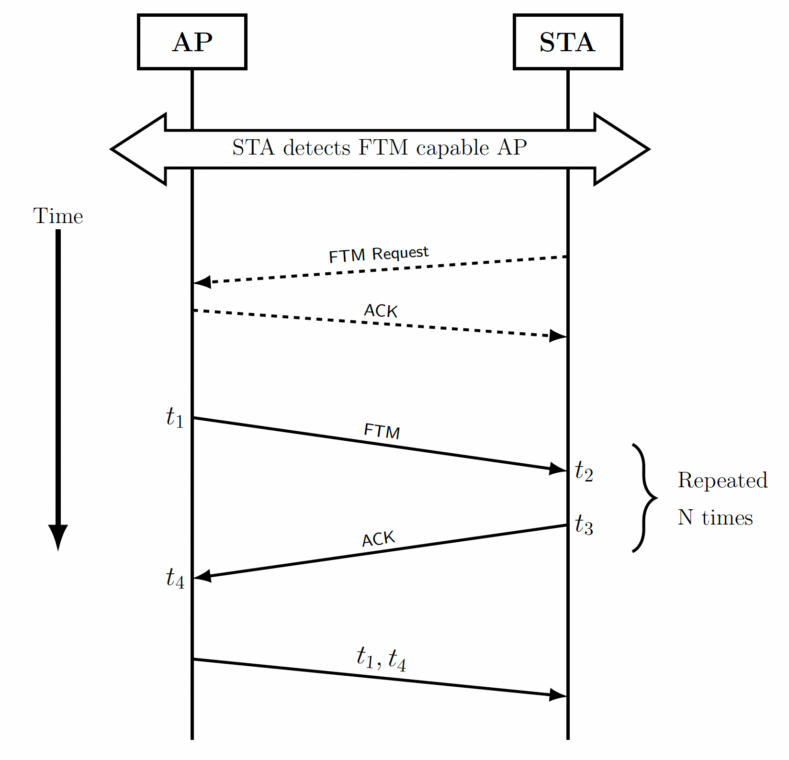
Figure 1: Example of an FTM ranging exchange between a Wi-Fi station and an access point.
Using the four timestamps shown in Figure 1, the distance can be estimated as:
,
where is the speed of light, and are the access point’s transmit and receive timestamps, and and are the corresponding receive and transmit timestamps at the station. The division by two accounts for the signal travelling to the other device and back. In practice, the exchange is repeated several times to obtain a more reliable measurement.
This allows existing Wi-Fi infrastructure to support applications such as indoor navigation, asset tracking, and proximity-aware services without requiring a separate positioning technology. But as soon as the measured distance starts influencing a security decision, for example whether a device is considered close enough to perform some action, the trustworthiness of that measurement becomes important as well.
That is where the newer IEEE 802.11az standard, introduced in 2023, comes in.
Making Wi-Fi ranging secure
The original FTM design focused on improving ranging accuracy, but did not provide strong protection against an active attacker. Important management messages were unprotected, while the physical-layer signals used to estimate when a signal arrived followed publicly known patterns. This meant that an attacker could potentially manipulate the exchange and influence the measured distance.
IEEE 802.11az was introduced to strengthen FTM at both levels. At the protocol level, it protects the management frames exchanged during ranging. At the physical layer, it changes the High Efficiency Long Training Fields (HE-LTFs), which are special training signals that the receiver uses to estimate when the Wi-Fi signal arrived. Instead of using predictable patterns, secure HE-LTFs are generated from shared secret key material and are intended to change for every measurement.
The standard also introduces Preassociation Security Negotiation (PASN), which allows two devices to establish the cryptographic keys needed for secure ranging without first setting up a normal Wi-Fi data connection.
In principle, these changes address many of the weaknesses of legacy FTM. In practice, however, the security obtained depends strongly on how the devices authenticate each other and how secure ranging is configured.
Who are you actually ranging with?
One of the less obvious limitations of secure FTM is that protecting the ranging exchange is not the same as proving that you are ranging with the intended access point.
In common WPA2-Personal and WPA3-Personal networks, authentication is based on a shared password. In WPA2-Personal, anyone who knows that password and observes the connection setup can derive the keys protecting the session. WPA3 improves this by preventing such passive key recovery, but a person who knows the shared password can still create a convincing rogue access point and establish a valid connection with the victim. In both cases, secure ranging may end up proving proximity to an attacker rather than to the trusted infrastructure.
A similar issue appears when PASN is used on its own, without an already authenticated Wi-Fi connection. PASN can still establish keys and protect the ranging messages, but the standard does not guarantee strong mutual authentication in this mode. An active attacker can therefore place themselves between the two devices and participate in the ranging exchange.
This distinction matters most for security-critical applications. For indoor navigation or analytics, knowing that a nearby device participated in the exchange may be sufficient. For access control or distance-based authorisation, however, the system must also know which trusted device it is measuring distance to.
For the full analysis of these authentication issues, together with downgrade paths, configuration choices, error handling, and denial-of-service scenarios, we refer interested readers to the full paper.
Can an attacker still manipulate the distance?
Secure HE-LTFs are designed to make the ranging signal difficult to predict. Since their contents are generated from fresh secret material, an attacker who has observed only part of the signal should not be able to reliably reconstruct what comes next. Our simulations show that observing more of the signal provides more information, but reliably reconstructing the unseen part remains difficult.
Why does this matter? To make two devices appear closer, an attacker can try to transmit an advanced replica of the ranging signal, causing the receiver to detect it earlier than the legitimate signal. The attacker first observes part of the secure HE-LTF and then advances the remaining portion of the signal.
Figure 2 shows the resulting effect on the measured distance. The horizontal axis represents how far the attacker advances the signal in time, measured in samples, while the vertical axis shows the resulting error in the estimated distance. Positive shifts make the devices appear closer, while negative shifts make them appear farther apart. The different colours indicate how much of the HE-LTF is observed before the attack. For example, 20% observed means that the remaining 80% of the signal is advanced, giving the attacker a larger portion of the waveform with which to influence the distance estimate. With 90% already observed, only the remaining 10% can be advanced, so the resulting distance bias is much smaller. The different line styles show different signal-to-noise ratios.
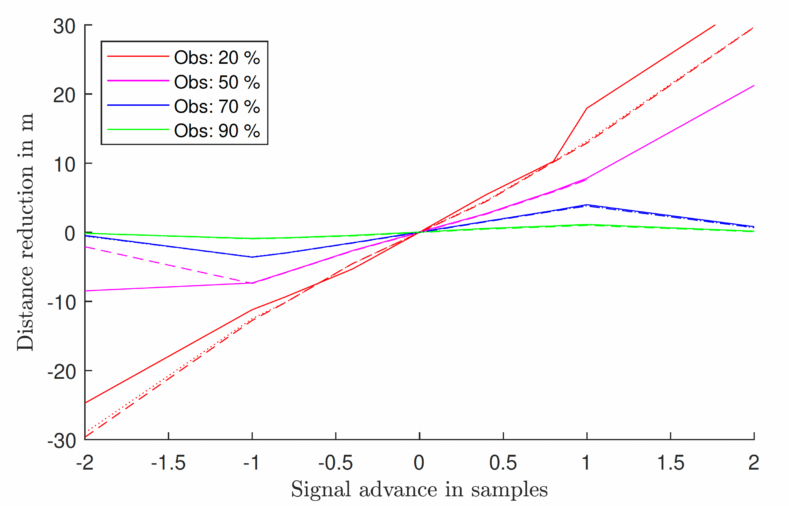
Figure 2: Distance bias caused by advancing different portions of the secure HE-LTF.
The result highlights why keeping the secure HE-LTF fresh and unpredictable is important. If the waveform becomes known in advance, for example because key material is reused or the system falls back to predictable legacy training fields, the attacker can generate and advance the signal much more easily. For the full attack model and simulation results, we refer interested readers to the full paper.
Why is secure Wi-Fi ranging still rare?
Despite being standardised, secure FTM is still difficult to find in real devices. During our testing, even hardware advertised as supporting IEEE 802.11az implemented only part of the standard. The development platform we used supported protected management frames, but not the secure HE-LTFs that provide the physical-layer protection. We also did not observe secure FTM support on the Google Pixel 9a that we tested.
One reason is that some of the new protections are difficult to realise in existing radio hardware. In particular, secure HE-LTFs replace the usual cyclic prefix with a zero-power guard interval, during which the transmitter should briefly stop transmitting between training symbols. Achieving such rapid changes in power is challenging for a real radio-frequency front end.
Figure 3 illustrates this problem. It compares the spectrum of legacy FTM on the left with secure FTM on the right. The blue curve shows the ideal signal before the power amplifier, while the orange curve shows what happens after modelling a realistic, non-linear power amplifier. The black line is the spectral mask, which defines how much energy the transmitter is allowed to emit outside its intended Wi-Fi channel.
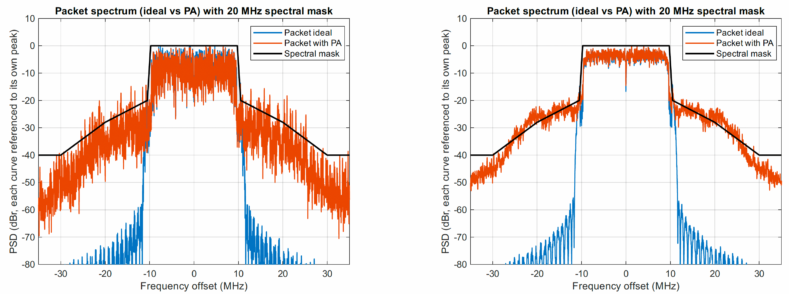
Figure 3: Simulated spectrum of 20 MHz FTM signals. Left: legacy HE-LTF with cyclic prefix. Right: secure HE-LTF with zero-power guard interval. Blue shows the ideal signal, orange the amplified signal, and black the spectral mask.
In both cases, the real amplifier spreads some energy outside the desired band. With the secure waveform, however, the zero-power guard interval spreads this unwanted energy across a larger part of the spectrum. In our simulation, about 31.6% of the analysed frequency bins exceeded the mask for secure FTM, compared with about 6.7% for the legacy waveform. This does not mean that secure FTM cannot be implemented, but it can require additional filtering, lower transmit power, or changes to the RF hardware.
This helps explain why full IEEE 802.11az support may require more than a firmware update. Together with the relatively strict conditions needed to obtain its strongest security guarantees, these hardware challenges create a real barrier to widespread adoption. For a more detailed analysis of the spectral behaviour and implementation challenges, we refer interested readers to the full paper.
What does this mean in practice?
Secure FTM is a meaningful improvement over legacy Wi-Fi ranging, but its guarantees depend on several conditions being met at the same time. Devices need strong mutual authentication, secure HE-LTFs must actually be enabled, insecure fallbacks should be avoided, and the ranging signals must remain fresh between measurements.
For lower-stakes applications such as indoor navigation or analytics, secure FTM can still be a useful additional signal. For security-critical uses such as keyless entry or distance-based access control, however, we recommend treating it with more caution and relying on strongly authenticated deployments with strict configuration policies.
These observations also apply to IEEE 802.11bk, which increases the available bandwidth to improve ranging accuracy but inherits the security mechanisms of IEEE 802.11az. Better accuracy therefore does not remove the authentication, configuration, or implementation challenges discussed above.
Conclusion
IEEE 802.11az represents an important step towards making Wi-Fi ranging more trustworthy, but our results show that its security depends on more than simply enabling a new standard. Strong authentication, careful configuration, fresh ranging signals, and suitable hardware are all needed for the intended protections to hold. IEEE 802.11bk improves ranging accuracy, but inherits the same security foundations and therefore the same limitations. For the complete analysis and recommendations, we refer interested readers to the full paper.


