One of the fundamental purposes of anonymous communication is to provide a platform for freedom of speech and expressing opinions. The idea is that users feel free to express their opinions in forms, such as public forums, micro-blogging, voting without the fear of being identified by powerful stakeholders such as the NSA and without the fear of retributions by such institutions.
In the last three decades, numerous anonymous communication networks (ACNs) have been suggested in the literature and deployed in the real world that enable the senders to remain anonymous when communicating with (potentially malicious) destinations by hiding their identity or location from the destinations itself but also from anyone who can track their communication on the Internet. Many ACNs operate by routing messages over multiple servers (relays) in such a way that an adversary is unable to link the source and destination of the messages.
Tor is the most commonly used anonymous communication system in real world with over 2 million users per day. However, Tor’s threat model is assuming an adversary that has only local reach, which is helpful in many cases, but it is not strong enough if you vote or cast your opinion against a very powerful adversary. Tor is not secure against traffic analysis and its anonymity rather relies on the fact that Tor is large and hopefully the adversary would not be able to reach the Tor relays that are re-routing targeted communication. Tor does not provide verifiable anonymity but rather provides good odds.
Recently, in our work “Multiparty Routing: Secure Routing for Mixnets” we developed a new protocol for anonymous communication that is geared towards applications more tolerant to latency, such as anonymous wiki, micro-blogging, voting, and auctions and that provides strong guarantees against a global adversary. The main novelty of our system lies in the decentralized approach we take to making the routing decisions (for each relay) by using multiparty computation techniques. We call our approach multiparty routing as all the routing relays contribute to the decision of where to forward the next message in the system. As long as a single honest routing party in the system exists, the message path is randomized at each step.
Compared to previous ACN designs our multiparty routing system achieves better resilience and scalability advantages over ACN systems using cascades structures (i.e., [2] JAP) where the paths are fixed and predetermined by the system and over source routing (i.e., Mixminion). We improve scalability which more concretely, refers to the possibility to better adapt our system without each user maintaining a complete view of it. Moreover, our multiparty randomized routing approach prevents the route capture attacks of the other hop-by-hop routing ACN systems (i.e., Freenet) where each router locally decides on the next immediate destination.
Scalability and resilience are important for ACNs because they support a growing user base for the system which generally improves the anonymity the system can provide.
Our concrete multiparty routing protocol employs cryptographic primitives, such as commitment schemes, signatures, and cryptographic hash functions. We combine our protocol with a mix network that employs provable shuffles, threshold decryption, and re-randomizable encryption to realize secure and verifiable anonymous communication.
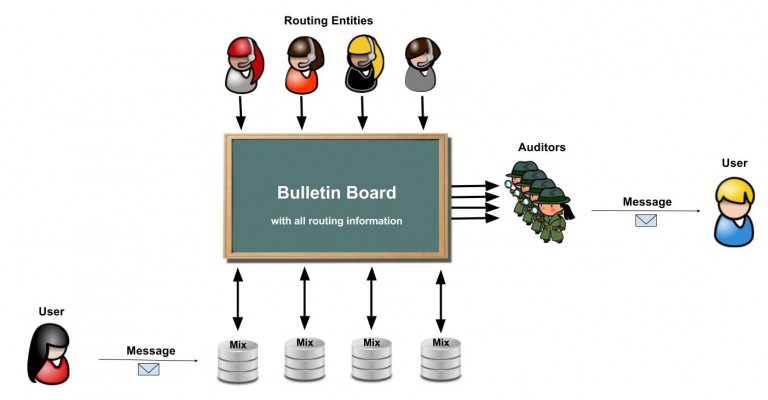
Our protocol uses a public bulletin board readable by all parties in the system: users and dedicated servers, as illustrated in Fig. 1. The users want to send messages anonymously and as a first step they encrypt their messages and send them to some of the servers. The servers altogether cooperate with each other to achieve secure anonymous routing. We have three sets of servers: relays, routing entities, and auditing entities. The relays fetch and then publish from and to the bulletin board ciphertext messages after processing those. The routing entities are responsible for establishing the route or the next relay to process a ciphertext message. The third set of servers are the auditors (auditing entities) AE. Auditors are mainly responsible for verifying the correctness of processing by the relays and routing entities in the system, and the final message decryption.
The details of our novel protocol can be found in [1].
References
[1] Fatemeh Shirazi, Elena Andreeva, Claudia Diaz, Markulf Kohlweiss , Multiparty Routing: Secure Routing for Mixnets, [link: 2017].
[2] David L. Chaum, Untraceable electronic mail, return addresses, and digital pseudonyms. Commun. ACM 24, 2 (February 1981), 84-90, 1981.
[3] George Danezis and Andrei Serjantov, Statistical disclosure or intersection attacks on anonymity systems. In Proceedings of the 6th international conference on Information Hiding (IH’04), Jessica Fridrich (Ed.). Springer-Verlag, Berlin, Heidelberg, 293-308, 2004.
Thanks to Elena Andreeva and Fatemeh Shirazi for writing this blog post!


