Real World Crypto (RWC) 2018 took place in Zurich, Switzerland on January 10-12. This year is the first time that it is organised by the International Association for Cryptologic Research (IACR). It brought together approximately 600 participants ranging from well-established cryptographers, CEOs of companies, developers, to bachelor students – making it the biggest IACR event so far. RWC aims at strengthening the collaboration between academia and industry in bringing the latest advances in cryptography to real-world applications and systems.
The programme consisted of invited and contributed talks selected on the basis of impact on the real world. There were 13 sessions on various topics including the session on Levchin prize and the special session of lightning talks. Below we tried to summarise each session and give you our impressions. If you are curious about any specific talk, you can always check the presentations here or watch the talks here.
Day One
Day one kicked in with a welcome message from Prof. Nigel Smart. As usual, his message was straight to the point, entertaining and refreshing. No one likes long and boring opening talks. 🙂
The first session of the day was on Key management services. The first talk was given by Shay Gueron (Amazon and U. of Haifa) who gave an insight into the AWS Key Management Service
(KMS) – more specifically – how to handle cryptographic bounds for use of AES-GCM. Following the NIST requirements, one should never invoke AES-GCM with the same (key, iv) pair with probability higher than 2-32. This restricts the number of encryptions that can be done under a single customer master key (without rotation) to 232 encryptions. Apparently, 4 billion is not a big number in the cloud, as it needs to protect trillions of objects. Thus, using AES-GCM in a naive way will not satisfy the NIST requirements. To overcome this limitation, Shay presented a way to extend the lifetime of a key by using a nonce based encryption scheme, and showed the security bounds of the key offered by their scheme. In summary, AWS KMS can support up to 240 master keys, and each master key can be used to perform 250 encryptions. The second talk was given by Anand Kanagala (Google) who explained the reasons for the `great’ Gmail outage of 2014, and gave a summary of the measures Google took to avoid such outages in the future. The take away messages here were: eliminate the global control plane, control roll-out of binaries and configuration, minimize dependencies, and isolate regional failures.
The second session of the day was on Crypto currencies. The first speaker was Andrew Poelstra (Blockstream) who explained what Mimblewimble and Scriptless Scripts are and how they work. Mimblewimble is a new design where people can verify the state of a system without the need of downloading all the background data. It reduces the amount of data space required by users from 270 GB (when the bitcoin blockchain with confidential transactions is used) to 65 GB when Mimblewimble is used. The trick here is that Mimblewimble gets rid of the intermediate outputs and uses new more efficient rangeproofs, called bullet proofs. Adding Scriptless Scripts to Mimblewimble allows one to execute smart contracts on the blockchain in a privacy-friendly way as only the public keys and digital signatures are visible to the public, but not the content of the contract.

Ian Miers presenting ZCash: past, present and future
The next talk was on ZCash presented by Ian Miers (JHU and Cornell Tech). This commercially deployed cryptocurrency is being used in real-world cases for about three years. This new coin that unlinks the shielded coins from their history on the blockchain (as claimed by its inventors), enables many new applications. The utilisation of zero-knowledge proofs combined with commitment schemes increases the levels of security and adds privacy features to the blockchain technology. That is why it currently seems that in 2018 ZCash will be getting a lot of attention. Furthermore, the developers of ZCash revealed that they are currently working on improving the usability and privacy protection of ZCash by integrating the use of Tor to it, so that ZCash can also protect against network adversaries. The last talk on zero-knowledge, subversion-resistance, and concrete attacks was given by Matteo Campanelli (CCNY), which was nicely linked with the talk on ZCash. The presentations in this session have given food for thought and were the main theme of discussion during the lunch break. However right before lunch there was a small ceremony in which the Levchin prices were granted. This year they were awarded to Hugo Krawczyk and the open SSL team. Well done to them!
The afternoon presentations kicked in with the first session on Attacks. There were two talks on side channel attacks presented by Yuval Yarom (University of Adelaide) and Olya Ohrimenko (Microsoft), respectively. The first talk even included a live demo of a side channel attack on implementations of Curve25519. Between these two talks, Ruxandra F. Olimid (NTNU) presented a privacy breach on the LTI system. Their team managed to impersonate a base station using low cost IMSI Catcher (costing less than 3000 EUR) to get the IMSI (International Mobile Subscriber Identity) of users in the clear.
The day finished with a session on Usability and privacy. The first talk was given by Yasemin Acar (Leibniz University Hannover). She presented some of the results of their study on usability of cryptographic APIs. In a nutshell, they looked at the usability of five cryptographic APIs which market themselves as user-friendly: PyCrypto, M2Crypto, cryptography.io, Keyczar and PyNaCl. The question they wanted to answer is whether these APIs actually lead to a better security. The recruited developers were split in two groups and each group was given a set of tasks, symmetric or asymmetric encryption tasks. The following tasks were the hardest to solve by the developers: certificate validation — in terms of functionality, and secure key generation and storage — in terms of security. Overall, the Keyczar API was the worst in terms of functionality, but the best in terms of security. It seems that there is still not a single cryptographic API out there that ticks both boxes functionality and security; one should still make a choice between the functionality and security. She also shared ideas on how to improve the current situation – APIs (i) with good documentation including example snippet codes and (ii) which support a full feature set. Next, Emily Stark (Google) talked about the usability of certificate transparency (CT) — a system which would allow anyone to monitor what certificates are being issued, and detect the ones issued mistakenly or maliciously. The take away message was: in order to make it usable, CT should be (i) deployed gradually, (ii) a supplement to the existing web PKI system, and (iii) deployable with a few warnings and with little breakage visibility to end users. Paul Rösler (U. Bochum) talked about the end-to-end security of group chats. Their team has found several weaknesses in the group settings of the widely-used Signal and WhatsApp IM applications. He showed that the traceable delivery requirement — the check marks confirming a message was delivered — is not satisfied by both applications. In other words, messages can be dropped without this being detected by the members of the group. In addition, WhatsApp does not satisfy the closeness requirement — a malicious WhatsApp server can add itself into the group without being invited. Gilad Asharov (Cornell Tech) concluded this session by talking about privacy-preserving search of similar patients in genomic data and more specifically their submission, which won the iDASH competition. He explained their solution and gave several best practice design principles — the most important one being — pushing most of the computation to the preprocessing stage.
Day one concluded with a generous reception including plenty of wine and beers — the essentials for a good networking. 🙂
Day Two
In the session for post-quantum crypto and other new hardware many interesting talks were presented. First, Melissa Chase (Microsoft Research) talked about “Post-quantum signatures”. She gave a motivating example where an attacker with a sufficiently powerful quantum computer can factor numbers and compute discrete logarithms essentially breaking public key crypto (e.g., RSA, DSA, ECDSA). To protect users from such adversarial capabilities, she presented their solution on a post-Quantum signatures schemes using Zero-Knowledge proofs namely Picnic. She presented the building blocks, the final scheme of Picnic. She explained the optimisations and security analysis they performed and tested the performance of Picnic. They run Picnic on TLS and HSM to measure the timings and compare the performance of Picnic with other cryptographic schemes. The talks continued with the “Supersingular isogeny based cryptography gets practical” presentation by Patrick Longa (Microsoft Research). He talked about “Supersingular Isogeny Diffie-Hellman” (SIDH) key exchange protocol and the “Supersingular isogeny key encapsulation” (SIKE) scheme. He presented the limitation of the SIDH related to security — not secure when keys are reused — and provided an implementation link for both schemes. He described their research efforts on improving performance along with a comparison table with other cryptographic schemes such RSA 3072 and ECDH NIST P-256. The session ended with the “UK Research Institute in Secure Hardware and Embedded Systems (RISE)” presentation given by Màire O’Neill. She discussed the importance of secure hardware devices as a key driver to establish a trusted computing baseline. She presented well-known practical attacks, i.e., the Meltdown and Spectre, gave a detailed example about hardware attacks in IoTs and presented a geo-location distribution of Mirai-infected IoT devices. [1] To minimise the attacking surface of hardware devices, she highlighted the following research questions: “How do we detect manipulated (insecure) devices?”, “Is it possible to build attack-resilient hardware platforms?” and “How do we deal with untrusted manufacturing processes & untrusted supply chains?”. She concluded with the research that the Research Institute in Secure Hardware & Embedded Systems (RISE) is conducting on hardware security.
Regarding the broken standards chaired by Kenny Paterson (Information Security Group at Royal Holloway, University of London), we found the research on “Finding collisions for SHA-1″ presented by Pierre Karpman very innovative. In the presentation, different setups for the computation of SHA-1 collision were introduced, the attack’s complexity was presented in an amusing scale (see picture below), and as future work was mentioned that these results could lead to the design of a SHA-1-based crypto-currency.
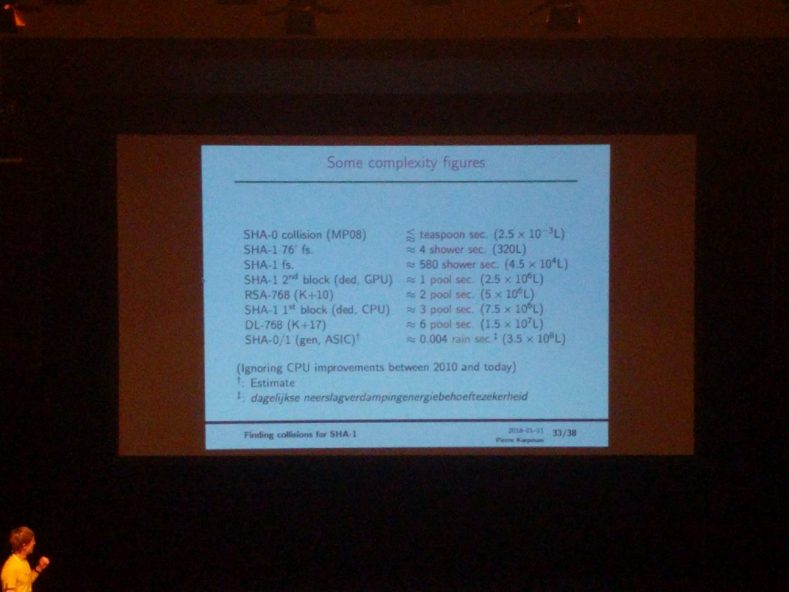
Pierre Karpman showing the complexity of computing SHA-1 collisions in dagelijkse neerslagverdampingenergiebehoeftezekerheid.
This was followed by a talk that explained a generic attack on Feistel networks by F. Betul Durak. In the talk “An attack on the FF3 format preserving encryption”, she gave a detailed overview on how the attack works and explained that it is practical enough to perform on the FF3 standard when the message domain is small. As it is good practice for cryptographers, she also pointed out how to prevent this attack. “Spectre and Meltdown attacks and how data leaks during speculative execution” presented by J. Horn (Google Project Zero) covered a nowadays hot security topic. The approach of the issue was advanced and aimed to underline how security and correctness of implementations can be well achieved discussing the possible trade-offs.
The Lightning talks, which took place right before lunch, gave a nice break from the interesting but rather information-packed talks. It gave people the opportunity to pass on a message in approximately one minute. There was a wide range of topics, from a brief description of their research to advertising some events, offering jobs and even a poem. So, if you are looking for collaborators or a job, or if you are simply just curious about the poem, check the video here.
The first afternoon session dealt with TLS, by far the most widespread and most important cryptosystem. It started with a talk by Cloudflare’s Nick Sullivan discussing the problem of distributing cryptographic keys to all their data centres around the globe. Surprisingly, they are actually using Pairing Based Cryptography to solve this problem, specifically they are using variations of IBE.
Nick’s talk was followed by a comparison of the standardization process of TLS 1.2 and 1.3 by Thyla van der Merwe from Royal Holloway. Thyla explores the historical development of TLS and how the standardization process has improved with respect to the involvement of academic researchers.
While Thyla was vaguely optimistic about the new standard, the final talk was given by Google’s David Benjamin who explained some of the difficulties with actually rolling TLS 1.3 out.
David presented two very important ideas:
- The universal law of users: The last thing that changed gets the blame.
- The Inverse Postel’s Law: Be conservative in what you accept, and liberal in what you send.
The universal law of users is the core reason that updating cryptographic protocols is difficult because security fixes that break functionality will look like failures to the user and nobody wants to be blamed for them. This again results in lots of lingering legacy systems requiring version negotiation and careful protection against downgrade attacks. David goes on to explain that Google has a breakage budget that allows them to break things for a small minority of users. This can be used to force upgrades for other systems and leads him to suggest the Inverse Postel’s Law. He argues that strategically breaking small amounts of things will lead to a more healthy ecosystem in the long run. The entire talk is filled with amusing anecdotes about the various errors that have cropped up in TLS implementations over the years making it also quite entertaining to watch. So, go look at it here!
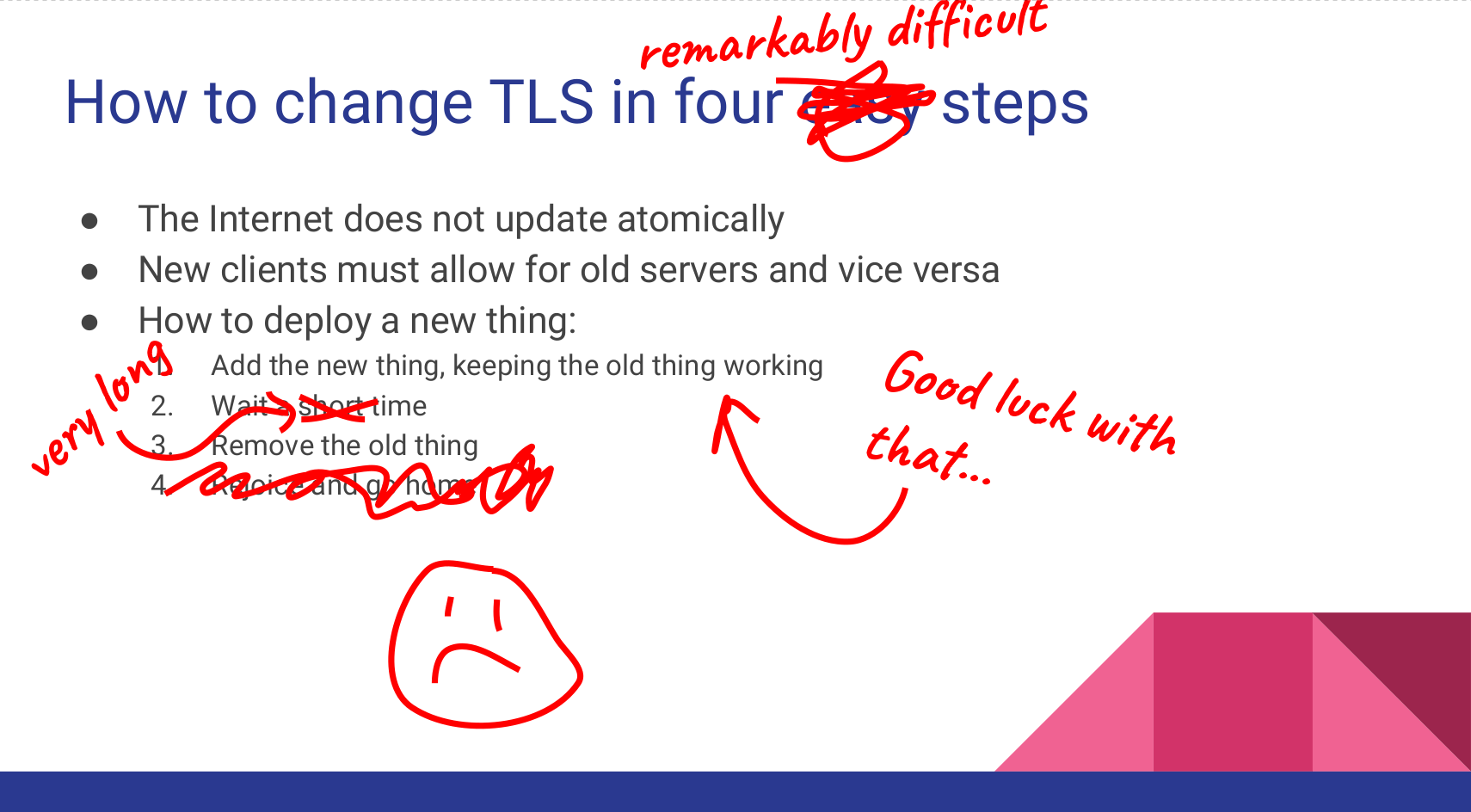
David Benjamin showing the challenges they are faced with when they want to change TLS.
The last session of the second day, which was about Crypto in the clouds, started with the talk “Can You Trust Your Encrypted Cloud?”. An Assessment of SpiderOakONE’s Security” given by Anders Dalskov. He discussed threat models for encrypted cloud storage and how the security in a real encrypted cloud storage breaks down, when the server becomes malicious. This was shown by the aid of achieved attacks on SpiderOakONE. Next up was Manisho Metha (Netflix), who presented the “Secrets at Scale”. This presentation gave a clear overview of the problems a company like Netflix faces, when they need to scale their security requirements to the tremendous amount of users and different applications they are dealing with. Manisho Metha succeeded in giving us a good view on the strategy used to satisfy these requirements in an entertaining talk. The final talk of the day was about Facebook’s view on scaling backend authentication. In the talk “Scaling backend authentication at Facebook”, Kevin Lewi and Callen Rain jointly elaborated on the backend authentication strategy of scaling the system with as few roots of trust as possible.
After all these interesting talks, there was an opportunity to attend a reception at the Google offices in Zurich. In the Swiss winter-setting they had set up for the reception, you could meet Google engineers and researchers from different offices around the world and of course a lot of the conference participants. Fruitful discussions came up all around the tables at this event.
Day Three
In the morning of the last day there was as session on New crypto. It started with an introduction to Noise, which is a framework for building crypto protocols. In this talk, Trevor Perrin gave an overview of the current possibilities of Noise. More information on this framework can be found on http://noiseprotocol.org/. The second talk given by David Derler (IAIK, Graz U.), explains how to use bloom filter encryption to make zero round-trip time key exchange with forward secrecy more efficient. For the interested reader, more details can be found in his talk “Bloom filter encryption and applications to efficient forward-secret 0-RTT key exchange”. Torben B. Hansen (Royal Holloway) presented InterMAClib, a library that implements a provably secure scheme for authenticated encryption, designed for dealing with the ciphertext fragmentation in the SSH protocol, called interMAC. Tests show that for this better security one only has to endure a minor performance hit. The last talk in this session was given by Seny Kamara, who talked about about “Building and deploying encrypted search systems”, more specifically he talked about Pixek — an application with end-to-end encryption for storing photo’s on the cloud. As a user you are able to link some tags to the pictures. These tags can be used later to search for photos which were saved on the cloud. It is a new app that is currently only available for android. More on the app can be found on https://pixek.io/ or in the recently appeared article on wired, https://www.wired.com/story/pixek-app-encrypts-photos-from-camera-to-cloud/.
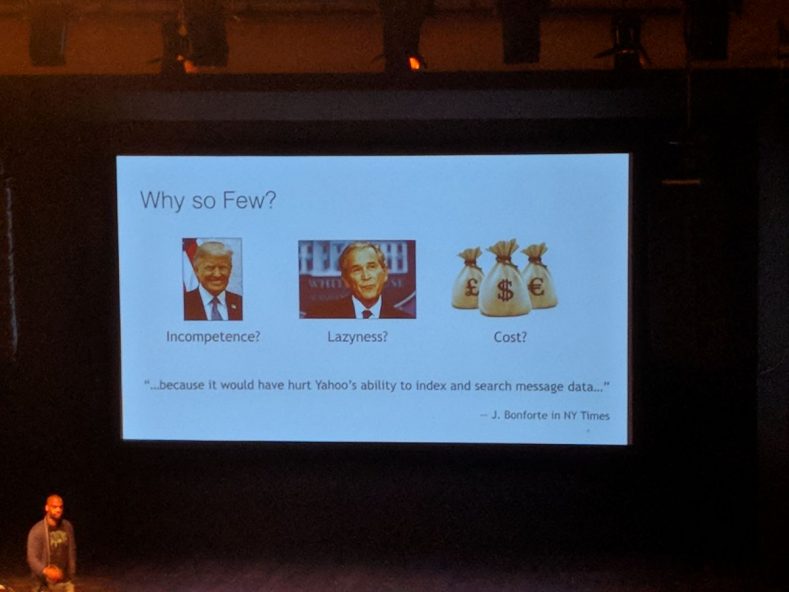
Seny Kamara talking about end-to-end encryption.
Attacks were again discussed in the second session of the last day. In this session each speaker had a short 15-minute timeslot to explain their work. The first talk given by Junwei Wang (CryptoExperts, U. Luxembourg, U. Paris 8) was about white-box crypto system developed for the capture the flag challenge of CHES in 2017. Even though it was the winning submission, it was broken like all other white box solutions. In the second talk of this session, Kristian Gjosteen (Norwegian University of Science and Technology) showed that an error in the implementation of the pseudo random number generator caused a provably secure protocol to become insecure. The details of the error and its consequences can be found in the talk “A faulty PRNG in a voting system”. The next talk continued on the safety of pseudo random number generators. Joanne Woodage (Royal Holloway) provided the audience with an analysis of the withdrawn NIST publication with the title Recommendation for Random Number Generation Using Deterministic Random Bit Generators, in the talk. “An analysis of the NIST SP 800-90A DRBGs”. In the fourth talk of this session, Matthew Smith (U. Oxford) explains to the audience a vulnerability in recent manufactured aircrafts. The exact breach of the Aircraft Communications Addressing and Reporting System is explained in the talk ”Modern jets, retro ciphers: How monoalphabetic substitution ciphers are still in use”. The last talk of this attack session deals again with random number generation, but this time in the setting of quantum computing. The interesting talk “Identifying Bias in a Commercial Quantum Random Number Generator” was given by Julio Hernandez-Castro(U. of Kent).
The very last session of the conference was about verification and provable security. It started of with “Untagging Tor: a tale of onions, raccoons, and security definitions” by Jean Paul Degabriele (U. Darmstadt). This talk dealt with tagging attacks on Tor and their severity. It also explained the proposed adaptations to Tor to prevent these known tagging attacks. This talk was followed by the live story of verificatum. Douglas Wikstrom (KTH) explained how this mixed-net system that is the heart of an electronic voting system, was established. More information on this system and the company behind it can be found on https://www.verificatum.com/.
The session ended with “HACL* in Mozilla Firefox” presented by Benjamin Beurdouche (INRIA). This talk started of by mentioning the difficulties in correctly implementing cryptographic primitives. To address these, they created a verified portable C cryptographic library that implements certain cryptographic primitives, named HACL*. This code is now incorporated in Mozilla Firefox. The speaker gave a brief overview of the challenges that appeared when they were integrating this academic project in the production code and encouraged everyone to try it out.
This talk concluded the Real World Crypto conference of 2018.
Co-located events
We should not forget to mention the two excellent events co-located with RWC 2018: (i) the ECRYPT-CSA School on Societal Aspects of Cryptology and on Business and Innovation in Crypto and (ii) the Second Theory of Implementation Security (TIs) Workshop. Both events had excellent speakers and, due to their format, provided their participants with a cosy environment to have lengthy and in-depth discussions on many interesting topics.
Concluding remarks
To summarise, RWC 2018 was an event that brought together people with diverse background with the aim to make academia and industry collaborate more closely. One aspect that could probably be improved is the focus of the talks. We saw many great talks from academia, where presenters explained (and demonstrated) how they broke standards and commercial products, as well as great talks from industry that promoted their companies and services. However, we all wished to see more talks where industry presents real-world problems they are facing and try to get some people from academia on board to try to solve these problems. Similarly, we wished to see more talks from academia where they pitch a cool solution and ask the industry to adopt their solutions. Seny Kamara (Brown U) and Douglas Wikstrom (KTH) were one of the few who satisfied our wishes.
p.s. Please include desserts to the lunch next year. 🙂
References
[1] Source: Breaking down Mirai: An IoT DDoS Botnet Analysis, www.incapsula.com, Aug 2017
Thanks to Charlotte Bonte, Mustafa A. Mustafa, Simon Friedberger, Eleftheria Makri, Iraklis Symeonidis, Christina-Angeliki Toli & Aysajan Abidin for writing this blog post.


