It is sometimes the case that a set of mutually distrustful parties need to perform a joint computation on their private inputs but they are not willing, or cannot afford, to reveal those inputs to each other. This can happen in auctions, data mining, and more generally when someone wants to link, compute and aggregate sensible data from various sources, and can be done using Secure Multiparty Computation (MPC). MPC is a well-established cryptographic technique and the past decade has seen huge progress to make MPC efficient and practical.
When we design an MPC protocol, or when we decide what kind of secure protocol we are going to use in a specific application, we first need to consider the computation and security model. In particular, we need to specify if the protocol allows the evaluation of Boolean or arithmetic circuits, the network structure, the adversary structure that can be tolerated (e.g. threshold adversaries, honest majority/dishonest majority), types of adversary (e.g. active/passive, static/adaptive), and many others. And it should not come as a surprise that the efficiency of the protocol strictly depends on the setting, so for example protocols secure against passive adversary, that follows the protocol specification but tries to learn more than is allowed from the protocol transcript, are usually much more efficient than protocols secure against stronger active adversary that can arbitrary deviate from protocol specification; and that protocols that allow a large number of corruptions are less efficient than protocol with fewer corrupt parties.
If we look at the efficiency of known practical passive secure MPC protocols, we have two very different and opposite situations, as showed in the picture below.
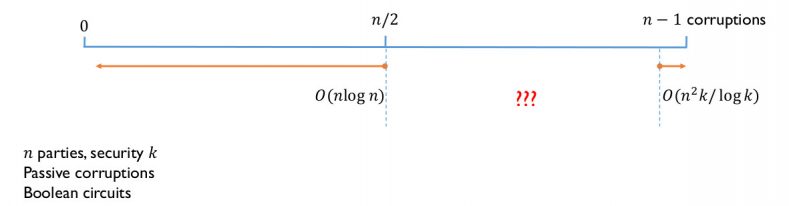
While in the honest majority setting it is possible to achieve almost linear communication complexity in the total number of parties using unconditionally secure protocols, in the dishonest majority setting we can find protocols achieving full threshold, i.e. supporting all-but-one corruptions, but with much worse communication complexity depending on the computational security parameter and quadratically on the number of parties.
What happens between these two extremes? Can we design efficient MPC protocols in the dishonest majority setting whose efficiency increases as the number of honest parties increases?
Increasing the number of honest parties seems to be a very reasonable choice especially when the total number of parties is large. In this case, practical protocols that allow all-but-one corruptions are very inefficient and, on the other side, it is maybe more realistic assuming only 70%-90% of corruptions rather than full threshold: if we are running a distributed computation among 200 parties, we certainly don’t expect that 199 of them are corrupt, but, in the worst case, a number between 130 and 180.
Taking inspiration from a late 80s movie, in this paper https://eprint.iacr.org/2018/208.pdf, that will be presented at CRYPTO 2018, we describe a new approach for semi-honest multiparty computation with Boolean circuits in the dishonest majority setting. Our main idea is to reduce the size of the symmetric keys used in the protocol depending on the number of the honest parties, in such a way that the security is no longer based on each individual key, but on the concatenation of all honest parties’ keys . This allows to reduce the communication complexity accordingly.
Using this idea, together with a committee-based approach, we can significantly improve the efficiency of both BMR and GMW-style protocols when the number of parties is fairly large, that is more than 50.
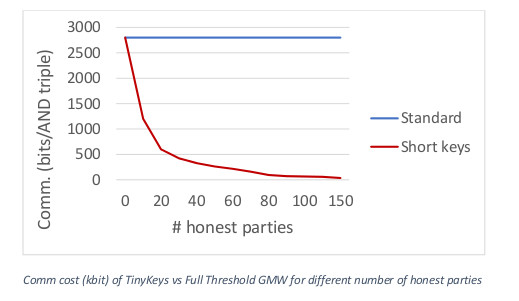
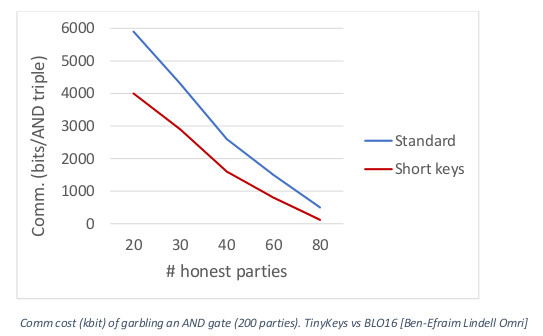
When considering GMW-style protocols, we can reduce the size of the keys down to just 1 bit when the number of honest parties is larger than 80; in the BMR case, due the underlying assumptions, we can have keys of length 5/6 bits when the number of parties is very big, say more 1000, and keys of length 7/8 bits, depending on the number of honest parties, when the number of parties is bigger than 100.
Large scale MPC, involving hundreds of parties has an increasing number of use-case scenarios, for example in measuring network activities, like the Tor network or blockchain network, and will be really interesting to generalise the TinyKeys idea to other setting like malicious adversary or arithmetic circuits.
Thanks to my co-authors on this work, Carmit Hazay, Peter Scholl and Eduardo Soria-Vazquez.


