This post is about a paper published in Eurocrypt 2022, MITAKA: A Simpler, Parallelizable, Maskable Variant of FALCON, presented by Thomas Espitau.
The proposed signature scheme called MITAKA improved one of NIST finalist digital signature FALCON, by offering parallelizable signing algorithm, simpler implementation without floating point arithmetic, and a new masking technique for side-channel protection.
1. Lattice Based Signature based on Hash-and-Sign Paradigm (a.k.a. GPV signature).
Let’s start with the base scheme of MITAKA/FALCON; Gentry-Peikert-Vaikuntanathan Signature.
- KeyGen(\(1^\lambda)\to vk,sk\), \( vk:=\mathbf{A}\in \mathbb{Z}_q^{n\times m},sk:=R\in\mathbb{Z}^{\omega \times m} \)
- Sign(\(sk,m)\to \sigma \)
– Generate \(H(m)\) by using a hash function H which outputs a uniform random element
– Sample \(\mathbf{s}\) from a Gaussian distribution over \(\mathbb{Z}^m \)
– outputs \(\sigma:= \mathbf{s} \). - Verfy(\(vk,m,\mathbf{s}\)): if \(\mathbf{As}=H(m)\), and \(\|\mathbf{s}\|\leq B\) for some small real number \(B\), then it is valid, otherwise invalid.
Here, we need to focus on the second step of signing algorithm which is called Gaussian sampling. In more detail, we need to define two lattices:
- \( \Lambda_q^{\perp}(\mathbf{A}) = \{ \mathbf{z} \in \mathbb{Z}^m\ :\ \mathbf{Az}=\mathbf{0} \mod{q} \}\)
- \( \Lambda_{\mathbf{u}}^{\perp}(\mathbf{A}) = \{ \mathbf{z} \in \mathbb{Z}^m\ :\ \mathbf{Az}=\mathbf{u} \mod{q} \}\)
Then Gaussian sampling will be done like the following:
- Compute \(\mathbf{z}\) such that \(\mathbf{Az}=H(m) \mod q\).
- Sample \(\mathbf{e}\gets \) GaussianDistribution(\(\mathbf{z},s\)) which is a Gaussian distribution with parameter \(s\) over the lattice \( \Lambda_{q}^{\perp}(\mathbf{A}) \) centered at \(-\mathbf{z} \).
- Output \(\mathbf{x}=\mathbf{z+e}\in\Lambda_{H(m)}^{\perp}(\mathbf{A})\)
As we can see that, the process is to solve approximate Closest Vector Problem (approxCVP) on the lattice \(\Lambda_q^{\perp}(\mathbf{A})\) given a target vector \(\mathbf{z}\) which is outside of the lattice.
FALCON and MITAKA instantiated their signature schemes over NTRU lattices which are rank 2 module lattices over cyclotomic rings on top of the above GPV framework.
2. Improved Gaussian Sampling for MITAKA
The Gaussian sampler used in FALCON is fast but has many disadvantages in implementation’s point of view due to its complex algorithm. It is poorly parallizable and the implementation relys on floating point arithmetic, moreover, it is vulnerable to side channel attacks.
- Towards parallel computation, flexible parameter selections (MITAKA): they replace the sampler of FALCON by Ducas & Prest’s hybrid sampler which is easy to parallelize, and support fairly inexpensive masking for side-channel protection.
This solution, however, has a downside which the output of the sampler has lower quality in terms of size. In other words, the Gaussian sampling has a larger standard deviation, thus it has an effect on the security. In order to increase the security level, the authors suggest a new method to improve the quality of (NTRU) trapdoor (key generation) which also influences on the concrete bit security.
As a naive approach, they just can replace the quality check of the key generation of FALCON, however, the desired output does not always come out often. Therefore, they “recycle” randomness which are already sampled and employ Galois automorphisms to produce trapdoors in reasonable time. As a result, it gives better private basis, resulting in achieving NIST security levels. - Towards integer arithmetic friendly (MITAKA\(_\mathbb{Z}\) ): They propose a new sampler which is compatible with the integral lattice Gram root technique to avoid floating point arithmetic, keeping the same complexity and the same quality as the hybrid sampler.
3. Maskable MITAKA for Side-channel Resistance
The masking countermeasure technique used in this paper is to protect their samplers from the so-called t-probing side-channel adversary, who is able to obtain t intermediate values of the computation. In other words, any set of at most t intermediate variables should be independent from the secrets to such adversaries, which is called t-probing security.
To achieve such provable security, they employ additively secret sharing; if there is a value x to be protected and t+1 random independent values are selected under the condition that the sum of them equals to x. Therefore, an attacker who just samples t values cannot learn anything about x due to the nice property of the secret sharing. The whole scheme is protected by using arithmetic masking, so all the polynomial multiplications are worked on FFT domain to use point-wise multiplication. Hence, they can handle polynomial multiplication with arithmetic masking.
Moreover, in order to mask MITAKA sampler efficiently, they generate arithmetic shares of Gaussians in offline phase, then the sum of them which is the output in online phase is also a Gaussian. Hence, they could avoid the masking process in online phase.
Implementation Results
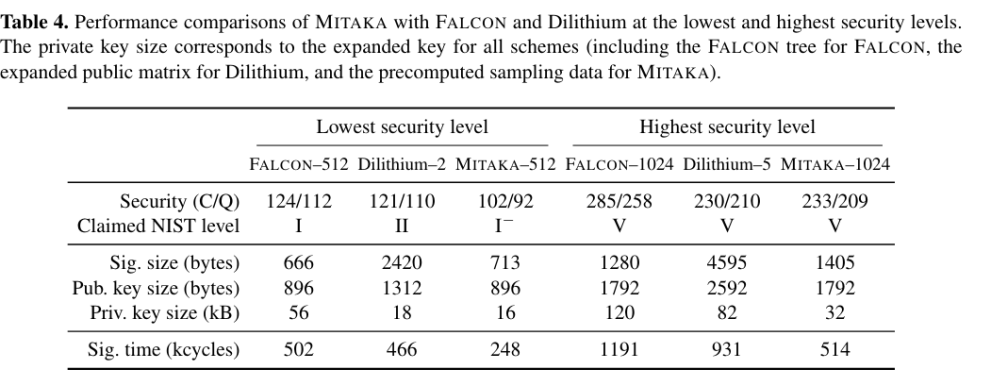
For the practical results, I refer the original paper. As we can see, the signing time is almost twice faster than FALCON and the signature size is slightly bigger as a trade-off.


