The goal of this blogpost is to provide a quick overview of the results presented in the following research paper:
- Fiat–Shamir Bulletproofs are Non-Malleable (in the Algebraic Group Model) (written by Chaya Ganesh, Claudio Orlandi, Mahak Pancholi, Akira Takahashi, and Daniel Tschudi)
which was presented in Eurocrypt 2022.
BACKGROUND:
A Zero-Knowledge (ZK) proof system allows a prover to convince a verifier, about the truth of a statement without leaking any information about the secret (a.k.a. witness) associated with the statement. A short introduction about zero-knowledge proofs can be found in this COSIC blog post. In summary, zero-knowledge proof systems can be either interactive, requiring interaction between the prover and the verifier, or non-interactive, where a single-round message is sent from the prover to the verifier. In the interactive proof systems, also known as multi-round interactive protocols, the prover and verifier interact by exchanging messages until the verifier is convinced about the truth of the statement. A special case of multi-round interactive proof systems is called \(\sum\)-protocols that only have 3 rounds.
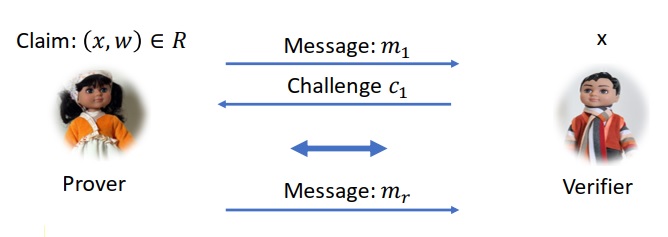
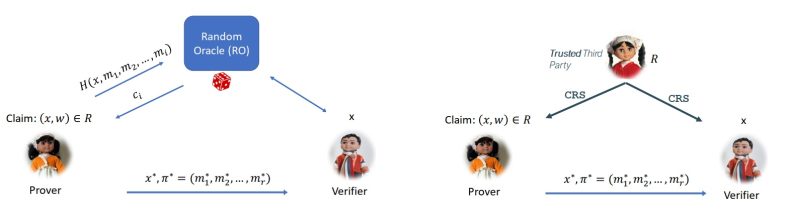
In practice, Non-Interactive Zero-Knowledge (NIZK) proof systems are more popular, as they do not require any interaction with the verifier and sometimes they are shown to be more efficient than the interactive protocols. NIZK proofs systems are constructed in two models, known as Random Oracle (RO) or Common Reference String (CRS). In the RO model, the prover and verifier have access to a RO that given distinct inputs it returns unique (uniformly) random outputs, while in the CRS model there exists a trusted pr-processing phase that generates some public parameters to be used by the prover and verifier for proof generation and proof verification. In 1986, Fiat and Shamir [FS’86] introduced a paradigm to transform any multi-round interactive proof system into a NIZK argument in the RO model.
NIZK proof systems need to satisfy some requirements:
- Completeness: The honest prover always convinces the honest verifier.
- Zero-Knowledge: The verifier does not learn anything more than the truth of the statement from the proof. In practice, this is proven by constructing a simulation algorithm (a.k.a. Simulator) that without knowing the witness, but using some auxiliary information, can generate simulated proofs that are indistinguishable from the real ones.
- Soundness: The malicious prover cannot convince the verifier.
- Knowledge soundness: The malicious prover cannot convince the verifier unless he knows the witness for the statement.
- Simulation Soundness: The malicious prover cannot convince the verifier, even if he has seen an arbitrary number of simulated proofs.
- Simulation Knowledge Soundness (a.k.a. Simulation Extractability): The malicious prover cannot convince the verifier unless he knows the witness for the statement, even if he has seen an arbitrary number of simulated proofs.
Items 1, 2, and 3 are the basic security requirement of any NIZK proof system. The ones that additionally satisfy 4, are called NIZK proof of knowledge systems. Items 5 and 6, are stronger versions of items 3 and 4, respectively, which additionally prevents attacks from the adversaries who have seen simulated proofs. Particularly the notations in items 5 and 6, namely simulation soundness and simulation extractability, imply the non-malleability of proofs [DDO+02] which is necessary for many practical applications. The notions of simulation soundness and simulation extractability also have a weak variant that allows proof rerandomization [BKVS21]. In the CRS model, simulation extractability with black-box extraction is shown to be sufficient for a NIZK proof system to achieve Universal Composability (UC) [Gro06].
NIZK variants of Bulletproofs are Simulation Extractable:
Bulletproofs [BBB+18] are one the known multi-round interactive proof systems that are deployed in various practical applications like privacy-preserving cryptocurrency Monero. Bulletproofs do not need a trusted setup phase, have linear time prover, and logarithmic proof sizes, which make them attractive for various applications. In practice, mainly their non-interactive variant is used which is obtained by applying Fiat and Shamir heuristic [FS86].
In this paper, the authors show that Bulletproofs [BBB+18], can achieve simulation extractability in the RO model and Algebraic Group Model (AGM) [FKL18] once they are made non-interactive using Fiat and Shamir heuristic. AGM is a new model for security proofs that lies in between the standard model and the Generic Group Model (GGM) and is introduced in [FKL18]. In the AGM, adversaries are limited to be algebraic in the sense that if the adversary inputs some group elements and outputs a group element, it can provide an algebraic representation of the latter in terms of the former. Achieving simulation extractability ensures that the proofs are non-malleable and they cannot be changed to prove a different statement. In this paper, the authors focus on the strong variant of it, where the proofs are not re-randomizable.
A similar study has been performed first time in [FKMV12] that showed that the Fiat-Shamir heuristic is sound and can be used to build non-malleable NIZK arguments in the RO model. However, their proof only applied to the 3-round interactive proof systems, a.k.a. \(\Sigma\)-protocols. While Bulletproofs are multi-round protocols, and the results in [FKMV12] did not hold for them. From a different perspective, the authors extend the recent result by Ghoshal and Tessaro [GT21], which shows that the non-interactive variants of Bulletproofs (made by the Fiat-Shamir transform) are knowledge sound in the AGM and RO model.
To this end, the authors first slightly modify two definitions from [FKMV12, GKK+21, GT21] and define State-Restoration Unique Response (SR-UR), and Fiat-Shamir Weak Unique Response (FS-WUR), and show that FS-WUR reduces to SR-UR. The state-restoration is a stronger property that allows the prover to rewind the verifier a polynomial number of times. The notion FS-WUR is defined for non-interactive protocols and is a weaker variant of the unique response defined for interactive protocols [GKK+21]. Both SR-UR and FS-WUR require that given a simulated proof, it is hard for an adversary to output a new proof that shares a prefix with the simulated one. This property is opposed to the Unique Response (UR) property defined in [GKK+21], which says that it should be difficult for an adversary to come up with two different proofs that share a prefix. Authors show that Bulletproofs satisfy SR-UR. They also slightly extend the previous results of [GT21] about Bulletproofs and show that Bulletproofs satisfy adaptive State-Restoration Witness Extended Emulation (aSR-WEE). In [GT21], it was shown that Bulletproofs satisfy SR-WEE. Intuitively, SR-WEE says that having resettable access to the verifier (or “restoring its state”) should not help a malicious prover in producing valid proof without knowing a witness for the statement [GOP+22].
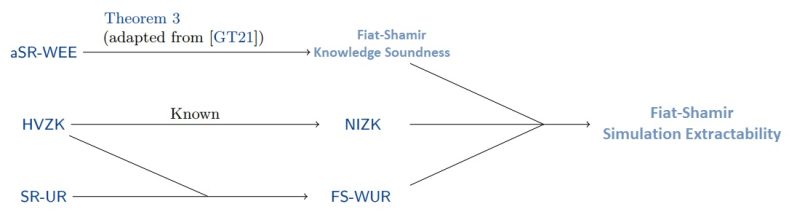
NIZK [GOP+22].
Finally, the authors presented a general theorem and showed that if a multi-round public-coin interactive protocol satisfies:
- aSR-WEE,
- perfect HVZK with an algebraic simulator,
- and SR-UR,
then the non-interactive version of the protocol obtained via the Fiat-Shamir transform is online simulation-extractable in the AGM and RO model. Bulletproofs were the main focus of their study, but the theorem seems general enough to be applied to other NIZK arguments derived via the Fiat-Shamir transform.
Karim Baghery
Trondheim, June 2022.


