This blog post is based on the paper “Secure Multiparty Computation with Free Branching” [1] presented by Aarushi Goel at Eurocrypt 2022, in Trondheim, Norway.
First and foremost, it is important to understand what secure multiparty computation (MPC) is (see below).

Problem statement. A class of MPC protocols presents functions using circuits. The efficiency of existing MPC protocols relies on the circuit representation of functions. Several parties evaluate the circuit while each party has a share of each wire of its gates. There are two important aspects to consider: computation and communication costs. Therefore, the smaller size they have the more efficient the MPC protocol becomes.
Communication size is linearly decreasing with the circuit representation of the functions. There have been some research efforts to decrease the size of communication from linear to sublinear, but it turns out that to achieve a sub-linear communication size they need to use heavy computational primitives such as Fully Homomorphic Encryption (FHE) or Homomorphic Secret Sharing schemes which are far from being practical today.
Research question. The main goal is to achieve an efficient circuit representation. Let’s start with an example. The representation of conditional branches is very inefficient. In other words, this is because the communication size depends on the size of all the branches, and regular MPC protocols go through all the branches. This bottleneck exists because of two security requirements of MPC: (1) all the values are secret, and therefore using the secret values it is difficult to activate just one branch; (2) it is difficult to obliviously activate just one branch while keeping it hidden and in a way that no one knows which branch is active.
It is interesting to come up with an answer to this question: can we achieve an efficient circuit representation for computing the conditional branches by decreasing the size of communication by just going through one active branch in a secure manner instead of all the branches? (aka Free Branching)
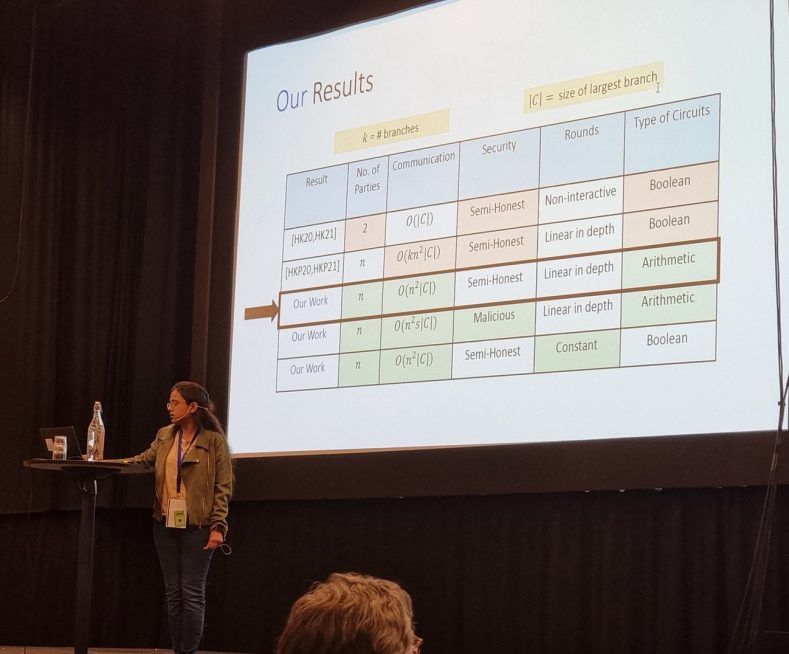
Prior work. This problem is already explored and solved for Boolean circuits in a semi-honest setting [2, 3, 4, 5]. However, in this paper, the authors present a solution to this problem for arithmetic circuits for two different semi-honest and malicious settings. Furthermore, they extend their protocol to achieve different properties with different costs, illustrated in this picture:
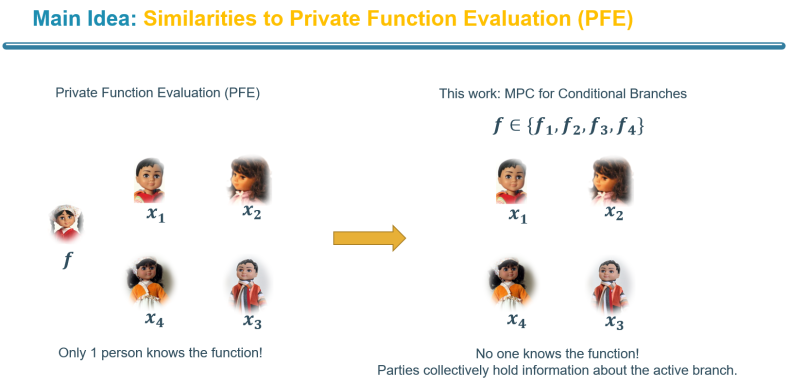
Main Idea. In prior research efforts, the main idea has been to evaluate all the branches and then filter out the correct branch. However, in this paper, the core idea is to obliviously select the active branch and only evaluate that on the correct outputs. More precisely, they need to compute on a hidden function since the active branch must remain secret. The idea of computing on hidden functions has similarities to the idea of Private Function Evaluation (PFE) [6, 7]. Although in PFE, only a party knows the function, in this paper, a variant of this technique is used where no one knows the function, and therefore parties collectively hold information about the function.
Challenges. The technique used in this paper follows the technique of hiding the circuit topology proposed by Mohassel and Sadeghiyan in 2013 [6]. To hide the circuit, we need to hide both wire configurations and gate functions.
Solutions. To solve these challenges, the authors are using the slightly modified version of the idea used in [6]. More precisely, in [6], there is a party that knows the function. This party performs some computations using the knowledge of the function in the pre-processing phase. The pre-processing step helps the parties to do evaluations of the private function. In this paper, unlike the previous work [6], the information on function is shared among all the parties and none of the parties fully knows the function. Basically, next to the main MPC protocol, they also run another MPC protocol whose secret value is the information about the function, and that information is shared among all parties instead of only one party.
To hide the wire configuration, they also use the idea of Oblivious Inner Products and do it using Threshold Linearly Homomorphic Encryption. The implementation of the proposed compiler for the semi-honest setting where the adversary is honest but curious can be find here. In order to know more details, I refer the reader to read through the paper [1].
References:
[1] Goel, Aarushi and Hall-Andersen, Mathias and Hegde, Aditya and Jain, Abhishek. Secure Multiparty Computation with Free Branching. Annual International Conference on the Theory and Applications of Cryptographic Techniques, pp. 397–426, Springer (2022). https://link.springer.com/chapter/10.1007/978-3-031-06944-4_14
[2] Heath, D., Kolesnikov, V.: Stacked garbling – garbled circuit proportional to longest execution path. In: Micciancio, D., Ristenpart, T. (ed.) CRYPTO 2020, Part II, vol. 12171 of LNCS, pp. 763–792. Springer, (2020). https://doi.org/10.1007/978-3-030-56880-1_27
[3] Heath, D., Kolesnikov, V.: LogStack: stacked garbling with O(blogb) computation. In: Canteaut, A., François-Xavier Standaert, editors, EUROCRYPT 2021, Part III, volume 12698 of LNCS, pages 3–32, Springer (2021). https://doi.org/10.1007/978-3-030-77883-5_1
[4] Heath, D., Kolesnikov, V., Peceny, S.: MOTIF: (almost) free branching in GMW – via vector-scalar multiplication. In: Moriai, S., Wang, H. (eds.) ASIACRYPT 2020. Part III, vol. 12493 of LNCS, pp. 3–30, Springer (2020). https://doi.org/10.1007/978-3-030-64840-4_1
[5] Heath, D., Kolesnikov, V., Peceny, S.: Garbling, stacked and staggered – faster k-out-of-n garbled function evaluation. In: Tibouchi, M., Wang, H. (eds.) Advances in Cryptology – ASIACRYPT 2021 – 27th International Conference on the Theory and Application of Cryptology and Information Security, Singapore, 6–10 December 2021, Proceedings, Part II, vol. 13091 of Lecture Notes in Computer Science, pp. 245–274, Springer (2021). https://doi.org/10.1007/978-3-030-92075-3
[6] Mohassel, Payman and Sadeghian, Saeed: How to Hide Circuits in MPC an Efficient Framework for Private Function Evaluation. Annual International Conference on the Theory and Applications of Cryptographic Techniques, pp. 557–574, Springer (2013). https://doi.org/10.1007/978-3-642-38348-9_33
[7] Mohassel, Payman and Sadeghian, Saeed and P. Smart, Nigel: Actively secure private function evaluation. International Conference on the Theory and Application of Cryptology and Information Security, pp. 486–505, Springer (2014). https://doi.org/10.1007/978-3-662-45608-8_26


