Homomorphic Encryption (HE) allows computations on encrypted messages, where computations always refer to boolean circuits. This blog will introduce its quantum analogue, Quantum Homomorphic Encryption (QHE), which supports evaluations of quantum circuits.
QHE may have practical use in the coming quantum era: on the one hand, quantum computing reduces computational complexity for certain hard problems, being inevitable for scientific research such as sorting through a big database of protein sequences; on the other hand, the high building expense would limit the prevalence of quantum computers in the foreseeable future. Therefore, clients outsourcing quantum computations over sensitive data to a quantum computer in the cloud with QHE would be a popular choice.
Below we discuss QHE schemes with clients of different power (quantum and classical). Without further delay, let’s begin with an important (also fun) building block, the quantum one-time pad.
1. Quantum one-time pad
Suppose Alice wants to send a quantum state \(|\psi\rangle\) to Bob over an untrusted channel, and they share a classical key a priori. The quantum one-time pad solution uses Pauli group up to a global phase, i.e., \(\left\{X^aZ^b|~ a,b\in\{0,1\}\right\}\) where
\(X=\begin{bmatrix}0&1\\ 1&0 \end{bmatrix}\) , \(Z=\begin{bmatrix}1&0\\ 0&-1 \end{bmatrix}\)
are Pauli gates. Note the global phase of a quantum state is not observable by measurements, hence being ignored.
In quantum one-time pad, Alice and Bob share two randomly-chosen bits \((a,b)\). Alice encrypts her quantum state \(|\psi\rangle\) by applying \(X^aZ^b\), and anyone without the knowledge of \(a\) and \(b\) only knows the density matrix
\(\sum_{a,b=0}^1 \left(\frac{1}{4}X^aZ^b|\psi\rangle\langle\phi|Z^bX^a\right)= I/2\)
where \(I\) is the identity matrix (of course being independent of \(|\psi\rangle\)). Bob, after receiving \(X^aZ^b|\psi\rangle\), can perform the inverse operation to recover the original state.
2. QHE with quantum clients
QHE schemes with quantum clients were first proposed by Broadbent and Jeffery in 2015 as a hybrid of a classical HE scheme and the quantum one-time pad. Precisely, the QHE encryption of a quantum state \(|\psi\rangle\)contains two parts: the classical HE encryption of two randomly-chosen bits \((a,b)\), and the one-time padded quantum state \(X^aZ^b|\psi\rangle\).
Homomorphic evaluations of quantum circuits are classified according to the “commutativity” with the Pauli group, i.e., whether a quantum circuit \(Q\) satisfies the following condition: for every element \(p\) in the Pauli group, there exists \(p’\) in the Pauli group satisfying \(pQ=Qp’\). Circuits “commuted” with the Pauli group form the Clifford group, which is generated by
\(P=\begin{bmatrix}1&0\\ 0&i \end{bmatrix}\) , \(H=\frac{1}{\sqrt(2)}\begin{bmatrix}1&1\\ 1&-1 \end{bmatrix}\) , and \(CNOT=\begin{bmatrix}1&0&0&0\\ 0&1&0&0\\0&0&0&1\\0&0&1&0 \end{bmatrix}.\)
Here we explain the homomorphic evaluation of a Clifford gate \(C\).
- Input: \(Enc(a,b)\) and \(X^aZ^b|\psi\rangle\) where \(Enc(\cdot)\) is a classical HE scheme.
- Process: Apply \(C\) to \(X^aZ^b|\psi\rangle\), and the “commutativity” means \(CX^aZ^b|\psi\rangle=X^{a’}Z^{b’}C|\psi\rangle\) for some \(a’,b’\). Then homomorphically update \((a,b)\) to \((a’,b’)\).
- Output: \(Enc(a’,b’)\) and \(X^{a’}Z^{b’}|\psi\rangle\)
Adding any non-Clifford gate to the Clifford group gives a generating set for all quantum circuits, and Broadbent and Jeffery chose the \(T\) gate
\(T=\begin{bmatrix}1&0\\ 0&e^{i\pi/4} \end{bmatrix}\),
which satisfies \(TX^aZ^b=P^aX^aZ^bT\). The operator \(P^aX^aZ^b\) is not a Pauli operator, so a simple homomorphic key update does not suffice. In 2016, Dulek, Schaffner, and Speelman used a quantum evaluation key to remove the “unwanted” \(P^a\) phase, but the nonreusable quantum nature means the client needs to prepare quantum keys in size linear to the number of \(T\) gates in the quantum circuit. What if the quantum evaluation can be controlled by a classical key, which is certainly reusable? This leads Mahadev (a Caltech researcher) and us (curious travalers) into QHE with classical clients.
3. QHE with classical clients
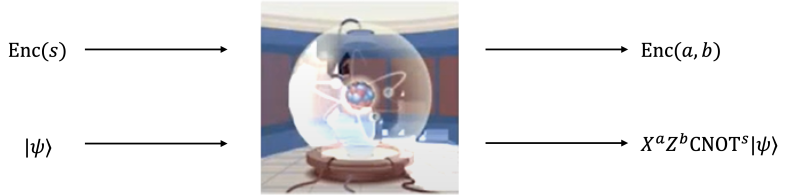
Is it possible to homomorphically evalute quantum circuits with classical ciphertexts? Mahadev answered in the affirmative, by first constructing quantum capable classical encryption schemes from learning with errors (LWE) and then turning a quantum capable ciphertext into a quantum operation. The figure below describes the encrypted CNOT opetation controlled by a classical bit \(s\), \(CNOT^s\).
In EuroCrypt 2022, Chung, Lee, Lin and Wu used QHE with classical clients to achieve blind proofs, where the input of verifier is hidden from the prover. To be more precise, they presented a protocol compiler that compiles any interactive proof system between a classical verifier and a quantum prover (\(QPIP_0\)) into a blind protocol. At a high level, the idea is simply regarding the classical verifier as a client and running the original \(QPIP_0\) protocol under QHE; we refer interested readers to the paper for their meticulous deal with a few potential issues.
In conclusion, we visited two constructions of QHE schemes, hopefully it is a pleasant journey! Provided that QHE are applicable both in practice (e.g. to securely compute in the quantum cloud) and in academia (e.g. to build blind proofs), I have no hesitation in recommending the topic to every curious mind.


