Pseudorandom correlation generators (PCGs) are a promising line of research to reduce the communication complexity of the pre-processing phase of many MPC protocols. In her invited talk at TPMPC 2022, Lisa Kohl gave an introduction to PCGs before presenting novel work on a PCG construction based on Expand-Acumulate codes in the learning parity with noise (LPN) setting, which is due to appear in Crypto 2022. The constructions shown in the talk focus on a two-party secure computation.
Introduction to PCGs
A PCG is a tuple of two algorithms \(\textsf{Gen}\) and \(\textsf{Expand}\). The former outputs two short seed values \(s_A\), \(s_B\) and the latter computes the correlated randomness for one party given the seed:
- \(s_A, s_B \gets \textsf{Gen}(1^\lambda)\)
- \(c_1, c_2, \dots \gets \textsf{Expand}(s_A)\)
- \(c’_1, c’_2, \dots \gets \textsf{Expand}(s_B)\)
A PCG must satisfy three properties
- Correctness: The values output by \(\textsf{Expand}\) need to satisfy the desired correlation, i.e. \((c_1, c’_1), (c_2, c’_2), \dots \) must be correlated.
- Pseudo-randomness: The values output by \(\textsf{Expand}\) must be pseudo-random.
- Security: Knowing their own part of the correlation, the party cannot learn more information about the other party’s part. Thus, the output of the other party must be pseudo-random up to the correlation.
Given a PCG producing the desired correlation, building an MPC protocol in the pre-processing model is straight forward. As an illustrative example, we have a PCG that generates OT correlations, i.e. pseudo-random pairs of \((b, m_b), (m_0, m_1)\) where \(b\) is a pseudo-random bit and \(m_i\) are pseudo-random messages of a certain length.
The protocol proceeds as follows
- Offline phase 1: The parties exchange some information to recover their seeds \(s_A, s_B\).
- Offline phase 2: The parties locally expand the seeds to obtain correlated OT pairs.
- Online phase:
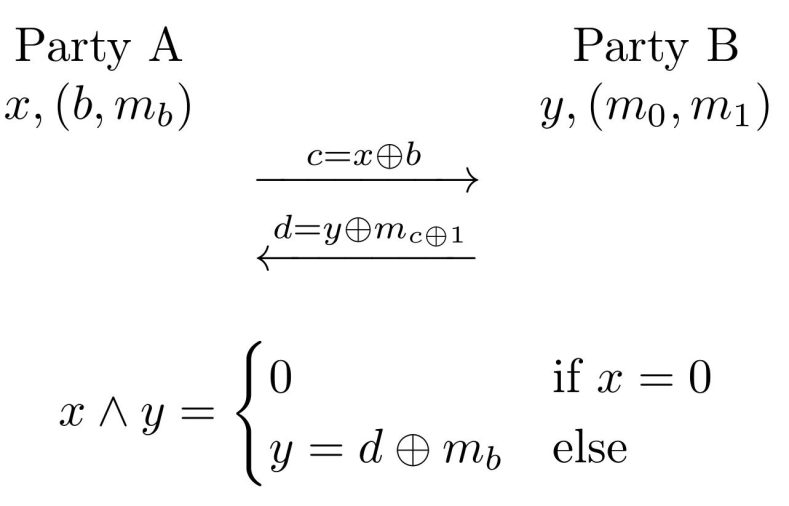
As a result, we obtain a protocol where the offline phase requires little communication (only the seeds are sent and the expansion phase requires no communication). The online phase can be a fast, information-theoretic one.
Detour: Function secret-sharing
With function secret-sharing, a concrete function \(f\) from a function family \(\mathcal{F}\) is shared into two keys \(K_0, K_1\) such that
- Security: \(K_0, K_1\) individually hide \(f\) (among other \(f’ \in \mathcal{F}\)).
- Correctness: With a key \(K_i\) the function can be evaluated at any argument \(x\), and \(f(x)\) can be recovered. For example, \(\textsf{Eval}(K_0, x) + \textsf{Eval}(K_1, x) = f(x)\).
- Succinctness: The keys \(K_0, K_1\) have similar size to the description size of the function.
A PCG for OLE correlations
An oblivious linear-function evaluation (OLE) correlation is a pair \((a, c), (b, c’)\) with the relation \(a \cdot b = c + c’\). In other words, the parties hold an additive sharing of the product \(a \cdot b\). The idea is to use a seed \(s_{\vec{a}}\) to generate a random vector \(a_1, \dots , a_N\) using a pseudo-random generator (PRG) and then share \(c_i\) via function secret-sharing (FSS), where the function to share is in \(\{ f_{\vec{a},\vec{b}}(x): a_x \cdot b_x \}\). Then, using \(K_0\) to evaluate the secret-shared function results in an additive share of \(a \cdot b\): \(Eval(K_0, x) + Eval(K_1, x) = a_x \cdot b_x\) (by definition).
However, FSS for this general function is expensive. The line of work presented in the talk approaches the problem from a different angle: They construct a FSS-friendly PRG, i.e. a PRG whose description/inner workings can be efficiently shared via secret-function sharing. This leads to concretely efficient PCGs.
A FSS-friendly PRG from LPN
A pseudo-random codeword can be generated in the LPN setting when keeping the message and noise vector hidden from the parties.
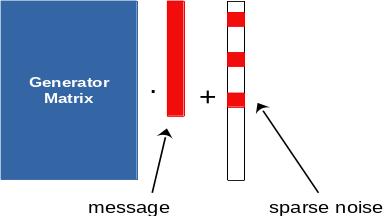
The seed for this PRG is an additive sharing of the message and a FSS-sharing of the noise. Concretely, the noise is shared as a multi-point function, i.e. \(f(x_i) = y_i\) for some fixed \(x_i, y_i\), otherwise \(f(x_j) = 0\). A multi-point function may be constructed as the sum of (single) point functions. The FSS-sharing hides \(x_i, y_i\). The generator matrix is public and thus doesn’t have to be sent.
While this PRG construction is FSS-friendly, the \(\textsf{Expand}\) step requires many vector-matrix multiplications with the large, dense generator matrix, making the expansion computationally very expensive.
Expand-Accumulate Codes
The main idea is to replace the generator matrix with the product of a sparse matrix and an accumulator matrix which speeds-up the matrix multiplications.
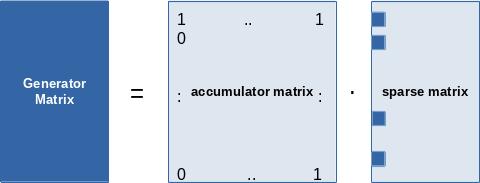
This construction yields an PCG in the offline-online mode. This means that some computation of the PRG is done in the offline phase of the MPC protocol where high parallelization and cache-friendly operations give speed-up. The remaining work is due in the online phase of the MPC protocol, which is admissible according to the authors, since waiting for communication leaves CPU resources for additional computation.
Since the generator matrix created by the expand-accumulate code differs from the original LPN assumption, this defines a new assumption: EA-LPN. At the moment, no reduction to the original LPN assumption is known.
Estimated performance
For the offline phase of the PCG, material for 10 million random OT correlations is generated in ca. 100ms. In the online phase of the PCG, finalizing the OT correlation requires 7-40 table lookups and a hashing operation.
Conclusion
PCGs are a very interesting development in the pre-processing MPC world. Once practically efficient PCGs are constructed, everybody benefits from a faster total execution time of their MPC program. Splitting the PCG construction into two phases is somewhat surprising as most MPC protocols have tried to shift as much work as possible from the online to the offline phase. Now the offline phase seems to push back.
Since the reported performance values are only estimates, a practical implementation would shed light in which scenarios a communication-based approach for the offline phase can be replaced by a PCG, and in which scenarios the traditional approaches still outperform silent pre-processing.
The talk was easy to follow and requires no previous knowledge on PCGs. It can be found on the TPMPC youtube channel.


