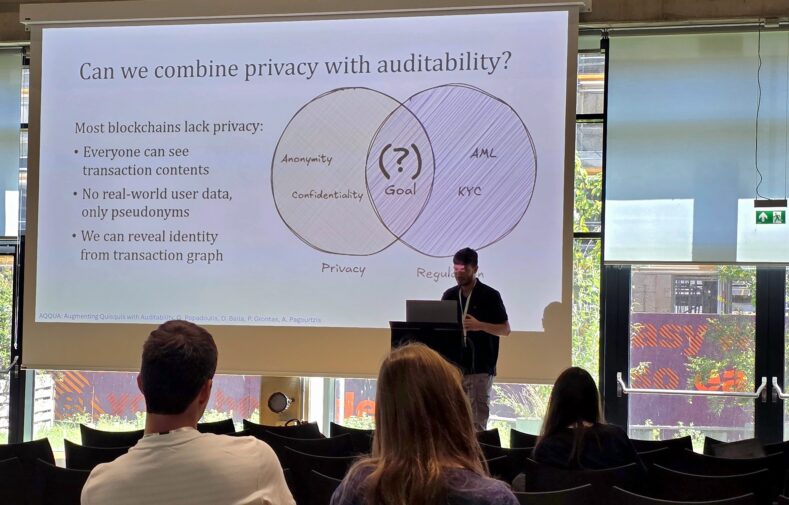
The goal of this blog post is to provide a high-level overview of the new results presented in the research paper:
- AQQUA: Augmenting Quisquis with Auditability (By George Papadoulis, Danai Balla, Panagiotis Grontas, and Aris Pagourtzis)
which was presented at ACNS 2025, at Munich, Germany.
Introduction and Motivation:
Fifteen years after Bitcoin’s inception, blockchain-based payment systems (cryptocurrencies) have gained immense popularity. Yet their integration with traditional finance remains limited due to three key gaps: performance, privacy, and regulation. While Bitcoin’s pseudonymity fails to provide true privacy, solutions like Zcash, Monero or Quisquis use advanced cryptographic technologies like zero-knowledge proofs (particularly zk-SNARKs, zero-knowledge succinct non-interactive arguments of knowledge), ring signatures, updatable public keys and shuffling (permutation and re-randomizaiton) protocols to hide transaction details, but this complicates regulatory compliance. Malicious actors can exploit these systems for money laundering or tax evasion, hindering mainstream adoption.
The core research question addressed in this paper is: How can we design a decentralized payment system that preserves user privacy while enabling necessary regulatory oversight?
Privacy vs. Regulation: Most cryptocurrencies fall into two categories. Transparent but Regulatable (e.g., Bitcoin): Transactions are public, simplifying compliance but sacrificing privacy (identities can be revealed from transaction graph). Private but Unregulated (e.g., Zcash, Monero, Quisquis): Strong privacy via zero-knowledge proofs, ring signatures or updatable public keys, but no built-in auditability. In both Monero and Zcash, the set of potential unspent coins is always growing. Due to this fact, users cannot store a concise representation of the blockchain. Quisquis is a later construction which uses a different design via Updtable Public Keys (UPKs) and shuffle arguments and stores a relatively small amount of data (compared to Zcash), and does not re-use the user address multiple times (compared to Monero). These key features, makes Quisquis an appealing and efficient privacy-preserving cryptocurrency.
Financial Regulations and Prior Works: During the last few years, various auditable privacy solutions are proposed to make privacy-preserving cryptocurrencies regulation-friendly without compromising user privacy. In various proposed regulation-friendly protocols, the financial regulations that are usually supported include Know-Your-Customer (KYC), Anti Money Laundering (AML), and restrictions to the number or the value of transactions a single user can make, or to the total value that can be exchanged in a single transaction. Prior Attempts to reconcile these goals either: Relied on permissioned settings (e.g., enterprise blockchains), limiting decentralization. Used centralized mixers (e.g., Privacy Pools), which can censor transactions or offer incomplete audit trails. Added transaction tracing (e.g., Zerocash extensions), compromising user privacy post-audit.
AQQUA: Extension of QuisQuis to Support Auditable Payments
AQQUA improves the Quisquis privacy-preserving cryptocurrency by adding auditability and accountability, while maintaining its anonymity, decentralization, and trustlessness. It does so by introducing two new entities:
- Registration Authority (RA): Enrolls users with real-world credentials (KYC) and issues them an initial public key (a cryptographic pseudonym,
pk₀). - Audit Authority (AA): Conducts audits based on user consent or in collaboration with the RA. Crucially, it cannot censor transactions and neither entity can link transactions to identities after registration.
AQQUA allows two types of audits: Voluntary audits (e.g., to access an exchange or prove innocence in investigations) and Cooperative audits via RA-AA cooperation, potentially with off-chain enforcement. During a voluntary audits, a user can reveal their initial public key and prove compliance in zero-knowledge using only on-chain data, keeping transaction contents and identities private. In the scenario where there is no external information, the auditor can ask all the initial public key holders weather they participated or not in certain transactions. In this case, the audit can take linear time in the number of users and the collaboration of the authorities can help the auditor to learn the real user identity in order to penalize the non-compliant users.
How AQQUA Adds Accountability to Quisquis:
- KYC-based Registration: Each user registers once with the RA using real-world credentials and receives an initial public key
pk₀. This binds user activity to a verifiable identity, adding accountability from the start. However, it is important to note that users can create unlimited accounts by updatingpk₀cryptographically. Unlike systems like Bitcoin (one account/user), this prevents sybil attacks while hiding activity. - Trackable but Private Account Creation: The number of accounts per user is tracked in a committed form in the UserSet, ensuring accountability for account proliferation while preserving unlinkability. During the transactions, users re-randomize account data and prove compliance using on-chain data only. The Audit Authority (AA) verifies proofs without learning unrelated details.
- Voluntary or Enforced Auditing: Users can prove compliance with policies (e.g., not engaging in illicit use) without revealing transaction contents, using zero-knowledge proofs. More precisely, the users prove compliance in zero-knowledge for policies like:
- Spending/receiving limits (“Total sent ≤ $10,000 this month”)
- Transaction value caps (“No single transfer > $5,000”)
- Non-participation (“I did not transact in this period”)
- Selective disclosure (“I sent exactly $200 in transaction X”).
- RA/AA Collaboration Enables Traceability: Although transactions are anonymous, the AA can, with RA support, identify the initial public key behind suspect accounts and initiate an audit.
- Deterrence via Policy Enforcement: Exchanges or regulators can require users to prove policy compliance (e.g., legality of funds), creating real-world accountability mechanisms.
Security: The authors formally prove that the new protocol, AQQUA, satisfies the following properties: Anonymity: Senders and receivers are hidden from both the public and the auditing authority (AA). Theft Prevention: Users can only move funds from accounts they own and cannot spend others’ funds. Audit Soundness: Non-compliant users cannot forge proofs. In other words, no successfully verified audit can be generated by a non-compliant user. Audit Privacy: Audits do not leak information about non-audited transactions. In fact, audit privacy prevents an adversarial auditor from using information gained during the audit process to compromise users’ privacy, even after one or more audits.
Efficiency: In terms of efficiency, AQQUA introduces approximately twice the transaction size and moderately more complex proofs than Quisquis. However, the asymptotic performance remains comparable, making AQQUA a practical and scalable upgrade that adds accountability with minimal overhead relative to its benefits. For more details on the protocol’s performance, refer to Section 7 of the paper.
Conclusion: To sum up, AQQUA represents an important step toward practical, privacy-preserving, and auditable cryptocurrencies. By augmenting Quisquis with auditable privacy, it demonstrates that decentralization, anonymity, and regulatory compliance can be achieved, without backdoors or compromises. As cryptocurrencies evolve, frameworks like AQQUA will be crucial for their acceptance in a regulated world.
For technical details, check out the full paper here.
Karim Baghery,
Munich, June 2025


