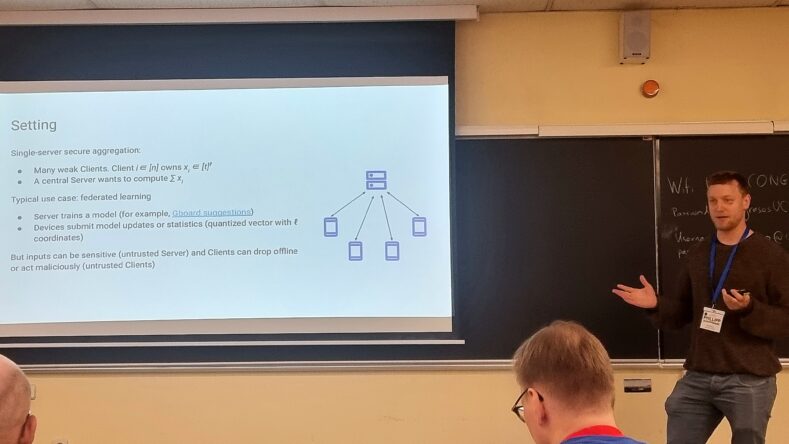
The goal of this blog post is to provide a high-level overview of the new results presented in the research paper:
- Willow: Secure Aggregation with One-Shot Clients (By James Bell-Clark, Adrià Gascón, Baiyu Li, Mariana Raykova, Phillipp Schoppmann)
which was presented at AICrypt 2025, at Madrid, Spain.
Introduction: The Challenge of Secure Aggregation
Federated learning (FL) enables millions of devices (e.g., smartphones, IoT sensors) to collaboratively train machine learning models without sharing raw data. A critical component of FL is secure aggregation, which ensures that individual user updates remain private while the server learns only the aggregated result. However, many of existing protocols face a major bottleneck: they require clients to synchronize their contributions across multiple rounds. In practice, this might lead to significant delays, especially when dealing with thousands of clients with unstable connections. For example, gathering 10,000 clients at a rate of 10 per second takes over 15 minutes, by the time the last client joins, early participants may have already dropped out. This “long tail” problem plagues real-world deployments, where device availability is unpredictable due to factors like poor connectivity or battery constraints.
Another point is that, most of current solutions often rely on fixed client identities or multi-round interactions, making them impractical for dynamic environments like smart cities or disaster response systems. In this paper, authors proposed a protocol called Willow, which aims to address these challenges with an approach that eliminates synchronization while achieving the security guarantees of a secure aggregation protocol.
Privacy, Scalability, and Real-World Impact of Willow
The rise of privacy regulations (e.g., GDPR) and the growing complexity of AI models demand solutions that are both secure and efficient. Consider a hospital network training a cancer detection model using patient data from thousands of devices:
- Privacy: Raw data must never leave devices.
- Latency: Delays caused by dropouts could stall critical model updates.
- Scalability: Protocols must handle thousands or even millions of participants without centralized trust.
Some of current solutions for secure aggregation might fail in the case, because they:
- Require clients to wait for peers, which might be impractical in large-scale protocols
- Leak metadata (e.g., who participated), risking deanonymization.
- Overload committees with linear computation costs, as in Flamingo.
Willow’s novelty lies in its ability to let clients contribute at their own pace while ensuring the server learns nothing beyond the aggregated result. This makes it ideal for time-sensitive applications like traffic prediction or emergency response systems.
Related Work: Evolution of Secure Aggregation
Prior efforts laid important groundwork but faced limitations in scalability or flexibility:
- Pairwise Masking (Bonawitz et al., 2017): Clients encrypt updates using shared keys with peers. However, if a client drops out, their masks cannot be canceled, forcing a restart.
- Flamingo (S&P 2023): Introduced committees to handle dropouts but required clients to pre-register identities. Committee costs grew linearly with clients, limiting scalability. As in case of Willow, clients require one round communication.
- Acorn (USENIX 2023): Used RLWE-based encryption for post-quantum security but lacked dynamic participation support. Its clients also requires multiple round.
Willow’s Key Innovations: Asymmetric Design and Lightweight Cryptography
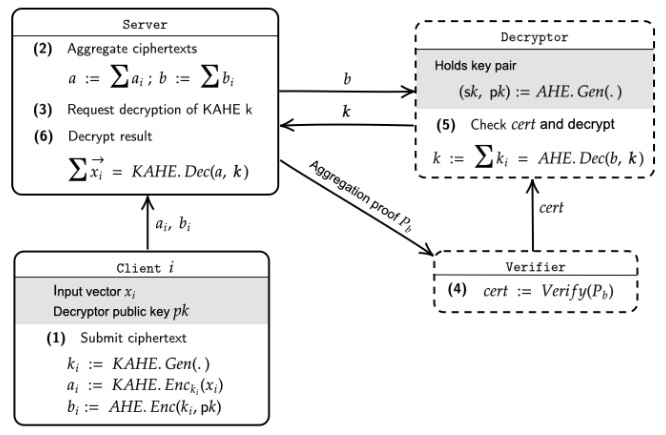
Willow’s architecture combines cryptographic primitives and distributed systems insights to achieve unprecedented efficiency. A blueprint of Willow is presented in the following figure:
1. One-Shot Clients with (RLWE-based) Key-Additive Homomorphic Encryption (KAHE)
- Clients encrypt their model updates once using a symmetric key, then encrypt that key using a threshold additively homomorphic encryption (AHE) scheme.
- The server aggregates ciphertexts homomorphically without decrypting individual contributions.
- Leakage Resilience: Even if the server learns the sum of all keys (via committee decryption), individual keys remain hidden, a property proven under the Hint-RLWE assumption.
Compared to prior RLWE-based schemes, Willow’s KAHE uses Gaussian-distributed keys, reducing ciphertext size by 50% compared to uniform key distributions.
2. Dynamic Participation via Merkle Tree Commitments
- Clients tag their contributions with a nonce (unique random value) to prevent replay attacks.
- The server builds a Merkle-like tree where each leaf commits to a client’s encrypted key and proof of validity. Internal nodes commit to aggregated values.
- A verifier committee checks random subsets of leaves, ensuring integrity without inspecting all data.
We note that, verification costs are distributed. For 1M clients, a 1,000-member committee reduces per-verifier work to ~1,000 checks, 1,000x less than linear schemes.
3. Malicious Security with Zero-Knowledge Proofs (ZKPs)
- Clients prove they generated keys honestly using Bulletproofs, a transparent ZK proof system.
- Decryptors prove they correctly decrypted aggregated keys, preventing “rogue key” attacks.
Performance Benchmarks: Willow vs. Flamingo
The paper includes rigorous experiments comparing Willow to Flamingo and Acorn:
1. Client Communication Overhead: For a model with 10⁵ parameters, Willow clients send 500KB vs. Flamingo’s 2MB. Savings grow with model size: At 10⁷ parameters, Willow uses 3MB vs. Flamingo’s 10MB.
2. Server Computation Time: Willow processes each client in 227ms, dominated by ZKP verification. Flamingo requires 2.5s per client due to pairwise masking.
3. Committee Efficiency: With 100 committee members, Willow’s decryptors handle 1M clients with 40KB communication each, 100x less than Flamingo’s linear scaling.
For technical details, check out the full paper here.
Karim Baghery,
Madrid, May 2025


