[This post is based on a talk by Gene Tsudik at AsiaCCS 2019 about the paper [1]]
Thermanator is a side channel attack introduced in [1] that exploits a consequence of the laws of thermodynamics. That is, when two objects, with different temperatures come into contact, an exchange of heat occurs. As a result, humans in contact with colder objects leave thermal residues, this can be used to recover a password typed in a plastic keyboard if an attacker manages to take a thermal image of the keyboard shortly afterwards.
Clearly, the attack would be meaningless if the victim notices someone taking a picture of the keyboard straight after typing a password. However, getting that opportunity is not highly unlikely to happen, for instance, a common scenario that occurs in a workplace is that once one arrives to their office, they type the password to login to their computer then they leave the office for some reason, e.g, grab coffee etc. That would leave the attacker a couple of seconds to take a thermal picture of the keyboard. In fact, it takes a while before the thermal residue totally disappears, therefore, the heat-map will still yield which characters were typed. For instance, the figure below depicts a thermal image of the word “passw0rd” 20 seconds after being typed.
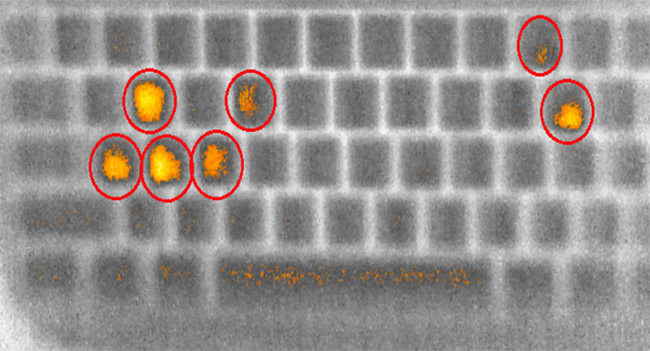
Of course, the heat-map doesn’t immediately yield the exact password, as we cannot tell how many times each character was pressed, nor the order of the keystrokes (although theoretically we can if some conditions hold as the residue fades uniformly, however, authors in [1] couldn’t take use of that). Nonetheless, what the attacker have in possession already leaves him a limited set of passwords to brute force, not to mention that dictionary tools can be used to infer which words are most likely to be the targeted password.
So in the paper, authors conducted a study to analyze this attack, where they considered the two main categories of typists, touchy typists, people that rest they fingertips on the home row of the keyboard, and non-touchy typists, people that use 2 fingers while pressing keys. The keyboards used are the 4 most purchased ones in amazon.
Then after typing the password, a picture is taken every 1 second for 1 minute using a mid-range thermal camera that can be affordable by anyone.
By analyzing those pictures, authors concluded that for the most part, you can retrieve the characters pressed from images taken within 30 seconds and at least a partial set of them from pictures taken within a minute. And the hardness of this task depends on which category of typist you are dealing with.
To mitigate the attack, a couple of counter measures were proposed, such as using metal keyboards which are less vulnerable to this attack than plastic keyboards, and pressing extra characters at random after typing a password in order to introduce residue on random locations in the keyboard. Another counter measure would be to use the mouse to select keys from a screen-keyboard, or use other means of authentication than passwords.
References:
[1]: Thermanator: Thermal Residue-Based Post Factum Attacks On
Keyboard Password Entry. AsiaCCS 2019


