The goal of this blogpost is to provide a quick overview of our new results presented in the following research paper:
- Updatable NIZKs from Non-Interactive Zaps (joint work with Navid Ghaedi Bardeh)
which was presented in CANS 2022.
BACKGROUND:
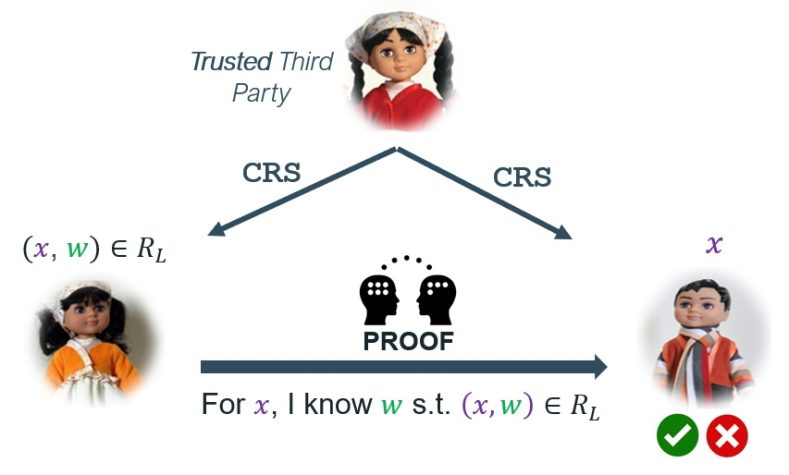
A Zero-Knowledge (ZK) proof system allows a prover to convince a verifier, about the truth of a statement without leaking any information about the secret (a.k.a. witness) associated with the statement. A short introduction to zero-knowledge proofs can be found in this COSIC blog post. In summary, ZK proof systems can be either interactive, requiring interaction between the prover and the verifier, or non-interactive, where a single-round message is sent from the prover to the verifier. In practice, Non-Interactive Zero-Knowledge (NIZK) proof systems are more popular, as they do not require any interaction with the verifier and sometimes they are shown to be more efficient than the interactive protocols. NIZK proofs systems are constructed in two models, known as Random Oracle (RO) or Common Reference String (CRS). In the RO model, the prover and verifier have access to a RO that given distinct inputs it returns unique (uniformly) random outputs, while in the CRS model there exists a trusted pr-processing phase that generates some public parameters (so-called CRS) to be used by the prover and verifier for proof generation/verification. A representation of a NIZK argument in the CRS model is shown below.
NIZK proof systems need to satisfy some requirements:
- Completeness: The honest prover always convinces the honest verifier.
- Zero-Knowledge: The verifier does not learn anything more than the truth of the statement \(x\) from the proof. In practice, this is proven by constructing a simulation algorithm (a.k.a. Simulator) that without knowing the witness \(w\), but using some auxiliary information (e.g., secret information of CRS), can generate simulated proofs that are indistinguishable from the real ones.
- Soundness: The malicious prover cannot convince the verifier, except with a negligible probability.
- Knowledge soundness: The malicious prover cannot convince the verifier unless he knows the witness \(w\) for the statement \( x , s.t. (x, w) \in R_L \).
- Simulation Soundness: The malicious prover cannot convince the verifier, even if he has seen an arbitrary number of simulated proofs.
- Simulation Knowledge Soundness (a.k.a. Simulation Extractability): The malicious prover cannot convince the verifier unless he knows the witness \(w\), for the statement \(x\), even if he has seen an arbitrary number of simulated proofs.
Items 1, 2, and 3 are the primary security requirement of any NIZK proof system. The ones that additionally satisfy 4, are called NIZK proof of knowledge systems, which additionally guarantee that the prover knows the witness \(w\). Items 5 and 6, are stronger versions of items 3 and 4, respectively, which additionally prevents attacks from adversaries who have seen an arbitrary number of simulated proofs. Particularly the notations in items 5 and 6, namely simulation soundness and simulation extractability, imply the non-malleability of proofs [DDO+02] which is necessary for many practical applications.
NIZK Arguments with Weaker Trust:
In the standard CRS-based NIZK arguments, all the above security notions are achieved under a trusted setup phase, and the parties of the protocol need to trust a third party to honestly sample the CRS. In practice, finding a third party trusted by all parties is challenging. Subversion-resistant and updatable NIZK arguments [BFS16, ABLZ17, Fuc18, Bag19, GKMM+18, ARS20, BS21], are an extension of the standard CRS-based NIZK arguments, which allow the parties to either entirely bypass the need for a trusted third party, or only trust themselves by updating the CRS. In a Subversion Zero-Knowledge (Sub-ZK) NIZK argument [BFS16, ABLZ17, Fuc18, Bag19, ARS20], the prover (entirely) does not trust the CRS generator but verifies the well-formedness of the CRS (before using it). On the other side, the verifier still needs to either generate the CRS or trust a third party who generates the CRS. In the updatable CRS model, the protocol parties (e.g., all provers and the verifiers) update the CRS and inject their shares into the secret key used in CRS generation. After a single update and some verifications, all the parties bypass the need for a trusted third party and only trust themselves [GKMM+18]. The following figure represents an example of the CRS generation in the updatable CRS model.

Our Results: NIZK Arguments with Updatable, Universal, and Succinct CRS from Non-Interactive Zaps
In ASIACRYPT 2016, Bellare, Fuchsbauer, and Scafuro [BFS16] showed that by defining a CRS as a tuple of knowledge assumption in bilinear groups (e.g. \(g^a, g^b, g^{ab}\) ), and then using a Non-Interactive (NI) zap to prove that either there is a witness for the statement or one knows the trapdoor of CRS (e.g. $a$ or $b$), one can build NIZK arguments that can achieve soundness and Sub-ZK. As mentioned before, in a Sub-ZK NIZK argument the prover does not trust the CRS generator but the verifier still needs to trust the CRS generator. Recall that, non-interactive zaps are single-round proof systems that do not require a trusted setup, but only can satisfy (knowledge) soundness and Witness Indistinguishability (WI) [GOS06, FO18]. WI is a slightly weaker notion than ZK, as it only guarantees that the malicious verifier cannot distinguish between provers that use different witnesses.
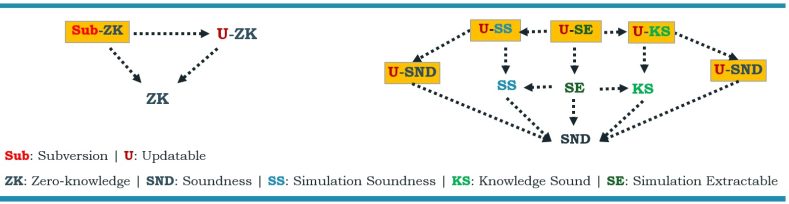
In this study, we show that the technique used by Bellare, Fuchsbauer, and Scafuro [BFS16] for building Sub-ZK and sound NIZK arguments, can also be expanded to build NIZK arguments with an Updatable, Universal and Succinct CRS that can satisfy Sub-ZK and Updatable-{Soundness, Knowledge Soundness, Simulation Soundness, Simulation Extracability} at the same time. It is worth mentioning that Sub-ZK ensures that the protocol satisfies ZK, even if the CRS is subverted and Updtable-X ensures that the protocol satisfies X as long as the initial CRS generation or one of (the follow-up) CRS updates is done
by an honest party, where X \(\in\) {Soundness, Knowledge Soundness, Simulation Soundness, Simulation Extracability}. The next figure represents the relationship between the mentioned definitions and highlights the ones achieved in our constructed NIZK arguments.
Our key insights to generalize their OR-based technique that uses NI zaps have been the following: First, since NI zap (or NI zap of knowledge) arguments do not have a CRS, therefore once we define an OR-based language based on them, the CRS of the resulting NIZK argument only contains the elements that are added from the second clause in the OR language. Consequently, to simulate the proofs in the resulting NIZK argument, one can use the trapdoor (secret information) of the CRS that comes from the second clause of the OR relation. The second key point is that by using an updatable CRS in the second clause, one can construct NIZK arguments with universal and updatable CRS. The third insight is that if the updatable CRS in the second clause of the OR language will be the public key of a (key-updatable) signature scheme [ARS20], then using the OR compiler of Derler and Slamanig [DS16], we can construct Sub-ZK NIZK arguments that can achieve Updatable Simulation Soundness (U-SS) and Updatable Simulation Extractability (U-SE).
Using the above insights, we first propose a CRS updating and a CRS verification algorithm for the Sub-ZK and Sound NIZK argument of Bellare, Fuchsbauer, and Scafuro [BFS16], and then show that under the same security assumptions used in the security proof of their scheme, their construction can also achieve Updatable Soundness. Updatable soundness allows the verifier to update the CRS one time and bypass the need for a trusted third party. This results in the first NIZK argument with updateable, universal, and succinct CRS which does not exploit an RO. The only previous construction in the plain updatable CRS model [GKMM+18] has succinct proofs, but a CRS of size \(O(n^2)\), where \(n\) denotes the number of multiplication gates in the target circuit. Follow-up works managed to decrease the CRS size to linear but at the cost of adding an RO to the protocol [MBKM19,GWC19,CHMM+19,RZ21]. Our resulting NIZK arguments have a succinct CRS, without the need for an RO, but at the cost of having linear-size proofs.
In the rest, considering the third insight, we show that given a NI zap argument (resp. NI zap of knowledge) and a key-updatable signature scheme [ARS20], one can define an OR language, namely,
\( (x, w) \in R_L \vee (\text{I know the \(sk\) associated with the signature’s updatable \(pk\) }) \),
where \((sk, pk)\) are a pair of secret and public keys and build NIZK arguments that can achieve Sub-ZK and U-SS (resp. U-SE). Our resulting Sub-ZK and U-SS NIZK arguments are the first constructions that can achieve these notions at the same time. However, in [ARS20], Abdolmaleki, Ramacher, and Slamanig also built Sub-ZK and U-SE NIZK arguments (with succinct proofs) using a similar OR language. However, as stated in [ARS20, theorems 2, and 3], they require a NIZK argument that satisfies Sub-ZK and (U-) Knowlege Soundness, which are stronger security requirements than what a NI zap (or NI zap of knowledge [GOS06, FO18]) achieves. In nutshell, we require weaker security guarantees from the input proof system, but, on the other side, we obtain Sub-ZK and U-SE NIZK arguments with succinct CRS and linear proofs, but they obtain NIZK arguments with succinct proofs and a linear-size CRS.
We instantiated our compilers with the NI zap of Groth, Ostrovsky, and Sahai [GOS06], and the NI zap of knowledge proposed by Fuchsbauer and Orru [FO18] and obtained some subversion-resistant NIZK arguments with updateable, universal, and succinct CRS. Our evaluations show that in the resulting NIZK arguments the computational cost for the parties to verify/update the CRS is negligible, namely, a few exponentiations and pairing checks. The run times of the prover and verifier, as well as the size of the proof, are asymptotically the same as those of the underlying NI zap systems.
In this study, we instantiated the compilers with DL-based schemes, however, our theorems are general enough to later (hopefully) will be instantiated with post-quantum primitives.
Karim Baghery
Abu Dhabi, November 2022.


