Block ciphers are one of the key components in cryptography. Recently, lightweight cryptography became popular and it carried the design approach of a block cipher into different points. Depending on the requirements of the platform: low energy consumption, restriction on area, low multiplicative complexity, resistance against side-channel attacks etc., many new design approaches were proposed over the years.
In 1945, Shannon defined two properties of a block cipher: diffusion and confusion. Restrictions on lightweight cryptography pushes the search of a perfectly secure diffusion and confusion components to find suboptimal secure but efficient components. S-boxes are one of the main primitive in symmetric-key cryptography. They are the smallest component in an algorithm which provides confusion. The size of an S-box can change from three-bit to n-bit but mostly four and eight-bit length is preferred.
We focus on S-box constructions and consider the uniformity property of an S-box which plays an important role in Threshold Implementations (TI). Most papers so far have studied TI sharings for given S-boxes. We proceed in the opposite way: starting from n-bit S-boxes with known sharings we construct new (n + 1)-bit S-boxes from them with the desired sharings. We studied general n-bit S-boxes but we did our experiments for small sizes i.e. three to five bits.

It follows that the truth table of the constructed (n + 1) × (n + 1) S-box S has the form shown in Table 1.

Applying the approach over 3 × 3 S-boxes to obtain 4 × 4 S-boxes showed that (1) enriches the number of classes we can construct and the uniform sharings we can obtain as shown in Table 2.
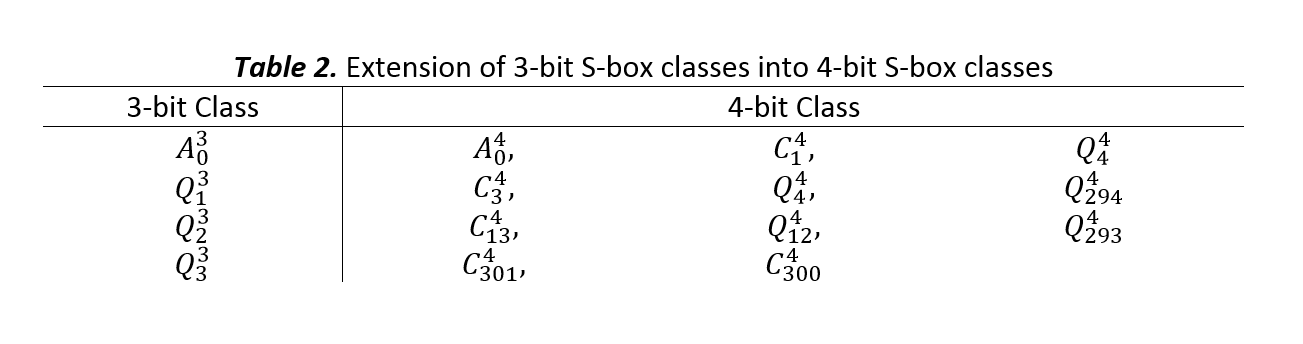
Similarly, applying the approach over 4 × 4 S-boxes to obtain 5 × 5 but restricted only to the affine and quadratic S-boxes gives the results shown in Table 3. We obtain 23 out of the 75 quadratic classes given in [1]. In addition, it is clear from this construction why for the classes and no uniform sharing with 3 shares was found in [1]. Namely, they are extensions of class which has no uniform sharing itself.

To sum up, we have shown that Shannon’s expansion can be used to construct uniform sharing for certain affine equivalent classes of S-boxes. We have also shown the limitations of this expansion, namely that not all 4-bit S-box classes can be obtained from the 3-bit S-box classes in this way.
Thanks to Kerem Varici for writing this blog post!


