CSIDH is an efficient isogeny based key agreement protocol that generalizes Diffie-Hellman key agreement to the setting of commutative group actions and is assumed to be quantum safe, i.e. it resists attacks by a quantum computer. A detailed overview of CSIDH was given in a previous blog post by Wouter Castryck, where he explained how a commutative group action can be defined in terms of isogenies between elliptic curves. In the remainder of this post we will assume the reader has either read Wouter’s blog post or has some familiarity with isogeny based cryptography. Although the key agreement scheme is efficient, a major open problem is how to construct an efficient digital signature scheme in this isogeny based framework.
CSIDH: Using the same notation as in Wouter’s blog post, we let \(S_p\) denote the set of supersingular elliptic curves over the finite field \( F_p \) with \( F_p\)-rational endomorphism ring \( Z[\sqrt{-p}] \). Such curves have exactly \( p +1 \) points defined over \( F_p \). For each non-zero ideal \( \frak{a} \) in \( Z[\sqrt{-p}] \) and curve \( E \in S_p \), one can construct an isogenous curve \( {\frak a} \star E \in S_p \). Furthermore, two ideals in the same ideal class result in the same curve, so we end up with an action \( \star \) of the ideal class group \( G = \mathcal{C}l ( Z[\sqrt{-p}]) \) on the set \(S_p\).
Given a random ideal \( \frak{a} \) in \( Z[\sqrt{-p}] \) and curve \( E \in S_p \), it is in general not possible to efficiently compute the corresponding isogeny and isogenous curve \( {\frak a} \star E \). In CSIDH the prime \( p \) is chosen such that for \( n \) special ideals \( \frak{l}_i \), namely those having small odd prime norm, the corresponding isogeny is efficiently computable. By composing the action of these special ideals, it is possible to efficiently compute the action of any ideal of the form \( \prod_{i = 1}^n {\frak l}_i^{e_i} \) with small exponents \( e_i \). In CSIDH-512, the exponents \( e_i \) are chosen in the interval \([-5, 5]\) and since \(n = 74 \), it allows to compute the action of roughly \(11^{74} \sim 2^{256} \) (not necessarily different) ideal classes, which is large enough to instantiate a secure key agreement protocol. Recall that the isogeny based version of Diffie-Hellman works as follows: Alice chooses a secret \( {\frak a} \in \mathcal{C}l ( Z[\sqrt{-p}]) \) and sends the curve \( {\frak a} \star E_0 \) to Bob, where \(E_0\) is a publicly known base curve. Bob acts similarly and sends \( {\frak b} \star E_0 \) to Alice, where \( {\frak b} \) is Bob’s secret ephemeral key. At the end, both recover the shared key \( ({\frak a }{\frak b} ) \star E_0 \). The main underlying hardness assumption therefore is that given a curve \( {\frak c} \star E_0 \), it is infeasible to recover the ideal class of \( \frak c \).
Identification schemes and signatures: Given that the CSIDH key agreement scheme is totally equivalent to the discrete logarithm based Diffie-Hellman schemes, such as EC-DH, one might be tempted to assume that discrete logarithm based signatures schemes, such as ECDSA or Schnorr signatures, can also be ported in a straightforward way to the isogeny based setting. To see if this is indeed the case, let’s consider Schnorr signatures which are derived from the Schnorr identification protocol. The prover Alice has private key \(a \in Z_N \) and public key \(P_A = [a]P \) where \(P \) is a publicly known base point on an elliptic curve \(E\), and Alice wants to convince a verifier Bob that she knows the private key \( a \). To do so, Alice and Bob execute the following protocol:
- Alice chooses a random \( k \in Z_N \) and sends \( R = [k] P \) to Bob.
- Bob chooses a random challenge \( c \in Z_N \) which he sends to Alice.
- Alice responds by computing \( r = k + c a \bmod{N} \) and sends this to Bob.
- Bob now verifies the following equality: \( [r]P = R + P_A \) and is convinced that Alice knows \( a \) when the equality holds.
This identification scheme is then turned into a signature scheme using the Fiat-Shamir transform, i.e. the random challenge \( c \) is replaced by \( {\cal H}(m || R ) \) where \( \cal H \) is a hash function and \( m \) the message being signed.
If we now try to port the above identification scheme to the CSIDH setting, we run into several problems:
- In Schnorr’s case, the set of scalars, i.e. the set where \( k \) and \( c \) are sampled from is a ring \( Z_N, +, \cdot \). In CSIDH, the corresponding set is \( [-B,B]^n \), which is only a group. As such we run into problems in step 3, since we cannot perform the equivalent computation for \( r \). Furthermore, the reduction modulo \( N \) prevents leakage on the secret key \( a \), since the addition with \( k \) modulo \(N \) makes \( r \) uniform random modulo \(N\). In the CSIDH setting, we can only add exponent vectors over \( Z^n \) which would leak information on the secret exponent vector (if no countermeasures such as rejection sampling are used). This problem is not totally hopeless since it can be solved if we would know the order of the class group \( \mathcal{C}l ( Z[\sqrt{-p}]) \). In this case, we could use a cyclic subgroup of order \( N \) allowing us to work in the ring \( Z_N \) again.
- Much more fundamental problems occur in step 4: here the ephemeral key \(R \) is added to the point \( P_A \). In the isogeny setting, the equivalent operation would be that we somehow “combine” two elliptic curves \(E_R \) and \(E_c\), but no such operation exists. Furthermore, even if we would know the class group order and so could work in \( Z_N \), the operation \( P_A \) corresponds to the operation \( {\frak a}^c \star E_0 \), which is impossible only given \(E_A = {\frak a} \star E_0 \).
The above analysis shows that the main problem lies in the verification equation, so the current solution is to make the verification equation as simple as possible by only sending bit challenges \( c \in \{ 0, 1\} \). This identification protocol was proposed by Couveignes and independently by Rostovtsev and Stolbunov (CRS):
- Alice chooses a random \( {\frak k} \in \mathcal{C}l ( Z[\sqrt{-p}]) \) and sends \( E_k = {\frak k} \star E_0 \) to Bob.
- Bob chooses a random challenge \( c \in \{0, 1\}\) and sends this to Alice.
- If \( c = 0\) then Alice responds with \( {\frak r} ={\frak k} \), else she responds with \( {\frak r} = \frak{ k } \frak{a}^{-1} \).
- Bob verifies that \( E_k = {\frak r} \star E_c \) where by definition \(E_1 = E_A\).
This identification scheme comes with its own problems: firstly, since the challenges now are only bits it is easy to see that in each run of the protocol, the prover can cheat with probability \(1/2\). This issue can be solved easily by running the protocol \(t \) times, lowering the probability to \(2^{-t}\). Secondly, step 3 implicitly assumes that the representation for the ideal \( \frak r \) does not leak any information on the secret ideal \( \frak a \). If each ideal class has an efficiently computable canonical representant, this problem is trivially solved. However, in CSIDH, ideals are represented by their exponent vectors in \( Z^n \) which clearly are not unique, and thus can potentially leak information on the secret ideal \( {\frak a}\). To illustrate this, assume that \(V_{\frak a} = [e_{{\frak a}, 1}, \ldots,
e_{{\frak a}, n}] \) denotes the exponent vector for \( \frak a \) and similarly, \(V_{\frak k}\) for the ideal \( \frak k\), then in step 3 for \( c = 1 \) Alice would return the vector \( V_{\frak k} – V_{\frak a}\). Since both vectors are sampled uniformly in \( [-B,B]^n\), it is clear that this leaks information on \( \frak a\). A possible, but not very efficient, solution to this problem was devised by Luca De Feo and Steven D. Galbraith in their signature scheme SeaSign, which samples the ephemeral vector \(V_{\frak k}\) from a much larger space \( [-\delta B, \delta B]^n \) and then uses rejection sampling on the vector \( V_{\frak r} = V_{\frak k} – V_{\frak a}\) to avoid information leakage on \( \frak a \). It is obvious that knowing the class group structure would solve this problem much more efficiently, since each element now has an efficiently computable canonical representant.
Class group computation: Computing the cardinality and structure of \(\mathcal{C}l ( Z[\sqrt{-p}]) \) is a classical problem in computational number theory. The best algorithms are improvements of an algorithm due to Hafner and McCurley and run in subexponential time \( L_{1/2}(p) \). The largest such classgroup was computed by Kleinjung for a prime \( p \) of roughly 130 digts. The CSIDH-512 prime \( p \) however has 154 digits, which is considerably larger. In the following we will pretend that \( Z[\sqrt{-p}] \) is the maximal order.
Factor base: The Hafner-McCurley algorithm uses a classical index calculus approach, and thus starts off by selecting a factor base \( \mathcal F \) of “small” elements. In this case, the factor base consists of all degree one prime ideals \( {\frak p}_i \) of norm smaller than a bound, for instance, in our case we choose the bound \( 7000 000 \).
Relation collection: The bulk of the computation is spent on relation collection; a relation is an ideal decomposition of the form
\( (a+\sqrt{-p})=\prod_{{\frak p} \in \mathcal F} {\frak p}^{e_{a,\frak p}} \)
with \(a, e_{a,\frak p} \in Z\). To speed up finding such integers \( a \) a sieving approach is used to identify good candidates. The goal of this step is to generate sufficiently many relations such that the subsequent steps are able to determine the class group. This step is one of the two main steps in terms of computational effort. Fortunately, it is trivially parallelized and has moderate memory requirements. In our computation it took an estimated time of 43 core years to collect roughly 320 million relations over an extended factor base of size 32.7 million. Given that our cluster has 800 cores, the wall clock time of this step was less than one month.
Matrix and linear algebra: The huge relation matrix from the previous step is then reduced to a much smaller matrix using elementary column operations. In our case, we reduced the matrix down to a slightly overdetermined matrix with roughly 222000 rows. Since the left hand side of each relation is principal, and assuming \( \mathcal F \) is large enough, we obtain a surjective group morphism
\( Z^{\# \mathcal F}/\Lambda \to \mathcal{C}l ( Z[\sqrt{-p}]) \)
where \( \Lambda \) is the lattice spanned by the columns. As such, selecting a square submatrix and computing its determinant will result in a large multiple of the class number. By repeating this step for another square submatrix and taking gcd’s we finally obtained the class number. This step took roughly 9 core years to compute. The result is that \(
\# \mathcal{C}l ( Z[\sqrt{-p}]) \) is given by
\( {\small 3 * 37 * 1407181 * 51593604295295867744293584889 *31599414504681995853008278745587832204909} \)
Generator and discrete logs: The above result shows that \( \mathcal{C}l ( Z[\sqrt{-p}]) \) is cyclic, and in fact, the class of the ideal \( {\frak g} = \langle 3, \sqrt{-p} – 1\rangle\) can be chosen as generator. Computing the kernel of the matrix above modulo all prime factors of the class number, also allows to express each small prime ideal \( {\frak l}_i \) as a power of the generator \( \frak g \).
The result of this computation is that now each element in the ideal class group \( \mathcal{C}l ( Z[\sqrt{-p}]) \) can be expressed as \( {\frak g }^a \) for some \( a \in Z_N \) with \( N = \# \mathcal{C}l ( Z[\sqrt{-p}]) \). This solves the problem of an efficient canonical representation.
Class group action: Given a random \( a \in Z_N \) however, we still need to be able to efficiently compute the action of \( {\frak g }^a \). Since we can only efficiently act by ideals of the form \( \prod_{i = 1}^n {\frak l}_i^{e_i} \) for small exponents \( e_i \), we first have to express \( {\frak g }^a \) in this form. This corresponds to solving a closest vector problem (CVP) in the relation lattice:
\( L := \{ {\bf z} = (z_1, \ldots, z_n) \in Z^n : \prod_{i = 1}^n {\frak l}_i^{z_i} = (1) \} \)
Ineed, in our case, we have that \( {\frak g} = {\frak l}_1 \) and we therefore have to find a closest vector in the lattice \( L \) to the vector \([a, 0, \ldots, 0]\). To solve this problem, we first computed a good basis for \( L \) (in fact, Léo Ducas was kind enough to compute an optimal basis which is HKZ reduced), and then used a combination of Babai’s nearest plane algorithm with a random walk approach due to Laarhoven et. al. This combined approach is only 15% slower compared to a native CSIDH class group action, where the exponents are in \( [-B,B]\) by construction.
CSI-FiSh: Combining the above efficient representation and action of random elements in \( \mathcal{C}l ( Z[\sqrt{-p}]) \) with the identification scheme of CRS, and applying the standard Fiat-Shamir transform, results in the signature scheme CSI-FiSh (Commutative Supersingular Isogeny based Fiat-Shamir signatures). The basic scheme can be further improved by two well-known techniques (for instance also used by SeaSign):
- To increase the size of the challenge space, the single public key \(E_A\) can be replaced by \( S \) public keys: \( E_{A_i} \) for \( i = 1, \ldots, S \). Instead of a bit, the challenge \( c \) now is an integer modulo \( S \), and the prover has to answer the challenge for public key \( c \). This lowers the soundness error from \( 2^{-1} \) to \( S^{-1} \).
- The challenge space can be enlarged by a factor two for free by considering twists of curves. For every curve \(E_{A_i}\) we also (implicitly) include the quadratic twist of \(E_{A_i} \) as part of the public key, which corresponds to the private key \( -a_i \). As such the public key now contains twice as many keys compared to before. The only change in the protocol is that for a twist the response equals \( k + a_i \bmod N \) instead of \( k – a_i \bmod N \) .
- Using optimization 1 the public key has now become \( S \) times larger. Using a Merkle tree whose leaves are these \( S \) public keys, the public key can be replaced by the root of the tree. This comes at the expense of larger signatures, since (the siblings of) the path to the root has to be included.
We implemented both variants of CSI-FiSh and the open-source code is available on GitHub. The benchmark results are as follows:
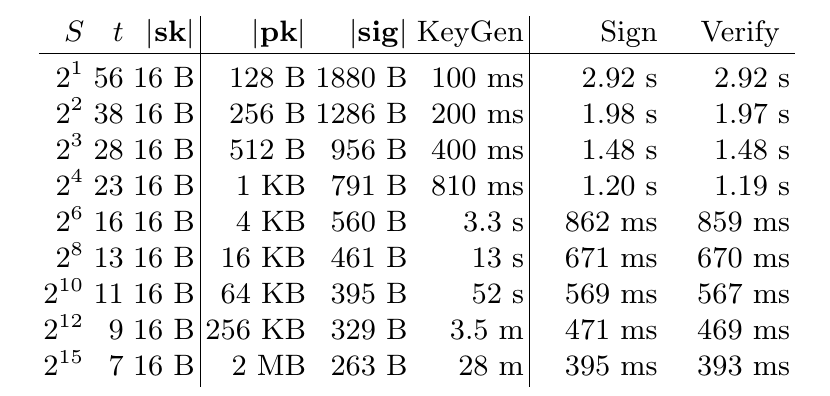
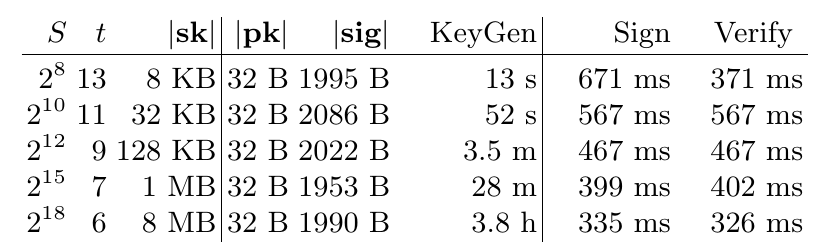
The above tables show that various trade-offs are possible, e.g. small signatures and fast signing / verification at the expense of a large public key, or small combined size of public key and signature, at the expense of a larger private key. We note that the simple variant for \( S = 2^3 \) results in a combined public key + signature size of 1468 bytes, which is the smallest combined size of all post-quantum signature schemes.
Open problem: The main open problem is to find a three pass identification protocol à la Schnorr, where the challenges are simply taken uniformly from \( Z_N \) and not some (much smaller) set of \( S \) public keys. The challenge lies in finding a verification equation that is computable given the limitations of the group action setting.
Frederik Vercauteren (joint work with Ward Beullens and Thorsten Kleinjung)


