The goal of this blog post is to provide a quick overview of the following talk:
Hiding in Plain Sight (Location privacy for the IoT) by Bart Preneel
which was recently presented in Interdisciplinary Summerschool on Privacy 2023.
IoT security
An important part of IoT devices is usually clouds, The concept of utilizing clouds for data storage introduced the question of whether it was necessary to send data to cloud. Initially, the focus was on the cost-effectiveness and reliability of cloud storage, with little consideration given to its privacy. However, the emergence of regulations such as GDPR(the General Data Protection Regulation) in the EU and other similar regulations in different parts of the world shed light on the importance of protecting data privacy. This led to some confusion and the need to address these concerns.
As an example, Apple devices store their data in the cloud, creating a link between IoT and cloud. However, this connection can also be exploited, as evidenced by instances where internet connectivity is required for certain functionalities, such as on the Apple Watch, despite Bluetooth being sufficient for its normal operations, which makes us concerned by security of IoT devices.
Data breach
Although it is often claimed that companies like Meta adhere to regulations, data breaches are still a frequent occurrence. A great example is the Office of Personnel Management (OPM) breach, where personal data including names, security details, and health information was compromised and sold to China. Such incidents serve as a motivation to assess IoT systems more thoroughly. Another significant concern is the exponential growth of IoT devices, as shown in Fig.1. This rise can be attributed to a combination of factors, including the lucrative market potential, the appealing usability for consumers, and the influence of consumerism. Examples of IoT devices contributing to this surge include dishwashers, vacuum cleaners, and many others.

Figure1: Total number of device connections
Security concerns
There are instances where small devices within an organization are susceptible to hacking as soon as an IoT device, such as a lamp, is switched on. In more vulnerable situations, even implantable IoT devices have been hacked, posing a threat to people’s lives. However, stakeholders often hesitate to address these privacy concerns due to the associated costs in terms of time and money. Various other cases highlight the following underlying reasons for such security breaches:
- Massive deployment of IoT devices.
- Low cost, which may compromise security measures.
- Limited resources available for robust security implementation.
- Large attack surface due to the interconnected nature of IoT devices.
- Difficulty in updating devices with necessary security patches.
- Insecure programming practices during the development of IoT systems.
- Lack of expertise in managing and securing IoT devices.
Unlike traditional warfare, which involves brutality and destruction, the hacking of civilian IoT devices often serves as a peaceful means to infiltrate more sensitive components of larger systems. However, this raises significant controversy regarding the decision to connect everything to the web platform and who should be held accountable and liable for the security and safety of the data involved. Sometimes it is argued that by prioritizing security, the appeal of newer, more expensive versions of IoT systems may diminish, leading individuals to opt for less secure alternatives at a lower price point.
Restrictions by law
Are there any regulatory initiatives in place to address these risks? In the course of history, several regulations have been introduced, such as UL or California regulations. In the EU, the most well-known initiative is the EU CyberSecurity ACT. However, obtaining the certificate under this act remains optional for IoT inventors or producers, which raises concerns about privacy risks.
Another issue is the extremely slow process of establishing new laws. Sometimes, the passage of even a simple law requires extensive investigation and can take years to complete. This raises questions about accountability. Taking a future perspective, imagine looking back from 2043 to 2023 and reflecting on the process and the prevailing environment of insecurity. This realization may drive us to pursue a more sustainable and efficient process for enacting and implementing laws.
Privacy
Providing a concrete and universally applicable definition for privacy is challenging, as it heavily relies on the specific context and the concept of contextual integrity. One interpretation of privacy is the practice of maintaining confidentiality control. Confidentiality can be viewed in relation to the historical origins of privacy, such as the right to be alone or the efforts made to prevent a single point of failure by storing data locally.
While it is inevitable to share some of our data, there is a growing interest in sharing more personal information. However, it is crucial to minimize the data shared and handle it with care. As Alan Westin stated in 1967, privacy is “the right of the individual to decide what information about himself should be communicated to others and under what circumstances.” This concept encompasses information self-determination, transparency, accountability, compliance, and individual responsibility, which can be manifested through obtaining consent in various ways, such as when seeking authentication without disclosing excessive personal details.
In practical terms, privacy can be seen as the freedom from unreasonable constraints on the construction of one’s identity, as described by Agre and Rotenberg in 1998. Privacy becomes an integral element of common practice, emphasizing the role of the user in negotiating their privacy. It involves decision support and requires transparency regarding the social impact of data practices.
When considering privacy, it is essential to incorporate design techniques that promote awareness and provide feedback to users.
Examining the triangle of users, industry, and government, as shown on Fig 2., it becomes evident that as the industry captures more individuals’ data, as they produce more IoT devices. This poses challenges and raises questions about the responsible handling of data, the balance of interests among stakeholders, and the need for proper regulation and governance.

Location Privacy
It is important to acknowledge the fact that we are constantly being tracked in various ways. For instance, using Google Maps and the GPS on our phones allows us to navigate through our preferred routes, but it also means that our location is being constantly reported. Even if we switch off Wi-Fi or turn off our mobile phones, the microphone remains active as long as the battery is connected, potentially compromising our privacy.
One specific area where location privacy holds significant importance is based on the principles outlined in GDPR. According to GDPR, personal data that reveals sensitive information is subject to specific processing conditions, as stated in Article 9. Such sensitive personal data may include:
- Personal data that reveals racial or ethnic origin.
- Personal data that reveals political opinions.
- Personal data that reveals religious or philosophical beliefs.
- Personal data that reveals trade-union membership.
- Genetic data or biometric data processed solely for the purpose of identifying an individual.
- Health-related data.
- Data concerning a person’s sex life or sexual orientation.
The inclusion of these categories in GDPR highlights the significance of protecting individuals’ location privacy, as it falls under the broader scope of sensitive personal data.
Case study
There are techniques available to mitigate the risks of online tracking, such as data pseudonymization and data aggregation. Data aggregation can be challenging, but it provides an acceptable degree of anonymity while the other one may lead to the deanonymization of a significant portion of users, often up to 95%. It is important to understand these challenges through a case study involving the tracking of a suitcase using an Apple tracker.
In this scenario, the Apple tracker collects coordinates and sends them to the cloud, allowing the user to track the suitcase’s location through their iPhone. However, there are inherent risks associated with this process. Since the phone continuously sends and receives data, there is a potential threat to the user’s location privacy.
Initially, a naive approach was employed, as shown in Figure 3. The module in the suitcase would send its ID and location data to a nearby bystander, who would then relay this information to the cloud. The user could subsequently access the cloud from their mobile phone to retrieve the location data. However, the visibility of the location data in the cloud posed a concern for privacy.
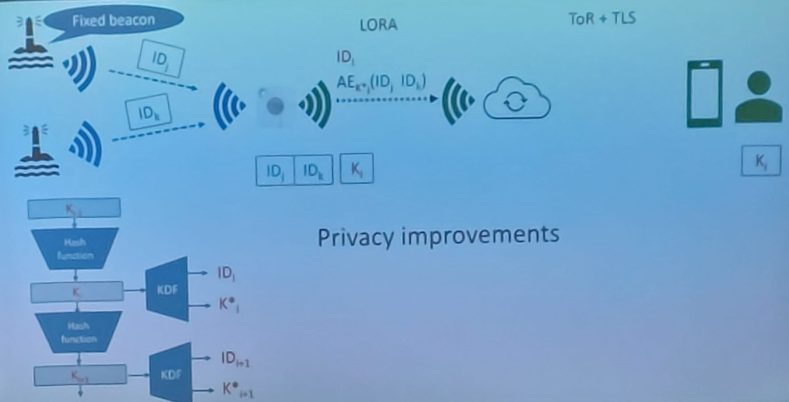
To address this issue, symmetric cryptography was used between the module and the user’s phone, providing encryption to reduce the risk of detection. Nevertheless, adversaries could still employ correlation attacks or other methods to deanonymize the user. To counter such attacks, advanced cryptographic techniques can be utilized.
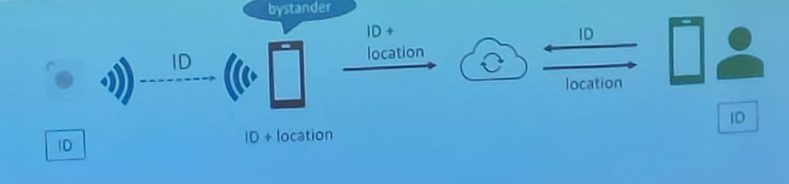
Figure3: Naive approach of suitcase tracking: suitcase module sends ID and location data to a bystander, who sends it to the cloud. The user accesses the cloud to retrieve location information.
Utilization of mobile phones for tracking one’s suit could be subject to abuse. Therefore, An alternative approach is proposed that eliminates the need for using the phone altogether, instead emphasizing the importance of maintaining the confidentiality of location data, message integrity, and tag authentication, while also ensuring tag identity privacy and message unlinkability. In this new system, beacons play a crucial role in the network by providing fresh hashes of public keys and IDs to the tags. Additionally, the combination of tags from the past five minutes obscures the tag’s identity. The encrypted data is then forwarded to the cloud, which users can access through TLS and onion routing to minimize any potential leaks of anonymity. By implementing these measures, the system significantly mitigates privacy risks.
Conclusion
In conclusion, the widespread adoption of IoT brings significant security and privacy risks that cannot be ignored. To address these challenges, it is crucial to rethink the architectures of IoT systems, moving towards more distributed models. Such architectures can enhance security by reducing the reliance on centralized systems and minimizing the potential for single points of failure or attack. However, the transition to distributed IoT systems will not happen effectively without the support of legislation and robust enforcement mechanisms. Clear regulations and standards are needed to ensure that IoT devices and networks prioritize security and privacy. Additionally, open technologies and the involvement of open communities in the development and review of IoT systems can play a vital role. By combining legislative measures, distributed architectures, and the power of open technologies and communities, we can strive towards a more secure and privacy-respecting future for the Internet of Things.


