iDASH (Privacy & Security workshop) is a competition that revolves around the secure analysis of genomic data, organized by the Department of Biomedical Informatics at UCSD, the School of Biomedical Informatics at UTHealth and the School of Informatics and Computing at Indiana University. The competition have taken place every year since 2014 with the goal of challenging and evaluating different methods for secure computation, in order to maintain the confidentiality of sensitive data when deployed on a cloud environment.
The iDASH 2019 competition counts 4 tracks, each one with the goal of solving a machine learning problem on genomic data by using a different technology: blockchain for Track I, homomorphic encryption for Track II, trusted executive environments (i.e. SGX) for Track III and secure multiparty computation for Track IV. The solutions, presented during the workshop in Bloomington (Indiana, USA) on October 26th showed that the secure computation technologies are becoming really competitive and might be efficiently deployed in real world applications.
Track II
Track II (Secure Genotype Imputation using Homomorphic Encryption) asks the participants to provide an homomorphic encryption based solution to perform genotype imputation. In practice, a dataset containing genotype information (SNP) for multiple individuals with missing entries is given in input: the solutions have to provide a trained model able to predict these missing entries. The training of the model can be done in cleartext, while the classification has to be performed over encrypted data. The solutions have to be as accurate as possible and have to perform the homomorphic imputation of 500 target SNPs in less than 10 minutes.
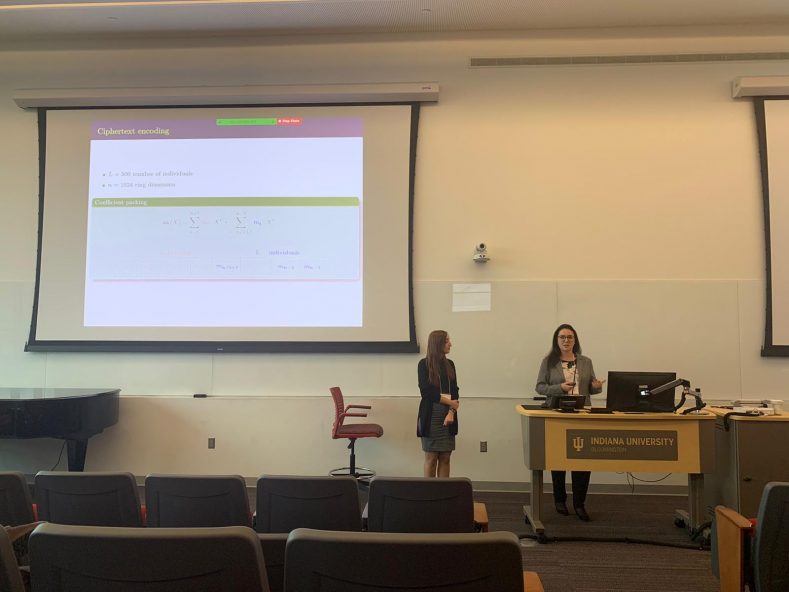
The organizers of Track II announced that, among 54 participating teams, only 6 completed the task within the time limit, and KU Leuven appears between the winners of this track. In fact, the first place for the homomorphic encryption solution belongs to the TFHE-Chimera team, composed by Sergiu Carpov (CEA List, France), Ilaria Chillotti (COSIC, KU Leuven, Belgium), Nicolas Gama (Inpher, Switzerland and UVSQ, France) and Mariya Georgieva (Inpher, Switzerland). The solution presented by the winning team has shown better accuracy and better performances than all the other teams competing in the same track. The model, that takes into account a small nearest neighbor of the target SNP to predict, is trained by performing logistic regression. The homomorphic evaluation is done by using TFHE-Chimera with coefficient packing to encrypt the genomic data and by performing a linear regression evaluation with the coefficients of the trained model. The model proposed for the 1k dataset achieves 0.9971 accuracy and takes 0.7063 seconds to perform the homomorhic imputation (3.5496 seconds for the total round trip, including encryption, computation and decryption), while the model for the 10k dataset achieves 0.9763 accuracy and takes 0.3146 seconds to perform the homomorhic imputation (0.8179 seconds for the total round trip).
Second and third position for Track II belong to the SNU team (Seoul National University) and to the EPFL team (EPFL and Peking University) respectively.
The other tracks
Track I (Distributed Gene-Drug Interaction Data Sharing based on Blockchain and Smart Contracts): among 30 participating teams, 5 completed the task. The victory belongs to the Emory Team (Emory University and Kyoto University).
Track III (Privacy-preserving Machine Learning as a Service on SGX): among 48 participating teams, 6 completed the task. The victory belongs to the ZJU-CITYU team (Zhejiang University and City University off Hong Kong).
Track IV (Secure Collaborative Training of Machine Learning Model): among 67 participating teams, 9 completed the task. The victory belongs to the Gene X Team (University of Washington).