The summer school on security in the age of AI recently took place in Leuven. The majority of the lectures focused on adversarial machine learning, however we will not discuss any of the talks per se. Rather we will look at two issues that were a common theme throughout the talks.
The first one is the presence of a disconnect between academia, and the practical relevance and impact of adversarial machine learning attacks. The easiest way to illustrate this is through a (possibly extreme) example. Let us consider the task of cardiac disease detection using blood measurements. To this end, we’ll use neural networks, which we can view as a map \( f: \mathbb{R}^m \mapsto [0,1]^2 \) for some \(m > 0\). In this setting the entries of a feature vector may for instance contain the level of cholesterol in the blood of a patient or other measurements. Now, let us suppose a malicious party attempts to craft an adversarial sample. Loosely speaking, these are inputs to neural networks that we as humans would classify correctly with high confidence, whereas a given machine learning model would fail to do so without any apparent reason. In the context of image classification, this could be a picture of a panda that is confidently misclassified as a gibbon by the network as shown in the image below:
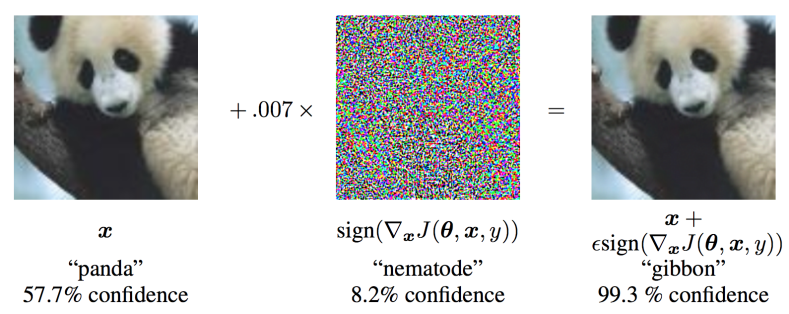
In our case, examples are a bit less intuitive. An adversarial sample could be given by a vector of measurements where certain values would, under normal circumstances, cause a human to immediately seek medical attention, e.g. a heart rate consistently over 150. Yet, the network will missclassify this input, due to how the attacker crafted the remaining entries.
Coming back to our previous adversary, they may find some input \(v \in \mathbb{R}^m\) that is indeed incorrectly classified. However, upon closer inspection we could notice that some entries of \(v\) are negative even if this is physically or medically impossible. From a purely academic perspective such a result could be described as a success. Yet, from a practical point of view, it is more difficult to assess the impact of such attacks: in many real life scenarios some kind of pre-processing happens, which could reject impossible inputs. Indeed, Dr. Fabio Pierazzi pointed that a large body of works on adversarial ML only analyse attacks on the networks themselves without considering the systems around them. A similar issue was mentioned by many speakers including Prof. Fabio Roli, namely that many works overestimate the capability of an attacker. As cryptographers we are quite familiar with this concept through security games and other settings, and in general this type of approach is sound. However in the case of machine learning, giving an adversary too much power makes it difficult to quantify the viability and therefore the threats such attacks pose.
We may think that these issues are specific to the field of privacy and adversarial machine learning. However, similar problems are present in other fields as well, including cryptography. Most likely, many readers will have stumbled upon papers that claim fantastic improvements or contributions, but upon closer inspection necessitate assumptions that are unrealistic. Similarly, can one really claim that a new algorithm is practical or “better” than previous works if it is slightly faster but requires so much memory that it would even cause a server to run out of storage ? The point here is not to argue that purely theoretical research is worthless or claim that small improvements are not valuable, because both statements are obviously not true. Rather, whenever we claim to have made a discovery that is practical or will supersede previous research, we should actually consider to what extent this is true. After all, practicability is not just about time or memory efficiency but also simplicity, ease of use, implementation effort and many other aspects readers will think of now. To be even more specific, if we perform research on cryptographic algorithms for which we want to see practical applications we should ask ourselves to what extent we are fulfilling a core tenet of cryptography: to protect data.
The previous points lead us to the second major issue: reproducibility. In this case, the problem is the same in both (adversarial) machine learning and cryptography, and in fact all research. Even in 2023 a large body of works will not provide datasets or implementations of their techniques. For the former, we may still refer to privacy issues, but there aren’t many excuses not to provide the code itself. This is a problem as it raises concerns about whether a paper can be trusted and in many cases one will base the credibility of the work on the name and background of the authors, an approach that is flawed as
well. Similarly, not providing resources makes it difficult for other researchers to compare the results to other techniques or their own findings, and the result is that many don’t do it. To make things worse, some speakers at the summer school pointed out that there may be PhD students or other researchers
that would be willing to take the time to reproduce findings despite these hurdles, but in some cases they are held back by their supervisors due to the time that would need to be invested. As mentioned previously, the issue is not specific to cryptography or (adversarial) machine learning. This crisis of reproducibility is multifaceted, yet it is worth pointing that the barrier and amount of effort necessary to improve the situation is much lower in fields like computer science or mathematics as opposed to
biology and chemistry, and a major step towards that would be to always supply code. Yet it is not happening, but needs to change especially when we take into account the current lack of trust in science.


