Securely Sampling Biased Coins with Application to Differential Privacy (CCS’19)

The paper presented in this blogpost can be found here. This paper was presented at CCS’19 by Jeffrey Champion. Being able to securely sample biased coins is a fundamental problem in a range of areas. Indeed, the problem of securely sampling from specific distributions (e.g. gaussian, exponential, …), can be reduced to the ability of […]
Sparse-secret LWE at WAHC’19

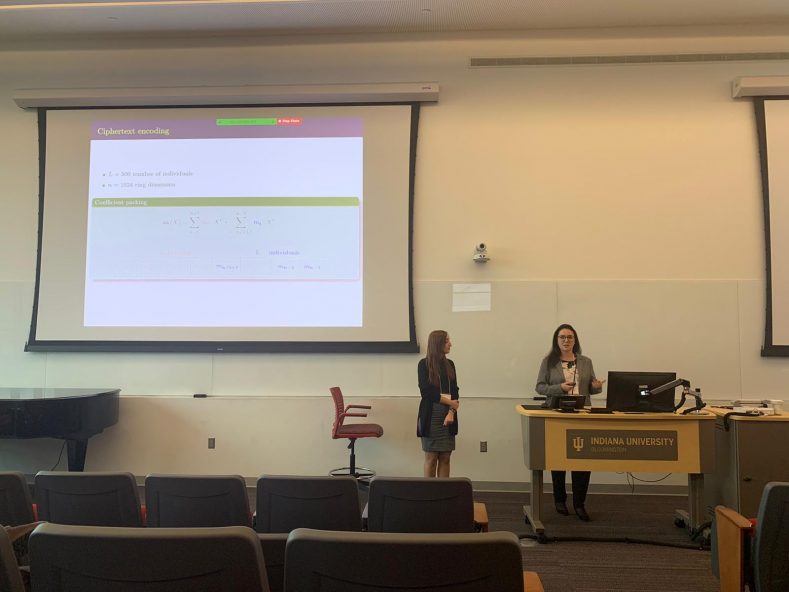
On Monday a bunch of COSIC researchers attended the WAHC workshop, which stands for Workshop on Encrypted Computing & Applied Homomorphic Cryptography. Two COSIC correspondents, Ilaria and Ilia, share their feelings about some of the talks presented at this venue. Ilia: Ilaria, what was the first talk about? Ilaria: Thanks, Ilia. Let me give you […]

Leakage Distribution Network for Masking Schemes

Masking schemes, such as Threshold Implementations (TI), are the most popular technique for countering side-channel attacks (SCA). They decorrelate  the computation from the resulting physical emanations by splitting the target function into multiple shares. For example, a variable \(x\) can be shared into \(N\) shares by randomly generating \(N-1\) values \(x_1\), …, \(x_{N-1}\) and calculating \(x_N\) such […]

iDASH 2019 – KU Leuven among the winners

iDASH (Privacy & Security workshop) is a competition that revolves around the secure analysis of genomic data, organized by the Department of Biomedical Informatics at UCSD, the School of Biomedical Informatics at UTHealth and the School of Informatics and Computing at Indiana University. The competition have taken place every year since 2014 with the goal […]

Algebraic Cryptanalysis: A Short Introduction

Cryptanalysis is the study of analyzing ciphers or systems in order to reveal hidden secrets. As its name indicates, algebraic cryptanalysis is a type of cryptanalytic methods that mainly exploit algebraic techniques such as equation-solving algorithms. Algebraic cryptanalysis turns out to be powerful when it comes to the ciphers with simple algebraic structures such as […]

[CRYPTO 2019] Noninteractive Zero Knowledge for NP from Learning With Errors

Zero knowledge proofs are standard primitives in cryptography. In this setting, a Prover \( P \), using a secret witness \( w \), wishes to convince a verifier \( V \) that a certain statement holds true (formally that \( x \in \mathcal{L} \)). In particular, in this work [1], Peikert and Shiehian focus on […]

[SAC2019] A DFA Attack on White-Box Implementations of AES with External Encodings

[This blogpost is based on a talk titled A DFA Attack on White-Box Implementations of AES with External Encodings by A. Amadori, W. Michiels and P. Roelse @ SAC2019] The classical attack model on cryptographic algorithms is in the so-called black-box scenario, where the mathematical security of a cipher is uniquely deduced by observing the input and […]

[SAC2019]

The authors describe a new chosen-plaintext attack on the Giophantus encryption scheme. Akiyama & al. [1] introduced the indeterminate equation version of the learning with errors (IE-LWE) problem. Given a prime \( p \), denote by \( R_{p} \) the ring \( \mathbb{F}_{p}[t]/(t^{n}-1) \). In what follows \( \ell \) will denote an integer much […]

[SAC 2019] Towards a Practical Cluster Analysis over Encrypted Data

In a work presented yesterday at SAC 2019 [1], Jai Hyun Park (SNU) showed how he and his co-authors designed a privacy-preserving clustering analysis method using homomorphic encryption (HE) that is both accurate and practically efficient. Data clustering analysis groups points from a data set into clusters based on common characteristics without knowing such clusters […]

The Three Musketeers of Secure Computation: MPC, FHE and FE

From the beginning, cryptography took care of the protection of data. At first the data to be protected consisted of messages in transit, that had to be hidden from adversaries trying to intercept a communication. Lately, with the advent of modern computers and portable memory devices, cryptography also had to protect the data in storage. […]